
Construction Management with a Foundation Year - BSc (Hons)
Currently viewing course to start in 2026/27 Entry.
If your ambition is to gain a senior site management role within the construction industry, our BSc Construction Management degree will set you on the right path. The Foundation Year course option enables you to study for our BSc (Hons) degree over an extended full-time duration of four years by including a Foundation Certificate (year one of four).
- Level Foundation
- Study mode Full Time
- Award BSc (Hons)
- Start date September 2026
- Fees View course fees
- Subject
- Location City Centre
This course is:
Open to International Students
Overview
Birmingham is the second largest city in the UK and is a great area for students to be in if you want to be in the built environment because there's redevelopment going on all around you and there's also a strong possibility that you could be working on these projects in the future. I've had a really good experience at BCU so far. We get to go on quite a lot of site visits. One of the biggest ones we've been on so far was the housing development by Taylor Wimpey, and we also had for our first assignment Taylor Wimpey's, managing director of the West Midlands, assessed one of our presentations. Support from lecturers is really, really good that always there, they're always there to reply to your emails no matter what the query is. They've all had real life experience, academic and industry wise, that we can learn from. One of the things that I'm most passionate about the built environment is the possibility of working on the creation of the built environment that we live in. I wanted a change of career. I wanted to do something that's a bit more impactful and something that can help the community. So I think the built environment was a perfect way to go about the student experience has been amazing, to be honest. The lecturers and the students actually have been very welcoming. There's definitely something for every person to get involved in. The Careers+ and Employability team and the support that I got from them with regards to updating my CV, get my professional network set up on LinkedIn, which has been excellent. So I was lucky enough to secure a placement with Atkins. After my placement year, I was actually offered the graduate role, which was fantastic because it meant that I've got something secured and now go back into industry and into a company that I really enjoyed working with.
It's only four years for me to change my career and really step into a brand new industry. And I'm really thankful for BCU for supporting me through this journey. There's always been something about buildings that has interest in me, kind of curious and how they're put together and what kind of technology goes into that. Coming to university, I knew that I wanted to go to Engineering or Architecture and seeing those courses in depth, I kind of knew to myself that it wasn't correct for me. So then I came across Architectural Technology and I found out it just answered both of those questions I had then, which was wanted to go to. So BCU offers a wide range of facilities. It provides a lot of equipment such as VR headsets, laptops that students can borrow whenever they need to, and industry level software such as AutoCAD and Revit to really useful to us as being used as currency in our industry and will continue to be used throughout the years to come. Being able to go outside of the classroom and use industry level equipment really helps us as students get a vision of what it's like in practice. I've really enjoyed my time studying at BCU and I can't wait to what the future holds.
If your ambition is to gain a senior site management role within the construction industry, our BSc Construction Management degree will set you on the right path.
About the Foundation Year
The Foundation Year course option enables you to study for our BSc (Hons) degree over an extended full-time duration of four years by including a Foundation Certificate (year one of four). The Foundation Certificate provides a broad study programme that underpins the follow-on degree. In order to progress to the next year of your degree, it is necessary to achieve a pass in all of the modules of the Foundation Certificate.
What's covered in this course?
In the UK, the construction industry provides one tenth of the UK’s gross domestic production and is a substantial employer, with over two million people employed in the industry.
Our course matches the needs of the industry, preparing you to be able to manage a construction project from inception and design through to occupation by developing your skills in management to enable you to deliver projects safely, on time, on budget and to the highest possible quality.
The complexity of construction projects requires construction professionals who have expertise in construction management and can work effectively with people from different cultural backgrounds and construction disciplines.
You will learn about the immediate and long-lasting effect which construction activities have on the environment, and discover sustainable and environmentally sound construction methods and innovative management practices. This degree has social innovation embedded its core.
You will learn through creative social problem solving, working with our industrial partners to develop your intellectual and practical competence, as required by professional bodies such as CIOB and RICS.
After completing this course, you will have a broad range of knowledge of the legal, technical, managerial, economic, social and environmental aspects of construction projects, and be able to confidently manage both commercial and civil engineering projects.
Why Choose Us?
- Accredited course - The course content is accredited by the Royal Institution of Chartered Surveyors (RICS) and the Chartered Institute of Building (CIOB) and developed in line with their requirements. By undertaking further suitable work experience and the Professional Review, you can apply for full membership of CIOB and AssocRICS following the Assessment of Professional Competence.
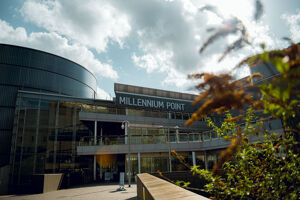
- State-of-the-art facilities and strong industry links - You will be based at our Millennium Point campus in City Centre, where our facilities have undergone a £6.5 million investment to provide you with the very best learning experience. Our links with employers such as Willmott Dixon allow you to apply what you learn in a practical context through work placement opportunities and live projects.
- Study at the heart of Birmingham’s regeneration - It’s an exciting time to study in Birmingham as it undergoes a huge regeneration. The Big City Plan, a 20-year vision covering every aspect of the built environment, is creating innovative redevelopments and opportunities.
- Access to international competitions - Apply your skills to real-life projects in competitions such as the Associated Schools of Construction (ASC) Design and Build competition. Our students have an impressive track record in these competitions and have travelled to locations across the world to take part, including Dallas, Texas and Prague.
- Scholarships - You might be eligible for grant funding of up to £9,500 towards your degree, through the Built Environment Scholarship. You may also be able to gain funding through our travel scholarship scheme.
Open Days
Join us for an Open Day where you'll be able to learn about this course in detail, chat to students, explore our campus and tour accommodation. Booking isn't open for the next event yet. Register your interest, and we'll let you know as soon as booking goes live.
Next Open Day: Friday 26 June
Entry Requirements
Essential requirements
80 UCAS Tariff points. Learn more about UCAS Tariff points.
If you have a qualification that is not listed, please contact us.
Fees & How to Apply
UK students
Annual and modular tuition fees shown are applicable to the first year of study. The University reserves the right to increase fees for subsequent years of study in line with increases in inflation (capped at 5%) or to reflect changes in Government funding policies or changes agreed by Parliament. View fees for continuing students.
Award: BSc (Hons)
Starting: Sep 2026
- Mode
- Duration
- Fees
- Full Time
- 4 years
- £9,790 in 2026/27
- Apply via UCAS
International students
Annual and modular tuition fees shown are applicable to the first year of study. The University reserves the right to increase fees for subsequent years of study in line with increases in inflation (capped at 5%) or to reflect changes in Government funding policies or changes agreed by Parliament. View fees for continuing students.
Award: BSc (Hons)
Starting: Sep 2026
- Mode
- Duration
- Fees
- Full Time
- 4 years
- £18,570 in 2026/27


Guidance for UK students
UK students applying for most undergraduate degree courses in the UK will need to apply through UCAS.
The Universities and Colleges Admissions Service (UCAS) is a UK organisation responsible for managing applications to university and college.
Applying through UCAS
- Register with UCAS
- Login to UCAS and complete your details
- Select your course and write a personal statement
- Get a reference
- Pay your application fee and submit your application
Course in Depth
Foundation Year
In order to complete this course you must successfully complete all the following CORE modules (totalling 120 credits).
The Built Environment is a complex, unpredictable and unique in its own way. This module aims to provide an introductory platform towards understanding the elements and factors that influence the built environment, which support shaping the context of built environment. This module will also walk you through different built environment professions.
Within the built environment, many traditional and modern techniques are being incorporated in order to cope with the nature and functional requirements of a building. This module aims to draw focus upon high level elements that are present in every building including building structure, enclosure, materials and environmental factors. Building on the knowledge that you developed from “Built Environment Context and Practice”, this module compliments the importance of different professions within the built environment
The use of computing and technology have become an essential part in our daily routines. This module aims to focus on many of the daily utilised computing technologies such as ICT, programming, graphics and effective use of visualisation tools. It then draws the attention towards built environment computing technologies, demonstrating how different professions utilise it to communicate, exchange and interpret information. Regardless of the built environment profession that you aim to specialise in, this module embeds computing technology-related knowledge that will support you at different levels during your degree.
The use of numbers within the built environment is inevitable, unavoidable and impactful in many ways. This module aims to provide an overview over the use of quantitative methods within the built environment and their relationship to different scenarios and identifying their value allowing you to develop the necessary foundation skills. This module acts as a preparatory stage in terms of both enhancing and developing your mathematical and quantitative abilities before commencing to Level 4. It also develops your awareness of the quantitative-related matters within different professions.
This module introduces students to the role of digital technologies and systems thinking within the contemporary built environment. The module explores the increasing digital transformation of the construction and property sectors, highlighting how digital tools and information systems support informed decision-making, risk reduction, collaboration, and performance improvement. Students are introduced to key concepts such as systems thinking, Building Information Modelling (BIM), Common Data Environments (CDEs), and digital workflows, emphasising that digital technologies operate as part of wider technical, organisational, and information systems rather than as isolated software tools.
During the journey within higher education, developing your independent study is an essential skill to support shaping the knowledge to become more useful and applied within practice. This module aims to provide you with necessary skills and tips that should support you to work independently within your discipline and to successfully apply project management tools and techniques to a mini project related to your subject discipline.
First Year
In order to complete this course you must successfully complete all the following CORE modules (totalling 120 credits).
This module explores how key ‘actors’, including professional bodies, landowners, developers, investors, politicians, members of the public, and the state, etc. influence the development of the built and natural environment.
This module introduces, for all of the built environment professions, a range of concepts relating to the technology of construction. It provides you with an understanding of modern and sustainable methods of construction. We use the example of low rise residential construction as it is relatively straightforward and allows us to introduce and explore these issues appropriately.
This module is delivered to all of the undergraduate programmes in the built environment disciplines and provides you with the basic legal concepts and principles you will need throughout your professional career.
Digital construction is an integral component of contemporary design, development and maintenance of modern residential development. Building Information Modelling (BIM) technology is at the forefront of the progressive movement towards total digitalisation of the built environment.
This module introduces you as a construction management student to site management practice which forms a key part of the construction manager’s role and provides the required understanding of the day-to-day management of construction projects. The principal focus of the module focuses on site related tasks such as planning for construction sites, site layout planning, resource management and health and safety on construction sites. The secondary focus is on the construction manager’s role in the overall building lifecycle process from inception to completion.
The built environment is continuously evolving through advances in construction materials, products and construction techniques. For future built environment professionals, it is essential to understand how material properties and performance requirements influence design decisions and the selection of construction methods, including modern and innovative approaches, while recognising key sustainability considerations such as durability, efficiency and waste reduction.
Second Year
In order to complete this course you must successfully complete all the following CORE modules (totalling 120 credits).
In this module you will cover core areas required in designing and setting up a contract. It is designed to give you an understanding of the procurement process and how it can deliver on a range of benefits to clients, contractors and other stakeholders involved with the development process.
During the module, you are required to develop your knowledge on issues that affect the choice of a procurement strategy by evaluating various projects and the best management and procurement approaches to be adopted. You will also learn about how the choice of procurement strategy will impact on time, cost, viability, quality and sustainability issues. Current issues influencing procurement, such as international markets, legislation and sustainable procurement, will also be covered.
This module develops Construction Management students’ understanding of structural technology and stability within a construction context, building on Level 4 foundations and progressing to a Level 5 focus on applied structural understanding for construction management practice. The module equips students with the level of structural awareness required to plan and manage construction activities safely and effectively; it is not intended to develop structural design competence.
This module will explore the wider implications of the key factors which affect the selection of both traditional and new building methods and materials used in the construction of new build commercial and industrial buildings and introduce environmental and mechanical services systems which need to be installed in these buildings.
Building Information Modelling (BIM) is an intelligent 3D model-based process that provides built environment professionals with the insight and tools to help plan, design, construct, and manage buildings and infrastructure. In this module, you will be encouraged to explore the potential of BIM in helping to understand the social, economic and environmental benefits associated with co-ordinated infrastructure and complex structure development.
You will be given a real construction project in which you will become increasingly aware of your own impact on the environment and communities we work within. Through group work, reporting writing and presentations you will develop the self-confidence to critically reflect upon your own leadership and problem solving skills via an integrated project delivery.
This module aims to develop and enhance the student’s knowledge and understanding of economic theories and high level external influences impacting the construction industry.
This module will broaden your knowledge on early estimating processes linked in to the RIBA Plan of Work and different costs involved in a construction project and encompasses cost considerations from early feasibility, final account stage, to life cycle costs. You will develop commercial management skills in construction through a theoretical and practical understanding of the monetary processes of a construction project from the initial brief through to the occupation or use of the project.
This module aims to deliver both knowledge and technical skills required to plan and program activities for a construction project and to manage resources on site to achieve project success.
The module delivers a breadth of knowledge on major areas of the construction process. This includes site set up activities, resource management, practical aspects of health and safety, accountancy of risks and risk assessment, planning and programming, data and information management, communication and management theories, and the role of CDM regulations within a construction project.
Final Year
In order to complete this course you must successfully complete all the following CORE modules (totalling 120 credits).
Further deepening your knowledge and understanding of contract law and procurement, this module will provide you with the hands on experience of designing and executing a contract, which is a core requirement of you, as a construction professional. This module will introduce you to the various forms of contracts and the responsibilities of the people involved in executing a contract.
The module explores and applies sustainable architectural engineering principles to the construction, planning and design of buildings / structures in order to create a sustainable built environment.
Through the study of the principles and pillars of sustainability, structural integrity of buildings, construction technologies, and energy management issues, the module seeks to promote the construction management process as a part of a creative, practical and interdisciplinary / collaborative approach, with involvement from the earliest stages of the design process, to consider new and evolving sustainability demands from all stakeholders and the use of sustainable materials and assembly techniques based on the need for more sustainable buildings.
The purpose of the module is to enable you to undertake a sustained, in-depth and research-informed project exploring an area that is of personal interest to you. In agreement with your supervisor, you will decide upon your topic which will take the form of a practical outcome (artefact) with accompanying contextual material. The main consideration when choosing your topic is that it must be aligned to the programme you are studying, and you should consider the relevance of this topic to your future academic or professional development.
At this level, you will be expected to work independently but you will receive additional one-to-one support from your supervisor, who will be familiar with your chosen topic area. As you progress on the module, extra support will be available and this may take the form of group seminars, workshops and online materials that will help to develop your project.
This module will provide you a critical perspective on the nature, and a number of essential aspects of construction projects together with the approaches and techniques to manage them.
The module will establish construction projects as an organisational entity, and highlight the two main approaches to the management of projects. The first one is the functional management approach which is largely based on structured techniques and methods, and the second one is the organisational management approach which sees management as an ongoing social and organisational process.
This module will focus on extending and providing appropriate evidence of your professional skills and development. Within an applied socially responsive framework, you will examine a range of issues related to the client, the site, planning, financial/development appraisal, design technology, legal and regulatory, health and safety etc. These will be covered in conjunction with other professional courses or your own discipline as appropriate, given that all built environment professions and recent reports such as the Farrell Review place increasing stress on interdisciplinary understanding and working.
Download course specification
Download nowVarious assessment methods will be used in this programme to address the different needs of individual modules, including essay, portfolio, individual/group presentation, and dissertation. Written and/or oral feedback and feedforward will be provided through Moodle, email, and group/1-2-1 tutorial.
A personal tutor and dissertation supervisor will be assigned to each student for tailored support. Various other supports at university, faculty, subject and programme level are also available (e.g. BCU library, student support tutor, Centre for Academic Success, EDS, SAP and Graduate+).
Employability
Enhancing your employability skills
The course provides you the skills and competencies needed to prepare for a career in construction management. You will understand numerous aspects of construction technology, innovation, safety, sustainability, leadership and planning relating to a wide range of building and civil engineering projects.
You will be able to manage complex construction projects from an operational perspective whilst utilising your problem-solving skills. You will gain a strong understanding of the legal implications, financial issues and overall global economic aspects of construction projects.
In addition to the technical skills, you will develop a range of interpersonal skills, such as how to communicate, work in a dynamic team and lead others in solving complex problems.
Numerous construction professional bodies and companies have publicly recognised a skills shortage of skilled construction managers - there is great demand for this qualification!
Placements
The delivery of the course is complemented by a range of visits to construction sites where you will be able to appreciate theory in context.
Facilities & Staff
Construction and the Built Environment facilities
Take a look at the facilities available to you as a Construction and the Built Environment student at BCU.
Our staff
Dr Chathu Jayakody
Senior Lecturer
Dr Chathuranganee Jayakody (Chathu) is a Senior Lecturer in Built Environment at Birmingham City University (BCU). Her research interests are urban planning and urban designing interventions for disaster resilience, planning and designing sustainable public open spaces and shared spaces, and addressing the needs of displaced communities and social...
More about ChathuDr Ilnaz Ashayeri
Senior Lecturer in Construction Management, Course Lead of Construction Management
Dr Ilnaz Ashayeri is a Senior Lecturer and Course Leader in Construction Management at Birmingham City University (BCU). With a PhD in Construction from Heriot-Watt University, she is an accomplished researcher and educator, with extensive experience in the architecture, engineering, and construction (AEC) sectors. Dr. Ashayeri also holds an MSc...
More about IlnazDr Saeed Talebi
College of Built Environment Academic Lead for Teaching Excellence and the Student Experience
Dr Saeed Talebi is an associate professor at the College of Built Environment. Saeed's research interests focus on the intersection between theory and practice. He has led research teams as either Principal Investigator or Co-Investigator on funded projects, particularly in the fields of (a) digital examination of critical infrastructure using...
More about SaeedDr John J. Posillico
Senior Lecturer in Construction Management
Whilst working in the Construction Management industry, Dr Posillico has been accountable for financial, schedule, quality and project management, as well as the owner’s representation services on numerous projects across North America. Dr Posillico’s work experience has ranged from the construction of academic / full-service healthcare facilities,...
More about John J.Dr Emmanuel Aboagye-Nimo
Senior Lecturer in Construction Management
Emmanuel Aboagye-Nimo is a Chartered Construction Manager (MCIOB) and a Senior Lecturer in Construction Management. He teaches on a range of Built Environment modules and supervises researchers of various levels from undergraduate to doctoral projects.
More about Emmanuel