
Education (International Education) - MA
Currently viewing course to start in 2027/28 Entry.
Do you want to expand your understanding of international education in a fast-changing world? Are you looking to form the foundation of a future career in many different educational or training settings? If so our MA Education (International Education) course will broaden your existing knowledge and set you on the right track.
- Level Postgraduate Taught
- Study mode Full Time
- Award MA
- Start date September 2027
- Subject
- Location City Centre / City South
This course is:
Open to International Students
Overview
Do you want to expand your understanding of international education in a fast-changing world? Are you looking to form the foundation of a future career in many different educational or training settings? If so our MA Education (International Education) course will broaden your existing knowledge and set you on the right track.
What's covered in this course?
You don’t need a teaching qualification for this course and you don’t have to intend become a teacher.
If you are an international student looking to study our MA Education in the UK full-time, you will follow the International Education pathway, giving you the benefit of a specific curriculum so that you focus on what is most relevant to you as an international student. This will ensure the content is meaningful in terms of your cultural context while also providing a global perspective on educational topics and issues.
We take a flexible approach and encourage you to explore educational issues within an international context, helped by working alongside the wide range of students from both the UK and overseas who study on this course.
Why Choose Us?
- Birmingham International Airport is nearby and we have excellent connections to London (as quick as 80 minutes by train) and the rest of the UK.
- We are regularly praised by external examiners for our focus on giving people transferable skills.
Open Day
Join us for an Open Day where you'll be able to learn about this course in detail, chat to students, explore our campus and tour accommodation.
Next Event: 21 November 2026
Course in Depth
Modules
To achieve a master's degree, you must successfully complete all of the following modules:
This module focuses on the transition to master’s level study to take account of the important differences between undergraduate and postgraduate study. There is a greater emphasis on your ability to undertake independent self-directed study, develop higher level critical thinking, originality and deeper reflection including your own experiences.
This module is designed to provide space for you to share learning experiences, lead discussions and to listen to and reflect on the module's key themes with tutors as co-creators of shared knowledge and new learning. A series of original, engaging, inclusive and innovative self-directed tasks to complement the timetable will build open dialogue, collegiate interactions with peers, academic skills, self-efficacy and confidence in studying at this level and developing an independent ‘critical voice’ with peer and tutor feedback.
Feedback and assessment for learning opportunities will centre on academic identity, education theory, academic skills, critical and reflective thinking, reading and writing to meet three Learning Outcomes demonstrated through ‘Patch Essays’.
This module is assess through dragon badges (self-check Moodle progress awards) with weekly themes which lead to a formative peer-team finale event known as the 'Dragon’s Den', designed to prepare and share patchwork ideas with your peers and a panel of ‘Dragons’. Through the activities on this module, you will develop important practical academic skills such as utilising a range of secondary resources effectively, referencing, critical thinking and writing.
This module will introduce you to the study of education in other countries, looking at how educational contexts, curricula, structures and policy vary throughout the world. It begins by introducing methods of comparison and looks at education in other European and Asian countries. There is a special focus on the pedagogy and practices and the module examines thematic issues relating to this including teaching, teacher training, school and classroom environments, curricular arrangements and structures of different education systems. It also introduces you to subjects such as globalisation and education, ideology and education and historical, social and cultural influences on education.
This module will consider leadership and management definitions, values, theories, strategies and styles and their impact on the performance of others and on teaching and learning, as well as the relationships and differences between leadership and management.
We will examine the role of legislation, policy, guidance and local/national frameworks in relation to educational leadership across a range of settings. We will focus particularly on global perspectives of leadership and management and will draw on the valuable experiences of the participants. There will be opportunities to discuss effective practice of leadership and management from a variety of contexts.
The practices of leadership and management will be discussed with regard to: the importance of collaboration, consultation, communication and challenge; leadership and management structures and processes; and teams and how they are integrated into institutions.
Discussions will be led through the use of case studies drawn from actual practice and group discussion and through the module Moodle forum.
This module is intended to raise critical debate through exploring a range of societal issues and current topics focusing predominantly on class, gender, race, sexuality, disability, and intersectional identities and education. There is an emphasis on equality, diversity and inclusion (EDI) agendas, policies, theoretical concepts and practices in the UK educational landscape where you will be invited to draw upon your own professional and personal experiences, observations and viewpoints. The module is designed to encourage honest, critical and divergent thinking on various EDI topics working closely with module tutors and peers, constructively challenging your own possible biases and privileges.
Delivery will be largely online through some synchronous taught sessions, asynchronous learning activities and personal study.
This module is your opportunity to plan a detailed proposal for an educational practice enquiry in your chosen educational field of study. We encourage an active approach to personal and organisational development, recognising how research can be used as a change agent for personal, institutional and sector development.
The module consolidates your ability to conduct a professional educational enquiry through a small-scale project proposal linked to an identified development focus in your chosen field. The research proposal submitted for this module can be a preliminary study for your final dissertation, focused on identifying suitable methodology, method for data collection and associated ethical concerns.
You will be taught by a teaching team who have a range of expertise in education and who are research active. The module will be delivered using blended approaches such as synchronous online teaching (via MS Teams and in person) and asynchronous resources (such as videos) that you can explore in your own time.
This is the culmination of your Master’s programme. It provides you with the opportunity to develop a systematic understanding of research in relation to your chosen area, and to develop your professional practice through the processes of educational research. You will be encouraged to use self-direction and originality in pursuing your development focus through this piece of independent research.
You will have the opportunity to act autonomously in designing and planning a Master's-level enquiry investigating the relationships between theoretical, practical and research knowledge, and consider the actual and potential impact on educational practice.
Your chosen development focus for the module will be based on your personal, professional and/or organisational needs and priorities. It may build on work carried out in earlier modules, or address an entirely different or new aspect of professional practice.
Delivery will include some initial taught sessions face-to-face, followed by substantial independent learning activities and personal study, supported by supervision meetings which may be online or in-person.
Download course specification
Download nowCourse structure
The course aims to give you a postgraduate qualification, whether you’re interested in early years, primary, secondary further or higher education. You don’t need a degree to do it if you have the relevant experience.
Our MA Education (International Education) provides exit awards at Postgraduate Certificate (60 credits) or Postgraduate Diploma (120 credits).
You could use evidence from previous study, which relates to this subject, to claim Accreditation of Prior Experience and Learning (APEL). This process involves mapping evidence against the learning outcomes for specific modules. You’ll need to speak to the Course Director first if you’re considering this option.
We use a variety of teaching and learning methods on this course. You’ll attend regular lectures and seminars, where students can share their learning and develop an understanding of different international contexts.
You’ll attend some whole classes and small group sessions and benefit from one-to-one support and online collaboration – using our virtual learning system, Moodle.
Our course team has a wide experience of the educational system and also in teaching, leadership and research.
We believe the development of transferable skills is a priority. It is a very important aspect when teaching at Masters level. We are regularly praised by external examiners for providing an excellent experience in this area.
Assessment methods
Assessment is by coursework only and participants need to demonstrate an ability to carry out in-depth critical analysis, effective research skills, critically evaluate research methodologies, have an enhanced knowledge and understanding of education and training in an international context and be able to critically evaluate their findings in relation to the academic literature.
Entry Requirements
Essential requirements
Applicants should have a degree or equivalent qualification, or professional experience that equates to degree level.
Exemption from some modules may be granted for appropriate prior learning.
We welcome applications from mature students and from members of communities traditionally under-represented in higher education.
Applying with international qualifications
See below for further information on applying as an international student.
If you have a qualification that is not listed, please contact us.
Fees & How to Apply
UK students
Sorry, this course is not available to UK students.
International students
Annual and modular tuition fees shown are applicable to the first year of study. The University reserves the right to increase fees for subsequent years of study in line with increases in inflation (capped at 5%) or to reflect changes in Government funding policies or changes agreed by Parliament. View fees for continuing students.
Award: MA
Starting: Sep 2027
- Mode
- Duration
- Fees
- Full Time
- 1 year
-
TBC


Application deadlines
International students: See our application, deposit and CAS deadlines.
To find out more, see our application timeline.
Personal statement
You’ll need to submit a personal statement as part of your application for this course. This will need to highlight your passion for postgraduate study – and your chosen course – as well as your personal skills and experience, academic success, and any other factors that will support your application for further study.
If you are applying for a stand alone module, please include the title of the module you want to study in your Personal Statement.
Not sure what to include? We’re here to help – take a look at our top tips for writing personal statements and download our free postgraduate personal statement guide for further advice and examples from real students.
Employability
Enhancing employability skills
This course will give you a foundation for a career in many different educational settings, both public and private, in the UK or abroad.
It's also suitable for people who wish to change career direction. This is because it provides a comprehensive international view of teaching, learning and educational systems – although it does not give you a teaching qualification.
You will develop important transferable skills in scholarly academic studies, plus research skills and practice. These will prove useful when you are working as part of a team and getting used to handling lots of data.
Facilities & Staff
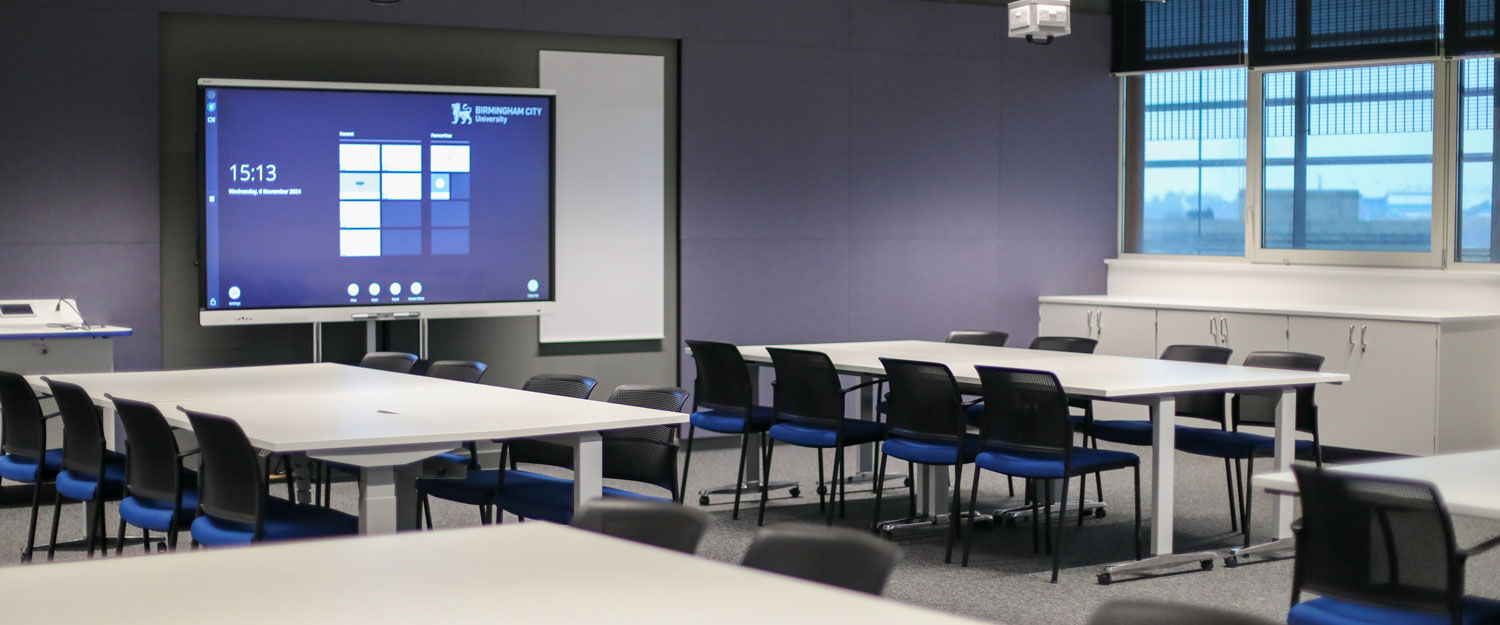
Our facilities
This course is primarily based at our City Centre Campus, in the Benjamin Zephaniah Building (formerly University House), however, for some practical activities, such as sport, cookery or science lab sessions, you may be based at our City South Campus in Edgbaston, or the Alexander Stadium and Doug Ellis Sports Centre in Perry Barr.
About Benjamin Zephaniah Building
This freshly renovated building provides a dedicated teaching and learning space for our Education and Communities students and staff.
Spaces in the building include:
- Primary and secondary science labs
- Innovation and Lego teaching room
- Flexible space for Design and Technology
- Art room
As well as general teaching rooms.
Our staff
Dr Louise Lambert
Associate Professor
Dr Lou Lambert has a background in schools’ education, initial teacher education and postgraduate education leadership. She is currently an Associate Professor at BCU where she teaches, researches, and writes about pedagogical practices across educational sectors and the use of arts-based, participatory and creative methodologies for both research...
More about LouiseDr Tina Collins
Senior Lecturer in Education
Tina is a Senior Lecturer in Education. She is joint course lead of the Master’s in Education (taught) programme. Tina’s experience also includes teacher training and she is Academic Lead for the PGCE(I)/PGDE(i) working with the Indus Training and Research Institute in India (ITARI).
More about Tina