Diagnostic Radiography - BSc (Hons)
Currently viewing course to start in 2027/28 Entry.
As a diagnostic radiographer you play a valuable part in a service user’s pathway by providing the imaging needed to support their diagnosis, treatment, and recovery. This is done through the use of highly specialist technology. A career in diagnostic radiography combines science, technology, patient care and an eye for detail....
- Level Undergraduate
- Study mode Full Time/Part Time
- Award BSc (Hons)
- Start date September 2027
- Fees View course fees
- Subject
- Location City South
This course is:
Overview
As a diagnostic radiographer you play a valuable part in a service user’s pathway by providing the imaging needed to support their diagnosis, treatment, and recovery. This is done through the use of highly specialist technology. A career in diagnostic radiography combines science, technology, patient care and an eye for detail. As well as being a rewarding field to work in, it offers a diverse career pathway with a variety of options to progress to advanced practice.
Our Diagnostic Radiography course here at BCU is approved by the College of Radiographers and will support you to develop the skills and knowledge you need to prepare you to become a fully qualified diagnostic radiographer once you have graduated. On successful completion of all course requirements, you will be entitled to apply for registration with the regulator, the Health and Care Professions Council (HCPC), to gain registered practitioner status and be able to practice in the UK either within the NHS or the private sector.
What's covered in this course?
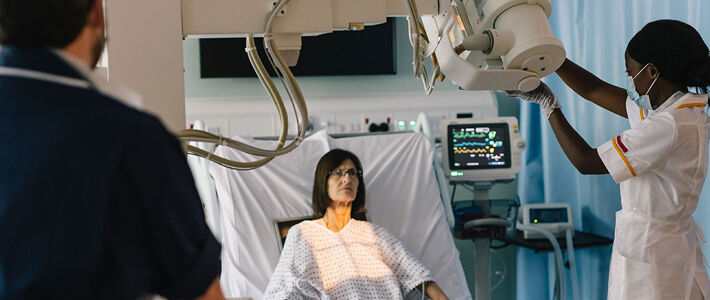
Our West Midlands based Diagnostic Radiography course provision is well-established and will offer you a mixture of education in academic and clinical environments. When on campus, as well as classroom delivery, you will have access to our specialist teaching spaces, including a well-equipped x-ray suite, image viewing facilities, ward, and operating theatre. You will also develop your specialist skills as you spend time on placements within a variety of imaging departments supported by our clinical partners in the Midlands region.
Your academic studies include subjects which form the core of diagnostic radiography practice, including the study of human anatomy, physiology and pathology, principles of radiation and imaging, and how to deliver exacting standards of patient care in the context of varying social and psychological needs. You will also develop a strong understanding of what it means to be a registered professional. The purpose of this is to ensure that you are prepared for practice with all the skills and knowledge you need to be a competent and confident diagnostic radiographer. This course will also support you with your employability skills so that you are ready to make the move into the working world as you complete your studies.
As you advance your knowledge of diagnostic radiography practice and the application of imaging technology to differing pathologies, you will develop academic and analytical skills and will explore the research evidence that forms the bases of current and emergent practices. You will also develop your ability to apply research strategies to health and care practice and will consolidate your clinical skills and knowledge to support your transition to registered practitioner status.
Accredited By
This course is accredited by:


“If we weren’t radiographers we would be detectives, our job is to find out what is going on... I was x-raying patients from the first hour of my first day.” Adam Robinson
Why Choose Us?
- Our course is approved by the Health and Care Professions Council (HCPC) and accredited by the College of Radiographers (CoR), who are our regulatory and professional bodies.
- We are one of the largest centres for diagnostic radiography training in the UK, with strong long-standing links to NHS and private hospitals across the West Midlands, Shropshire, Staffordshire, Worcestershire and Warwickshire.
- With our personal tutor model we support you to keep on track with your learning through regular meetings with the course team when both at university and when on clinical placement.
- As a student on an allied health professions course, you will receive at least £5,000 a year in additional funding for maintenance and associated study costs as part of the NHS Learning Support Fund.
- 96% of students rated the learning resources for this course as good or very good.
- Based at City South Campus in Edgbaston, we have access to a range of healthcare-focused education and training facilities with opportunity for interprofessional learning. Our radiography specific facilities include a fully functioning x-ray room, mobile x-ray, fluoroscopy and ultrasound units.
Open Day
Join us for our next Open Day where you'll be able to learn about this course in detail, chat to students, explore our campus and tour accommodation.
Next Open Day: 21 November
Course in Depth
Year One
In order to complete this course, you must successfully complete all the following CORE modules (totalling 120 credits).
This module will introduce you to the skills required when studying in higher education and to the resources that you will be using to support your academic and personal development. You will use the skills and resources introduced in this module throughout the course and after successful completion of your studies, to enable lifelong learning as a competent and autonomous practitioner.
The aim of this 20-credit module is to provide you with an introduction to the technical aspects of being a radiographer. Throughout the module, there will be a strong emphasis on safety and the application of legislation relevant to medical imaging.
Via a mixture of theory and practice, you will learn about principles of x-ray production, as well as an introduction to some of the technical factors that affect a beam of x-radiation and how they can be manipulated. You will also learn about how x-rays interact with the body and how radiographers are trained to use ionising radiation safely and effectively.
The aim of this 20-credit module is to provide you with a grounding in diagnostic imaging whilst taking a holistic approach to the patient. The module provides you with the necessary theory and practical experience to enable you to competently perform basic radiographic imaging examinations of the chest, abdomen and pelvis and to evaluate the images produced. It will integrate anatomical knowledge with basic radiographic techniques and image evaluation for conventional radiography of the chest, abdomen and pelvis. Justification of imaging requests will be considered, as will the process of bone formation.
The aim of this 20-credit module is to build on the skills learnt in RAD4063 Principles of Radiation Production and Protection to support your introduction to the technical aspects of being a radiographer. Throughout the module, there will continue to be a strong emphasis on safety and the application of legislation relevant to diagnostic imaging.
The aim of this 20-credit module is to continue to provide you with a grounding in diagnostic imaging whilst taking a holistic approach to the patient. Building on the knowledge acquired in RAD4059 The Chest, Abdomen and Pelvis, the module provides you with the necessary theory and practical experience to enable you to competently perform basic radiographic imaging examinations of the appendicular skeleton and to evaluate the images produced. It will integrate anatomical knowledge with basic radiographic techniques and image evaluation for conventional radiography of the appendicular skeleton. Justification of imaging requests will be considered, as will fracture mechanisms.
The aim of this 20-credit module is to provide you with an introduction to the care skills you will utilise as a Diagnostic Radiographer. You will also consider what it means to work as a healthcare professional in the NHS. This module will introduce and support you in achieving the skills and knowledge necessary to prepare you for clinical practice. Learning on this module will consist of large group lectures, workshops in our skills facilities, group discussions and online activities. There will also be the opportunity to apply the knowledge and skills developed in this module to practice during your clinical placements.
Through engagement with an allocated rotation of partnership practice placements, you will gain firsthand experience in a range of clinical settings and imaging modalities. Linking to the core principles and knowledge taught in your level 4 academic modules, your clinical module will offer you the opportunity to develop your clinical and care skills, radiographic technique, and professional aspects of practice.
Year Two
In order to complete this course, you must successfully complete all the following CORE modules (totalling 120 credits).
This module aims to increase your awareness of the ethical, legal and professional issues inherent in healthcare provision to facilitate autonomous practice. It helps you to develop a pro-active lifelong learning approach which will enable you to provide consistent service user focussed care. This includes those patient groups who require extra care and/or experience inequalities when accessing healthcare.
This 20-credit module allows you to build on the skills learnt at Level 4 relating to anatomy, physiology, and osteology, but this time with a focus on the axial skeleton. You will study the osteology of the skull, face and spine, covering basic radiographic techniques of these areas as well as common pathologies and mechanisms of injuries that affect these regions. Basic radiographic techniques of these areas will be practiced across a range of modalities.
The aim of this 40 credit module is to build upon the principles learnt in the level 4 modules Principle of Radiation Production and Protection and Principles of Conventional Imaging. As at level 4, there will be a strong emphasis on safety and the application of legislation relevant to medical imaging.
This 20-credit module allows you to build on the skills learnt at Level 4 relating to anatomy, physiology, and osteology, but this time with a focus on the systems of the body. You will explore the anatomy and physiology of multiple systems of the body, as well as a range of associated pathologies. You will discover the role that contrast agents play in the imaging of these systems and how Computed Tomography, Magnetic Resonance Imaging, Ultrasound, Radionuclide Imaging, and others are used to identify different pathologies.
This module will build upon the ‘Academic Skills and Knowledge’ module at level four. It is intended that by studying this module you will gain an understanding of the use of a range of research tools. It will further develop your study skills, especially in critique and analysis of research and evidence, to support your progression.
Building on your level 4 academic and clinical modules, this module will support you in further developing and applying the commensurate skills necessary to competently complete a radiographic examination to the ability expected of a level 5 student.
Year Three
In order to complete this course a student must successfully complete all the following CORE modules (totalling 120 credits):
This module will build upon the ‘Further Academic skills and Knowledge – Preparing for Research’ module at Level 5. Development of research skills and knowledge will underpin future practice in line with the aims of the College of Radiographers Research strategy and the Health Care Professions Council (HCPC) to embed research throughout the professions of therapeutic radiography and diagnostic radiography.
The aim of this 40-credit module is to build upon the principles learnt in levels 4 and 5. As with earlier modules, there will be a strong emphasis on safety and the application of legislation relevant to medical imaging. The module will encourage you to take a critical approach to modern radiographic practice.
Using a mixture of theoretical and practical teaching, you will develop your knowledge, skills and practice of more advanced radiographic techniques and new developments, supporting you to apply your knowledge to complex clinical situations. Alongside this, you will be encouraged to further develop the necessary communication skills to work safely and effectively within a multi-professional team in challenging healthcare environments.
You will also develop the image interpretation and communication skills required to provide a written preliminary clinical evaluation of radiographic images.
In order to prepare you for employment and professional practice, this module aims to develop your knowledge of leadership, governance, preceptorship and mentoring. You will be guided through the process of searching and applying for jobs and have the opportunity to develop your interview skills.
This module will give you the opportunity to further develop your knowledge and critical thinking skills with regards to one area of clinical practice that you are interested in. At the start of the module, you will choose one pathology to focus on. You will also be able to negotiate the exact form of final assessment that you will use to demonstrate achievement of the module learning outcomes. A selection of assessment methods will be available for you to choose from. If you wish to undertake a different method of assessment, this can be negotiated with the module team.
Building on your level 4 and 5 academic and clinical modules, this module will support you in further developing and applying the commensurate skills necessary to competently complete a range of imaging examinations to the ability expected of a level 6 student and ultimately, a newly-qualified autonomous diagnostic radiographer.
Download course specification
Download nowHow you'll learn
There will be delivery of academic modules worth 120 credits during each of the 3 years of the course. In addition to these, there will be a zero-credit clinical module at each level of study that you will also be required to complete. All modules are core, and therefore all content and assessments (both academic and clinical) must be passed to meet the requirements for the award of BSc (Hons) Diagnostic Radiography. Upon successful completion of all academic and clinical modules, you will be eligible to apply for registration with the HCPC as a diagnostic radiographer.
We utilise a variety of methods within our learning and teaching strategy to encourage reflective and critical thinking. The aim of this is to enable you to become a confident and autonomous learner, with sound academic and clinical knowledge, supporting your employability and skillset for lifelong learning and continuous professional development.
The year plan is designed to integrate theory and practice using a modular approach with alternating blocks of academic study and clinical practice across all 3 years. Delivery of academic elements of the Diagnostic Radiography course will predominantly be at the university, either in a face-to-face capacity or through online learning platforms, such as the university’s online Virtual Learning Environment (VLE), Moodle, to deliver a blended approach to learning. Clinical experience is gained through attending an allocated clinical placement rotation and is reinforced within the university environment through the use of our dedicated skills suite and simulation activities. Our onsite radiography suite has capabilities for both DR (Digital Radiography) and CR (Computed Radiography), allowing you to see the evolution of technology and the importance of utilising effective imaging technique. The radiography suite is used throughout all 3 years of the course alongside our PACS (Picture Archiving and Communication System) and anatomical model resources in order to support your learning of anatomy, physiology, positioning technique and technical factors.
There will be a variety of learning and teaching activities within the course including seminars, individual or small group tutorials, didactic lectures, and study groups. These will include anatomy, physiology and pathology workshops, simulation of clinical scenarios, debates, group presentations, amongst others.
Clinical practice
Throughout the course there will be an integration of clinical practice experience with academic learning, so that you can forge connections between your developing professional knowledge and practical skills as developing diagnostic radiographers. Our approach has been to embed fundamentals of professional knowledge within the first phases of the course so that you can develop a firm foundation in the principles of radiation and imaging, anatomy and physiology, and the provision of an excellent standard of patient care. As you advance through the levels of study, you will explore increasingly complex aspects of radiographic practice and develop your skills in analysing the evidence base that underpin protocols and procedures so that you understand where and how diagnostic radiography fits into a patient’s diagnostic pathway and beyond. During the final stages of the course, you will be encouraged to adopt self-critical and analytical approaches to your developing professional identity and your role as a diagnostic radiographer within the wider multidisciplinary hospital teams.
Clinical experience is gained through attending clinical placement rotation and is reinforced within the university environment through the use of our dedicated skills suite and simulation activities. Within the first semester of Level 4, you will be required to meet 4 mandatory requirements before you will be permitted to attend placement. These include a clear enhanced DBS (Disclosure and Barring Service) check, agreement from Occupational Health that you are fit to attend placement, as well as mandatory training in Basic Life Support (BLS) and Patient Movement and Handling. You will be required to renew your mandatory training in each academic year to maintain and develop your skills in these areas. You must also make us aware if there are any changes to your DBS at any point during the course, or if any changes to your physical or mental health impact on your fitness to practice. More information on this is available in the Course Handbook and Student Clinical Handbook.
Assessment
Throughout the course, you will be assessed using a variety of methods including examinations, assignments, presentations, case studies, in-person OSCE/VIVAs, and clinical assessments of competence. They will be supported in the development of your academic skills (including academic writing, knowledge base, referencing, literature searching, and criticality) as part of the curriculum starting at Level 4 but also with the support of wider academic support services across the university (e.g., Academic Development Department, Centre for Academic Success, and the Library). You will be supported in the development of your clinical competency skills by both academic and clinical-based staff. You will also be given opportunities to develop transferable skills, which you will be able to use in your employed professional lives after graduation and verbal skills to articulate and justify your decisions and intentions.
Formative assessment opportunities exist within all modules and help you to prepare for your summative assessments. Following completion of any formative assessments, you will receive feedback on your performance as well as guidance on how you should proceed with your learning to support your success in the summative item(s) (feedback and feedforward). Similarly, for your summative assessments, you will receive feedback on the assessment items, as well as feed forward on how to improve for future assessments.
Additional support
If you have a specific learning difficulty (such as dyslexia or ADHD), a disability, a long-term health condition or mental health difficulties, our support teams provide advice, information and practical support (such as reasonable adjustments). Engaging with our support teams early on in the application process means that the University is more likely to be able to implement support before your arrival at University. If you require reasonable adjustments in your placement setting, early disclosure will assist the University in securing suitable placements wherever it reasonably can.
This course is approved by:

Health and Care Professions Council
This course is approved by the Health and Care Professions Council, and will give you eligibility to apply for registration if you successfully complete the course.

College of Radiographers
The College of Radiographers (CoR) is a registered charity concerned with standards in the provision and development of diagnostic imaging and radiotherapy for the public benefit.
Entry Requirements
These entry requirements apply for entry in 2027/28.
All required qualifications/grades must have been achieved and evidenced at the earliest opportunity after accepting an offer to help confirm admission and allow for on-time enrolment. This can also include other requirements, like a fee status form and relevant documents. Applicants can track their application and outstanding information requests through their BCU mySRS account.
Essential requirements
120 UCAS Tariff points. Learn more about UCAS Tariff points.
Applicants will also need to complete an interview for this course; see interview arrangements below.
This course operates a ‘gathered field’ approach for admission, to make the process fairer. This means that all applications received by the UCAS Equal Consideration Deadline (13 January 2027 at 18:00 GMT) will be reviewed together after interviews have concluded, through a selection day held by our admissions and course team at the end of February 2027. Applicants will receive a decision on their application after that selection day. Find out more about the gathered field approach here.
If your Level 3 qualifications do not meet the UCAS tariff for this course, you may be offered a place on our Foundation Year instead. You do not need to submit a separate application but will automatically be considered for this if your predicted grades fall below the UCAS entry tariff.
Disclosure and Barring Service (DBS)
Prior to enrolling on the course, successful candidates will be required to obtain a satisfactory occupational health check and an enhanced DBS check via the School, as well as registration with the Independent Safeguarding Authority. Qualifications, personal statement, interview and references all form part of the selection criteria for this course. If you have any queries please refer to DBS Frequently Asked Questions or contact admissions@bcu.ac.uk.
If you have a qualification that is not listed, please contact us.
Fees & How to Apply
UK students
Annual and modular tuition fees shown are applicable to the first year of study. The University reserves the right to increase fees for subsequent years of study in line with increases in inflation (capped at 5%) or to reflect changes in Government funding policies or changes agreed by Parliament. View fees for continuing students.
Award: BSc (Hons)
Starting: Sep 2027
- Mode
- Duration
- Fees
- Full Time
- 3 years
- £10,050 in 2027/28
- Apply via UCAS
- Part Time
- 6 years
- Show fees
- £1675 per 20 credits
- Year 1 - 60 credits
- Year 2 - 60 credits
- Year 3 - 60 credits
- Year 4 - 60 credits
- Year 5 - 60 credits
- Year 6 - 60 credits
Fees for Part-time students
This course can be studied on a Part-time study basis. The cost per year of study is based on credit requirements for that year.
International students
Sorry, this course is not available to International students.


Guidance for UK students
UK students applying for most undergraduate degree courses in the UK will need to apply through UCAS.
The Universities and Colleges Admissions Service (UCAS) is a UK organisation responsible for managing applications to university and college.
Applying through UCAS
- Register with UCAS
- Login to UCAS and complete your details
- Select your course and write a personal statement
- Get a reference
- Pay your application fee and submit your application
Personal statement
The personal statement gives you a crucial opportunity to say why you’re applying and why the institution should accept you.
Here are the three areas you’ll need to address:
- Why do you want to study this course or subject?
Here’s where you explain what makes this course exciting to you. Think about your motivations for studying the course and your future plans. If you’re planning to take a year out, don't forget to give your reasons.
- How have your qualifications and studies helped you to prepare for this course or subject?
This is your chance to show what you’ve learned at school or college. You should include the skills and knowledge you’ve gained from education or training and how this will help you succeed in your chosen course.
- What else have you done to prepare outside of education, and why are these experiences useful?
Not everything you’ve learned comes from the classroom. Life experience counts too! You might want to talk about work experience, employment, or volunteering and how they’ve helped you develop the skills needed for your chosen course or future career.
Worried about Personal Statements?
If you've got no idea where to start or just want to check you're on the right track, we’ve got expert advice and real examples from our students to help you nail your personal statement. You can even download our ultimate personal statement guide for free.
Employability
Enhancing employability skills
You will be gaining a professional qualification that will enable you to gain employment within the wider NHS. The clinical skills you gain will support your developing competence and enable you to undertake the role of a qualified therapeutic radiographer. You will gain competence in the safe and effective operation of cutting edge medical technologies and develop autonomous practice skills including decision making and care provision.
Your qualification will enable you to seek professional registration with the Health and Care Professions Council and membership with the Society of Radiographers.
You will receive opportunities to develop your employability skills whilst a student. This includes development of your ability to mentor others, practice your interview skills and job application writing skills.
Placements
You will spend a significant proportion of your time on the course undertaking hospital-based clinical placement learning. This is typically 12-18 weeks in every year of the course. You will gain experience at more than one placement site, and will provide imaging services and patient care demonstrating a wide variety of clinical expertise. Students will engage with the latest imaging equipment and techniques and will gain experiences of professional groups in the wider multidisciplinary care teams.
Graduate jobs
Our graduates secure employment as diagnostic radiographers. Diagnostic radiographers are responsible for the accurate delivery of diagnostic imaging using high energy radiation, as well as the support of the patient as they undergo their examination. They are the only healthcare professionals who are qualified to do this, working in a multidisciplinary environment, with radiologists, engineers, medical specialists and other healthcare professionals to ensure the holistic care of the patient and their carers is enabled.
Examples of real graduates and their roles
Our graduates commence their working lives as diagnostic radiographers deploying effective and safe imaging procedures patients. Once further experience is gained radiographers are able to specialise and develop their skills in differing areas of practice. Our graduates have gained expertise and competence as advanced practitioners in the fields of Medical Ultrasound, Computed Tomography (CT), Image Reporting, education and research.
Facilities & Staff

Health Professions facilities
Take a look around the facilities available to you as a Health Professions student at BCU.
Our staff
Charlotte Burnside
Associate Professor - Health Professions
Charlotte is the Deputy Head of the College of Health and Care Professions. In 2018 Charlotte started as Head of Department for the Operating Department Practice and Paramedic Science department. The role included leading and coordinating the work of the Operating Department Practice and Paramedic Science Department. This involved...
More about CharlotteDanny Simeone
Senior Lecturer and Course Leader for BSc (Hons) Diagnostic Radiography
Danny qualified as a Diagnostic Radiographer at Birmingham City University in 2014. Before joining BCU, he had worked at an NHS major trauma centre in Coventry. Danny has always taken a keen interest in student development and experience during his time in the NHS, taking a lead role with student education within his department.
More about DannyJeremy Lima
Jeremy Lima qualified as a Diagnostic Radiographer at the University of Hertfordshire in 2009 after moving to England from Gibraltar. He worked at a large NHS foundation trust in Oxford before joining BCU.
More about Jeremy