


Architecture - BArch (Hons) *
Currently viewing course to start in 2027/28 Entry.
First founded in 1908, as the Birmingham School of Architecture, education in architecture, currently located in the Department of Architecture and Built Environment, has been at the heart of the profession in the city and across the region for over 100 years....
- Level Undergraduate
- Study mode Full Time
- Award BArch (Hons)
- Start date September 2027
- Fees View course fees
- Subject
- Location City Centre
This course is:
Available with Professional Placement year
Open to International Students
Overview
First founded in 1908, as the Birmingham School of Architecture, education in architecture, currently located in the Department of Architecture and Built Environment, has been at the heart of the profession in the city and across the region for over 100 years. This synergistic and interdisciplinary link between architectural education, industry, and the city’s wider history of making, continues to be part of the ethos of the course – building professionals that are adapted to the unique challenges of contemporary practice, and of the city we are rooted in.
The BArch (Hons) RIBA Part 1 course reframes architectural education as a tool for equity, civic responsibility, and cultural transformation. The course aims to equip our students with the skills to be creative, ethical, and entrepreneurial – capable of rising to 21st century challenges. We encourage our incredibly diverse student body to bring their lived experiences into studio generating design responses that reflect their own backgrounds. We empower students to radically respond to the urgent issues facing our city and the world, from climate crisis, to urbanisation, and the changing landscape of our cities. We seek not only to diversify the profession but to change what architecture is and does in our own communities.


Credits - Top Row L to R (Alexander Packham, Aun Naeem, Bisma Zahid) Middle Row L to R (Doree-Alphonsine Birimwiragi Nabuci, Fabien Daviau, Harvey Farren) Bottom row L to R (Hira Khan, Muhsinur Rahman, Phoebe Palmer)
What's covered in this course?
The programme is scaffolded over three years to help students grow and build confidence, specialist knowledge, professional literacy, and critical agency, to go out into the world as change makers. Each year includes design studio, professional studies, history/theory, and technology/environment modules that are taught as holistic interrelated topics. Here students have an opportunity to come out with their own unique set of skills, style, and approach as they develop and take ownership over their own design process and agendas.
Through a mixture of industry activities, live clients, real world scenarios, and engaging with our professional networks in Birmingham and beyond, students can be sure they have the skills they need for a professional practice that is rapidly changing.
We have a long tradition of fostering entrepreneurship, with multiple award-winning practices having been founded by our entrepreneurial graduates. With many of our visiting lecturers coming from architectural practices with active experience working on projects that are helping to define our growing city and region, and with major projects and development on our doorstep, there are lots of great opportunities for our students and graduates to learn from and participate in the design that will radically change the way the entire region functions. Through engaging with live clients and projects, local site visits, guest lectures, and engaging with local visiting critics you will be offered ample opportunities to be a part of the future of Birmingham and beyond.
Professional Placement year
This course offers an optional professional placement year. This allows you to spend a whole year with an employer, following successful completion of your second year, and is a great way to find out more about your chosen career. Some students even return to the same employers after completing their studies.
If you choose to pursue a placement year, you will need to find a suitable placement to complement your chosen area of study. You will be able to draw on the University’s extensive network of local, regional, and national employers, and the support of our Careers teams. If you are able to secure a placement, you can request to be transferred to the placement version of the course.
Please note that fees are payable during your placement year, equivalent to 20% of the total full-time course fee for that year.
Studying architecture at BCU taught me how to think, not just what to make. The course challenged my creativity and pushed me to produce work I never imagined I was capable of. Exposure to the brilliant minds of staff and fellow students gave me the confidence to communicate ideas visually and develop skills far beyond the studio.
Renia Downes
Why Choose Us?
- A future focused course shaped by industry and professional bodies
Our BArch course responds directly to major RIBA and ARB changes, ensuring your learning mirrors the evolving realities of contemporary practice while keeping you aligned with RIBA Themes & Values and Graduate Attributes. - Strong emphasis on climate literacy, retrofit, and sustainable futures
From climate responsive design to adaptive reuse, the course embeds environmental thinking throughout— deeply aligned with the profession’s shift toward low carbon and socially responsible architecture - Learn through real world projects rooted in Birmingham
You’ll work with live clients, community organisations, and local sites throughout your degree—an approach consistently praised by external examiners for its relevance, authenticity, and strong civic impact. - A diverse, supportive, and inclusive learning environment
External examiners repeatedly highlight the course’s exceptional student support and welcoming studio culture, where staff are “inspiring”, “committed”, and “go above and beyond” to help every student succeed. - Interdisciplinary learning that reflects how architects work today
The course integrates design, technology, history/theory, and professionalism, with opportunities to collaborate across the Built Environment and engage with professional and community partners—ensuring your learning reflects contemporary, cross disciplinary architectural practice. - Outstanding workshop and digital facilities
You’ll have access to extensive specialist workshops—including ceramics, plaster, CADLAB, woodwork, metalwork, print labs, textile and screen-printing facilities, and a photography studio—supported by expert technical staff, giving you the tools to explore modelmaking, fabrication, and material experimentation at a professional standard.
Open Day
Join us for our next Open Day where you'll be able to learn about this course in detail, chat to students, explore our campus and tour accommodation.
Next Open Day: 21 November
Course in Depth
First Year
In order to complete this course a student must successfully complete all the following CORE modules (totalling 120 credits):
Design Communication 30 credits
Architectural Histories in Context 30 credits
Design Fundamentals 30 credits
Architectural Technologies in Context 30 credits
Second Year
In order to complete this course a student must successfully complete all the following CORE modules (totalling 120 credits):
Adaptive Reuse 30 credits
Creative Ethics and Collaboration 30 credits
Design Negotiation 30 credits
Theories of the Built Environment in Context 30 credits
Professional Placement Year (Optional)
In order to qualify for the award of BArch (Hons) with Professional Placement Year you must successfully complete the following module.
This module is designed to provide you with the opportunity to undertake a credit bearing, 40- week Professional Placement as an integral part of your Undergraduate Degree. The purpose of the Professional Placement is to improve your employability skills which will, through the placement experience, allow you to evidence your professional skills, attitudes and behaviours at the point of entry to the postgraduate job market. Furthermore, by completing the Professional Placement, you will be able to develop and enhance your understanding of the professional work environment, relevant to your chosen field of study, and reflect critically on your own professional skills development within the workplace.
Final Year
In order to complete this course a student must successfully complete all the following CORE modules (totalling 120 credits):
Radical Proposals 30 credits
Creative and Critical Practice 30 credits
Resilient Futures 60 credits
Download course specification
Download nowThe aim of Level 4 is first and foremost to start off by building a sense of studio culture while introducing you to the core representational, theoretical, and technical skills to develop a design response. To aid in your transition to higher education, professional skills around time management, reflective working practices, and developing autonomy in working between session are central to all modules.
In Level 5 you will begin to critically engage with your future role as a potential practitioner. Learning is focussed on you building on core skills from Level 4, applying them to your own research and design process, and beginning to develop your own unique style and approach to design. With emphasis on reflecting on your own ethical and creative practice, in relationship to industry frameworks, you will begin to prepare yourselves for the landscape of the profession. Modules in this year rely heavily on collaboration, whether group work with colleagues, engaging with live clients and communities, or in an approach to 2nd semester studio, which aims to approximate the structure of a practice.
At Level 6, design ambition meets technical and professional confidence. Allowing the chance to align yourself with a particular design approach or methodology, the unit structure prompts and enables you to generate and resolve designs. Across the Level 6 modules, you are asked to engage with broad social contexts, radical outlooks, technological complexity, and ambitious communication techniques to create a final portfolio that sets you apart from each other.
Further study
Students may choose to go straight onto the MArch (RIBA Part 2) to begin their journey to becoming a registered architect, or they can progress onto a range of postgraduate studies within the Department of Architecture and Built Environment.
The department offers a range of courses (including full time, part time, apprenticeships and placement year routes to study) that span almost the full spectrum of built environment and construction disciplines, accredited by a variety of professional, statutory and regulatory bodies.
Trips and visits
Most of your design projects will be located on live sites, meaning regular trips to various locations will become an integrated part of the design studio modules. Study trips at all three levels are often linked to design projects or inform research activities. These provide a very important part of your learning and understanding, building knowledge and skills for interpretation of sites and buildings - locally, nationally and beyond.
We offer optional regional and international study trips which give students an opportunity to explore architecture in different settings. In previous years the course has taken students to London, Manchester, Liverpool, Cambridge and Amsterdam.
Entry Requirements
These entry requirements apply for entry in 2027/28.
All required qualifications/grades must have been achieved and evidenced at the earliest opportunity after accepting an offer to help confirm admission and allow for on-time enrolment. This can also include other requirements, like a fee status form and relevant documents. Applicants can track their application and outstanding information requests through their BCU mySRS account.
Essential requirements
136-96 UCAS Tariff points. Applicants will also need to submit a good portfolio.
The offer we make you takes into account the creative potential illustrated in your portfolio, along with your individual circumstances, predicted grades, achieved qualifications and potential to succeed at university.
If you have a qualification that is not listed, please contact us.
Fees & How to Apply
UK students
Annual and modular tuition fees shown are applicable to the first year of study. The University reserves the right to increase fees for subsequent years of study in line with increases in inflation (capped at 5%) or to reflect changes in Government funding policies or changes agreed by Parliament. View fees for continuing students.
Award: BArch (Hons)
Starting: Sep 2027
- Mode
- Duration
- Fees
- Full Time
- 3 years
- £10,050 in 2027/28
- Apply via UCAS
International students
Annual and modular tuition fees shown are applicable to the first year of study. The University reserves the right to increase fees for subsequent years of study in line with increases in inflation (capped at 5%) or to reflect changes in Government funding policies or changes agreed by Parliament. View fees for continuing students.
Award: BArch (Hons)
Starting: Sep 2027
- Mode
- Duration
- Fees
- Full Time
- 3 years
- £19,220 in 2027/28


Guidance for UK students
UK students applying for most undergraduate degree courses in the UK will need to apply through UCAS.
The Universities and Colleges Admissions Service (UCAS) is a UK organisation responsible for managing applications to university and college.
Applying through UCAS
- Register with UCAS
- Login to UCAS and complete your details
- Select your course and write a personal statement
- Get a reference
- Pay your application fee and submit your application
Guidance for International students
There are three ways to apply:
1) Direct to the University
You will need to complete our International Application Form and Equal Opportunities Form, and submit them together with scan copies of your original academic transcripts and certificates.
2) Through a country representative
Our in-country representatives can help you make your application and apply for a visa. They can also offer advice on travel, living in the UK and studying abroad.
3) Through UCAS
If you are applying for an undergraduate degree or a Higher National Diploma (HND), you can apply through the UK’s Universities and Colleges Admissions Service (UCAS).
You can request a printed form from your school or nearest British Council office. You will be charged for applying through UCAS. Birmingham City University’s UCAS code is B25 BCITY.
Portfolio guidance
If you receive an offer to study this course, you will be required to submit a portfolio. We ask that this is submitted within four weeks of receiving your offer.
Please see our portfolio guidance page for tips on putting your portfolio together.
Portfolio guidance
If you receive an offer to study this course, you will be required to submit a portfolio. We ask that this is submitted within four weeks of receiving your offer.
Please see our portfolio guidance page for tips on putting your portfolio together.
Personal statement
The personal statement gives you a crucial opportunity to say why you’re applying and why the institution should accept you.
Here are the three areas you’ll need to address:
- Why do you want to study this course or subject?
Here’s where you explain what makes this course exciting to you. Think about your motivations for studying the course and your future plans. If you’re planning to take a year out, don't forget to give your reasons.
- How have your qualifications and studies helped you to prepare for this course or subject?
This is your chance to show what you’ve learned at school or college. You should include the skills and knowledge you’ve gained from education or training and how this will help you succeed in your chosen course.
- What else have you done to prepare outside of education, and why are these experiences useful?
Not everything you’ve learned comes from the classroom. Life experience counts too! You might want to talk about work experience, employment, or volunteering and how they’ve helped you develop the skills needed for your chosen course or future career.
Worried about Personal Statements?
If you've got no idea where to start or just want to check you're on the right track, we’ve got expert advice and real examples from our students to help you nail your personal statement. You can even download our ultimate personal statement guide for free.
Employability
Enhancing your employability skills
Our Bachelor of Architecture course is designed to equip you with the skills, confidence and professional awareness needed to thrive in an evolving architectural landscape. From your first year onwards, you’ll be immersed in authentic learning experiences that mirror industry practice—developing your abilities through design studio, collaboration, critical thinking, and hands-on experimentation. External examiners consistently praise the course for the way it builds professional skills, reflective practice, and industry ready communication methods across all levels.
You will learn how to work as part of a design team, respond to real sites and community clients, and present your ideas clearly through drawings, models, verbal presentations, and digital media. These activities introduce you to essential attributes such as teamwork, time management, problem solving, and inclusive, ethical decision making—skills external examiners describe as well embedded and thoughtfully scaffolded throughout the course.
You will also develop strong technical literacy, from understanding environmental design and construction principles to using industry standard tools such as Adobe Creative Cloud, AutoCAD, and Revit, alongside key analogue drawing and making skills.
Live projects, engagement with local partners, and opportunities to work with community groups and professionals give you valuable real-world insight into how contemporary practice operates. These experiences have been commended for helping you build confidence and understand how to apply their skills beyond university.
By the end of the course, you will graduate with a unique portfolio, a strong professional mindset, and the creative, technical and collaborative abilities that employers across the built environment sector value.
Graduate jobs
While many graduates progress into architectural assistant roles in practices across Birmingham and the West Midlands, others successfully move into related areas such as urban design, community engagement, sustainability consultancy, digital design, modelmaking, or roles within creative industries. The course’s excellent industry links, live projects, and strong civic partnerships provide valuable exposure to professional practice and help broaden students’ career opportunities across the wider built environment.
Links to industry
Strong, meaningful industry engagement is at the heart of the BArch experience at BCU. Throughout your degree, you will work closely with architects, designers, community partners, and built environment professionals through live briefs, site-based projects, and collaborative activities that mirror real practice. External examiners consistently highlight the course’s impressive integration of real-world contexts, praising the course for its close connection to Birmingham’s communities and the way students engage with “live” issues in the city.
The course has long‑standing relationships with local and regional practices, supported by a pool of visiting lecturers—most of whom are registered architects actively working in industry. These practitioners contribute to studio teaching, guest lectures, tutorials, and reviews, giving you direct insight into current professional trends and expectations.
Facilities & Staff
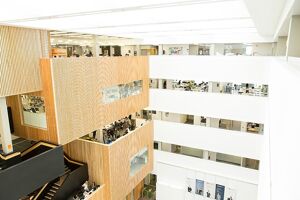
Architecture facilities
Take a look around some of the facilities, studios and workshops that you’ll have access to.
Our staff
Max Olof Karlsson Wisotsky
L4 Year Lead, Senior Lecturer in Architecture
Max Wisotsky is a Swedish-American designer, architectural historian and theorist from Los Angeles, California. He holds a BArch from California Polytechnic State University, San Luis Obispo, and an MA in Architectural History from the Bartlett School of Architecture, UCL.
More about Max OlofDr Rui Aristides Lebre
Lecturer, Course Leader for BA (Hons) Architecture
Dr. Lebre is an architect and academic focused on exploring ethnographically informed methods to examine the social and environmental effects of spatial production. He is currently lecturer and Course Leader for BA (Hons) Architecture at the Department of Architecture and Built Environment (ABE). As a designer, Dr. Lebre has worked as a solo...
More about Rui AristidesDr Yazid Khemri
Senior Lecturer in Architecture and Design - Academic Lead for Global Partnerships
Dr Yazid Khemri has been involved in the practice, research and teaching of Architecture for over a decade, and currently leads the third year (Level 6) of the BA (Hons) Architecture programme. Yazid was awarded a PhD in Architecture by the University of Portsmouth, where he also taught across Design Studio, Technology and History and Theory. He...
More about YazidHelen Iball
Academic Lead for Professional, Statutory and Regulatory Bodies and M.Arch Course Co-Leader
Helen is an intersectional feminist architectural academic creatively teaching feminist spatial practice for over twenty-seven year, where she set up PRAXXIS aiming to stimulate a positive intersectional feminist debate in Schools of Architecture.
More about Helen