Medical Ultrasound - Module / MSc / PgCert / PgDip
Currently viewing course to start in 2027/28 Entry.
The course is suitable for radiographers, midwives, nurses and doctors. So if you're a qualified professional wanting to extend your expertise into ultrasound scanning, imaging and interpretation of diagnostic ultrasound images, this course could be for you. You'll gain the core skills of a sonographer from practising professionals....
- Level Postgraduate Taught
- Study mode Part Time
- Award Module / MSc / PgCert / PgDip
- Start date September 2027
- Fees View course fees
- Subject
- Location City South
This course is:
Overview
This course is in the process of being revalidated to keep it up to date with current practice and content may be subject to change.
The course is suitable for radiographers, midwives, nurses and doctors. So if you're a qualified professional wanting to extend your expertise into ultrasound scanning, imaging and interpretation of diagnostic ultrasound images, this course could be for you. You'll gain the core skills of a sonographer from practising professionals. The course is also open to anyone with a health-based or science degree and an agreed clinical placement.
Ultrasound is used as a first-line investigation, in diagnosis, monitoring and treatment of disease and pathology having a great input into patient care and management. Sonographers work mainly in Radiology and ante-natal departments but also in community settings. Sonographers scan patients/clients with a variety of diseases and conditions and, under departmental protocols, produce a written report on the scan which they have performed.
What's covered in this course?
As a student on this course you will develop the core skills of a sonographer including, patient care and communication; technical skills, including scanning and use of equipment; clinical knowledge to make an accurate diagnosis and reporting skills. You will be taught by practising sonographers to further enhance your skills professionally, personally and practically.
A variety of learning and teaching methods will be used for your development into a technically competent, caring and knowledgeable sonographer. These skills will be developed in the classroom, by self-study, e-learning, on ultrasound simulators and on real patients in the clinical setting. Embedded into our teaching is to respect diversity, ensure equality and to apply a sound understanding of legal, ethical and professional issues to positively impact on care scenarios and delivery.
Clinical Placements
This is a part-time day course which has academic and clinical placement components. The academic components are delivered at the University. The clinical component takes place in practice and should cover a minimum of two days per week.
You must ensure that you have a satisfactory clinical placement where you can obtain a minimum of 320 hours of supervised ‘hands on’ clinical ultrasound experience - this is equivalent to 2 days per week over a nine month period.
Accredited By
This course is accredited by:

Why Choose Us?
- We offer blended learning which is a combination of in person teaching and online teaching. This provides you with flexible high-quality teaching required to become an autonomous ultrasound practitioner.
- We are professionally accredited by the Consortium for the Accreditation of Sonographic Education (CASE). You can be reassured that the education and training being delivered is against set standards and at an appropriate level to ensure you develop into a competent sonographer.
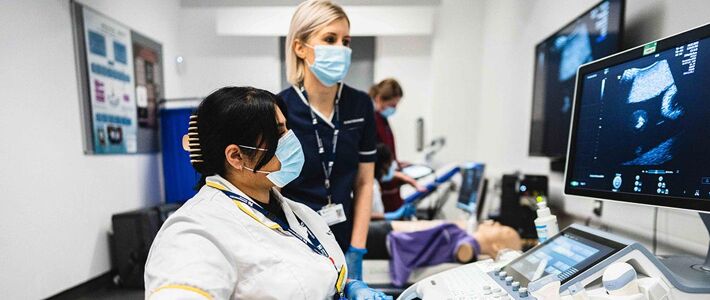
- Having recently been awarded Imaging Academy Hub status, you will be provided with the very best learning and teaching experience. We are at the forefront of radiography education, and you will have access to our state-of-the-art ultrasound simulation suite where you can be supported with practical ‘hands-on’ skills development.
- You will benefit from a choice of a wide range of clinical modules including, obstetrics, early pregnancy, gynaecological, abdominal, vascular, and musculoskeletal ultrasound. We are also able to accommodate any niche clinical requirements you or your department may have.
- You will learn from practicing sonographers in clinical placement and many of our course lecturers also work clinically, ensuring course content is current and relevant.
- We are a friendly and approachable team with an extensive skill set including research. We can guarantee that you will receive a high level of support in both your academic studies and clinical practise.
Open Days
Register your interest for an Open Day where you'll be able to learn about this course in detail, chat to students, explore our campus and tour accommodation.
Next Event: 26 June 2027
Course in Depth
Level 7
The Postgraduate Medical Ultrasound programme aims to advance your current professional role to that of a sonographer, where you should be continually seeking to improve your own diagnostic expertise and the patient experience. Your ability to understand and operate sophisticated ultrasound equipment is a major factor contributing to your diagnostic expertise and a sound grasp of patient care, professional and management issues is essential for improving the patient’s experience.
In order to complete this course a student must successfully complete the core module relevant to the level of study.
Core Module for PG Cert (20 credits)
Fundamentals of Ultrasound incorporates both physics and professional issues in sonography. The physics focuses on your ability to understand and operate sophisticated ultrasound equipment. The professional issues focuses on medico legal, ergonomic, latest protocol and guidelines, safeguarding and duty of candour. To improve and maintain professional standards around sonographic practice and patient care.
Core Modules for PG Dip (40 credits)
This module develops your understanding of both qualitative and quantitative research methodologies and their associated tests. This gives you the support and skills to develop your own research and progress to MSc and potential publication.
Fundamentals of Ultrasound incorporates both physics and professional issues in sonography. The physics focuses on your ability to understand and operate sophisticated ultrasound equipment. The professional issues focuses on medico legal, ergonomic, latest protocol and guidelines, safeguarding and duty of candour. To improve and maintain professional standards around sonographic practice and patient care.
MSc Option 1 (60 credits)
Core modules for the award of MSc (60 credits): On successful completion of the PgCert and PgDip, to progress to MSc, a student must successfully complete either study Option 1 or Option 2 below:
This module explicitly addresses your personal and/or professional development with a view to enhancing competence for service improvement in a rapidly changing health and healthcare environment. Through a flexible provision, we aim to inspire you to reflect critically upon their individual learning needs as well as their organisations’ practices, to appraise and apply concepts from the literature on leadership, to issues of relevance for their role, organisation and overall programme of study.
This double module provides you with the opportunity to complete a piece of work around a chosen topic in order to demonstrate competence in the planning, execution, analysis and evaluation of a Research Project, a Systematic Review or Project Management. It involves 400 hours of study. The focus is on facilitating your independent, critical study in their academic discipline or area of professional practice. It will also serve those who wish to embark on Doctoral studies in the future.
MSc Option 2 (60 credits)
This triple module forms the final bridge between the award of a Postgraduate Diploma and a Health MSc related to a named award. It provides you with the opportunity to complete a piece of work around a chosen topic in order to demonstrate competence in the planning, execution, analysis and evaluation of a Research Project, a Systematic Review or Project Management. It involves 600 hours of study. The focus is on facilitating your independent, critical study in their academic discipline or area of professional practice. It will also serve those who wish to embark on Doctoral studies in the future.
Optional Modules
Optional modules to be studied alongside the core modules:
- For the award of PgCert you need to complete 60 credits, of which a minimum of 40 credits must be clinically based.
- For the award of PgDip you need to complete 120 credits, of which a minimum of 60 credits must be clinically based.
- For the award of MSc you need to complete 180 credits, of which a minimum of 60 credits must be clinically based.
Remaining credits can be made up of the optional modules below.
The module teaches you the necessary skills to undertake an obstetric ultrasound examination and the concepts of report writing. The academic teaching provides you with a thorough knowledge of normal and abnormal fetal appearances in the first, second and third trimesters and early pregnancy. The module will involve learning both transabdominal and transvaginal scanning techniques and developing the skills required in breaking difficult news.
The module teaches you the necessary skills to undertake an abdominal ultrasound examination and the concepts of report writing. The academic teaching provides you with a thorough knowledge of normal and abnormal appearances within the abdomen including the liver, pancreas, gallbladder, biliary tree, spleen, appendix, and urinary tract. The module will also include an understanding of blood biochemistry and an introduction to incidental pathologies within the female pelvis.
The module teaches you the necessary skills to undertake a vascular ultrasound examination and the concepts of report writing. The academic teaching provides you with the theory and clinical applications of vascular ultrasound including deep vein thrombosis (DVTs) in the upper and lower limbs, carotids, arterial upper and lower limb, vascular access and vascular complications (AVFs and pseudoaneurysms). This module also includes a detailed understanding of haemodynamics and its application in diagnosing vascular pathology.
The module teaches you the necessary skills to undertake musculoskeletal ultrasound examinations and the concepts of report writing. The academic teaching provides you with the knowledge to recognise multiple musculoskeletal pathologies within the upper and lower limbs along with being proficient in scanning soft tissue masses and hernias. The module also involves understanding appropriate management and referral pathways for musculoskeletal patients.
The module teaches you the necessary skills to undertake gynaecological ultrasound examinations and the concepts of report writing. The academic teaching provides you with a thorough knowledge of normal and abnormal appearances within the pelvis including the uterus, ovaries, and adnexae. The module will also include the role of ultrasound in infertility and postmenopausal bleeding (PMB).
The module teaches you the necessary skills to undertake early pregnancy ultrasound examinations and the concepts of report writing. The academic teaching provides normal and abnormal appearances seen within early pregnancy and an overview of the pelvic anatomy. The module will involve learning both transabdominal and transvaginal scanning techniques and developing the skills required in breaking difficult news.
This module gives you the opportunity to study a self-identified specialised area of ultrasound more pertinent to your department’s service delivery requirements, for example testicular ultrasound. Through negotiation with academic and clinical staff, a framework for the theoretical and clinical skills required is identified for you to develop competence in the selected specialist area of ultrasound.
This module gives you the opportunity to study a self-identified specialised area of ultrasound more pertinent to your department’s service delivery requirements, for example testicular ultrasound. Through negotiation with academic and clinical staff, a framework for the theoretical and clinical skills required is identified for you to develop competence in the selected specialist area of ultrasound.
This module will framework the theoretical elements of fetal medicine. It is designed for qualified sonographers or midwives with an interest in developing an understanding of fetal medicine that will complement their obstetric practice.
Download course specification
Download nowHow will I be taught?
We place a real emphasis on student-centred learning, so the majority of study is by seminar and discussion groups where you and your fellow students will learn a great deal by sharing experiences. There will be a substantial amount of material that will be self-led either in preparation for lectures or case study workshops. There are also post session study tasks which will are designed to consolidate classroom based learning. You will also have access to Ultrasound scanning simulators and two high end ultrasound systems.
Medical Ultrasound Pathways Assessment
You will be assessed via:
- Viva Voce examination
- Written exam
- Written assignment
- Clinical assessment
- 10,000 or 15,000 word dissertation
To complete a clinical modules you are to keep a portfolio of evidence, recording your clinical examination and hours of clinical practice.

Consortium for the Accreditation of Sonographic Education (CASE)
The PG Cert / PG Dip / MSc Medical Ultrasound and Obstetric Ultrasound (Focused Courses) are accredited by the Consortium for the Accreditation of Sonographic Education (CASE).
Entry Requirements
Essential requirements
Applicants will normally be expected to have a 2:2 honours degree, or an equivalent professional qualification, and have had a minimum of two years experience as a qualified practitioner.
The majority of applicants will be radiographers, midwives, doctors and nurses. However we will consider applicants with health based or science degrees providing that they are able to obtain a clinical placement.
You must ensure that you have a satisfactory clinical placement where you can obtain a minimum of 320 hours of supervised ‘hands on’ clinical ultrasound experience - this is equivalent to 2 days per week over a nine month period.
If you have a qualification that is not listed, please contact us.
Fees & How to Apply
UK students
Annual and modular tuition fees shown are applicable to the first year of study. The University reserves the right to increase fees for subsequent years of study in line with increases in inflation (capped at 5%) or to reflect changes in Government funding policies or changes agreed by Parliament. View fees for continuing students.
Award: Module
Starting: Sep 2027
- Mode
- Duration
- Fees
- Part Time
- TBC
- £1,090 per 20 credit module
Award: MSc
Starting: Sep 2027
- Mode
- Duration
- Fees
- Part Time
- 3 years
- £1,090 per 20 credit module
Award: PgCert
Starting: Sep 2027
- Mode
- Duration
- Fees
- Part Time
- 1 year
- £1,090 per 20 credit module
Award: PgDip
Starting: Sep 2027
- Mode
- Duration
- Fees
- Part Time
- 2 years
- £1,090 per 20 credit module
International students
Sorry, this course is not available to International students.


Personal statement
You’ll need to submit a personal statement as part of your application for this course. This will need to highlight your passion for postgraduate study – and your chosen course – as well as your personal skills and experience, academic success, and any other factors that will support your application for further study.
If you are applying for a stand alone module, please include the title of the module you want to study in your Personal Statement.
Not sure what to include? We’re here to help – take a look at our top tips for writing personal statements and download our free postgraduate personal statement guide for further advice and examples from real students.
Employability
Employment opportunities
Health care professionals with a Medical Ultrasound degree are in great demand to work as sonographers and you will also be able to extend the scope of your current practice by incorporating expertise in sonography.
There is a severe shortage of sonographers. Sonography is an expanding field, with a steady increase in examinations requested year by year therefore you should have no difficulty in finding work as a qualified sonographer.
You would be able to work as a sonographer in a range of clinical specialities such as general abdominal, obstetrics, gynaecology and vascular studies, plus other clinical settings such as hospitals, health clinics and GP surgeries.
Placements
Students must have a suitable clinical placement to apply for the PGCert or PGDip in Medical Ultrasound at BCU. This is a compulsory requirement for the clinical modules. BCU does not arrange clinical placements and is unable to help applicants source one. Applicants must secure a placement with a trust or placement site prior to applying.
Facilities & Staff

Health Professions facilities
Take a look around the facilities available to you as a Health Professions student at BCU.
Our staff
Gemma Smith
Course Lead and Senior Lecturer Medical Ultrasound
Gemma previously worked as a Radiographer and Sonographer at Sandwell and West Birmingham NHS Trust before joining the BCU lecturing team. She took on the role of Course Leader in 2021. Gemma specialises in the teaching of Obstetric, Gynaecological, and Abdominal Ultrasound. She is passionate about supporting and encouraging students, helping them...
More about GemmaJames Michael
Co-course Lead and Senior Lecturer in Medical Ultrasound
James has previously worked as a Radiographer and Sonographer at University Hospital Birmingham NHS trust for 15 years before joining the BCU lecturing team. He is Co-Course lead of the MSc Medical Ultrasound Course. James teaches on both the BSc Medical Ultrasound and MSc Medical Ultrasound courses, along with radiology registrar...
More about JamesAnushka Sumra
Focus Course Lead and Senior Lecturer - Ultrasound
Since studying for her post graduate degree in medical ultrasound in 2009 here at BCU, Anushka has spent the majority of her clinical ultrasound career within a dedicated Womens teaching hospital. Anushka's areas of expertise include obstetrics, gynaecology and paediatric ultrasound. Anushka is fortunate to have an in-depth...
More about Anushka