
Architecture with a Foundation Year - BArch (Hons) *
Currently viewing course to start in 2027/28 Entry.
First founded in 1908, as the Birmingham School of Architecture, education in architecture, currently located in the Department of Architecture and Built Environment, has been at the heart of the profession in the city and across the region for over 100 years....
- Level Foundation
- Study mode Full Time
- Award BArch (Hons)
- Start date September 2027
- Fees View course fees
- Subject
- Location City Centre
This course is:
Open to International Students
Overview
First founded in 1908, as the Birmingham School of Architecture, education in architecture, currently located in the Department of Architecture and Built Environment, has been at the heart of the profession in the city and across the region for over 100 years. This synergistic and interdisciplinary link between architectural education, industry, and the city’s wider history of making, continues to be part of the ethos of the course – building professionals that are adapted to the unique challenges of contemporary practice, and of the city we are rooted in.
The BArch (Hons) RIBA Part 1 course reframes architectural education as a tool for equity, civic responsibility, and cultural transformation. The course aims to equip our students with the skills to be creative, ethical, and entrepreneurial – capable of rising to 21st century challenges. We encourage our incredibly diverse student body to bring their lived experiences into studio generating design responses that reflect their own backgrounds. We empower students to radically respond to the urgent issues facing our city and the world, from climate crisis, to urbanisation, and the changing landscape of our cities. We seek not only to diversify the profession but to change what architecture is and does in our own communities.
What's covered in this course?
The programme is scaffolded over three years to help students grow and build confidence, specialist knowledge, professional literacy, and critical agency, to go out into the world as change makers. Each year includes design studio, professional studies, history/theory, and technology/environment modules that are taught as holistic interrelated topics. Here students have an opportunity to come out with their own unique set of skills, style, and approach as they develop and take ownership over their own design process and agendas.
Through a mixture of industry activities, live clients, real world scenarios, and engaging with our professional networks in Birmingham and beyond, students can be sure they have the skills they need for a professional practice that is rapidly changing.
We have a long tradition of fostering entrepreneurship, with multiple award-winning practices having been founded by our entrepreneurial graduates. With many of our visiting lecturers coming from architectural practices with active experience working on projects that are helping to define our growing city and region, and with major projects and development on our doorstep, there are lots of great opportunities for our students and graduates to learn from and participate in the design that will radically change the way the entire region functions. Through engaging with live clients and projects, local site visits, guest lectures, and engaging with local visiting critics you will be offered ample opportunities to be a part of the future of Birmingham and beyond.
Accredited By
This course is accredited by:


The whole three years here have been amazing. I was glad that I have chosen this university and become part of the family. I found who I am as a designer and what the principles of the way I speak architecture are.
Marina Georgieva
Why Choose Us?
- Validated by the RIBA and prescribed by the Architects Registration Board (ARB), our course meets and exceeds the joint criteria set out by both professional bodies, thus meeting the requirements of Article 46 of the European Directive on the recognition of professional qualifications.
- You will be exposed to architectural practice and live projects with professional partners, enabling you to develop your skills and creativity. Our connections with over 60 architecture firms and practitioners forms an essential part of our teaching team, as well as enabling you to embark on valuable work placements within the West Midlands, North West, London and abroad.
- Our intimate study environment ensures exceptional support from staff, with 90 per cent of our graduates going on to work or further study within six months of completing the course. You’ll also have the chance to attend study trips and explore international opportunities, expanding your cultural and academic knowledge.
- The part-time course is taught one day a week to enable you to study alongside a full-time job in practice.
- Birmingham City University is highly respected for its Architecture provision, having delivered the subject since 1909.
- Two-thirds of the impact of our research was judged to be very considerable (3*) or outstanding (4*) - REF2021
Open Day
Join us for our next Open Day where you'll be able to learn about this course in detail, chat to students, explore our campus and tour accommodation.
Next Open Day: 21 November
Course in Depth
Foundation year
In order to complete this course you must successfully complete all the following CORE modules (totalling 120 credits):
Please note: The Foundation Year course is currently being rewritten, so module details in the Foundation Year may change. Content in First, Second and Final Year is not affected.
This module focuses on developing the 2D design skills and techniques required to communicate and visualise design concepts around space and form. You will work on a series of mini projects using predominantly manual techniques such as freehand sketching, technical drawing, and physical model-making. You will also be introduced to some digital techniques such as Photoshop and Desktop Publishing via InDesign.
This module is designed to encourage you to make connections between theory and practice and engage further in critical analysis. You will explore the historical aspects across the two design disciplines (a major and minor) and scales and current practices.
You will further explore the use of precedent studies, which will provide you with the tools to respond to the challenges and changes in different environments and habitations.
This module is designed to give you an introduction to the design processes used by the various disciplines and includes appraisal of design briefs, understanding context, design drivers, and the development of concepts and visuals through design feasibility studies. You will begin to understand how to turn your ideas into designs and the level required to reach a professional standard.
Underpinning the practice, you will explore and discuss fundamental concepts, particularly relating to human scale, ergonomics and anthropometrics, looking at design and its relationship to the physical aspects of the environment.
The aim of this module is to develop a concept design within your chosen discipline. You will document the design process, reflect on the experience and the final outcomes and the reasons for selecting your chosen field. The project will culminate in a comprehensive presentation, which will capture the whole design process via a design portfolio.
This module focuses on developing presentation skills, from visual and graphic presentation techniques to pitching and presenting ideas.
You will have opportunities through workshops and online tutorials to learn Adobe Creative Suite and 3D software such as Sketch-up.
Hands on workshop practice will be introduced across a range of materials.
This module is designed to develop your academic skills and make the transition to degree level study. It specifically focuses on your ability to critique, reflect and verbalise your thoughts and concepts through channels such as presentations, blogs and live journals.
You will learn how to use research methods to inform your practice and have the opportunity to advance your academic writing and referencing skills.
Year one
In order to complete this course you must successfully complete all the following CORE modules (totalling 120 credits):
Design Communication 30 credits
Architectural Histories in Context 30 credits
Design Fundamentals 30 credits
Architectural Technologies in Context 30 credits
Year two
In order to complete this course you must successfully complete all the following CORE modules (totalling 120 credits):
Adaptive Reuse 30 credits
Creative Ethics and Collaboration 30 credits
Design Negotiation 30 credits
Theories of the Built Environment in Context 30 credits
Year three
In order to complete this course a student must successfully complete all the following CORE modules (totalling 120 credits):
Radical Proposals 30 credits
Creative and Critical Practice 30 credits
Resilient Futures 60 credits
Download course specification
Download nowThe aim of Level 4 is first and foremost to start off by building a sense of studio culture while introducing you to the core representational, theoretical, and technical skills to develop a design response. To aid in your transition to higher education, professional skills around time management, reflective working practices, and developing autonomy in working between session are central to all modules.
In Level 5 you will begin to critically engage with your future role as a potential practitioner. Learning is focussed on you building on core skills from Level 4, applying them to your own research and design process, and beginning to develop your own unique style and approach to design. With emphasis on reflecting on your own ethical and creative practice, in relationship to industry frameworks, you will begin to prepare yourselves for the landscape of the profession. Modules in this year rely heavily on collaboration, whether group work with colleagues, engaging with live clients and communities, or in an approach to 2nd semester studio, which aims to approximate the structure of a practice.
At Level 6, design ambition meets technical and professional confidence. Allowing the chance to align yourself with a particular design approach or methodology, the unit structure prompts and enables you to generate and resolve designs. Across the Level 6 modules, you are asked to engage with broad social contexts, radical outlooks, technological complexity, and ambitious communication techniques to create a final portfolio that sets you apart from each other.
Further study
Students may choose to go straight onto the MArch (RIBA Part 2) to begin their journey to becoming a registered architect, or they can progress onto a range of postgraduate studies within the Department of Architecture and Built Environment.
The department offers a range of courses (including full time, part time, apprenticeships and placement year routes to study) that span almost the full spectrum of built environment and construction disciplines, accredited by a variety of professional, statutory and regulatory bodies.
Trips and visits
Most of your design projects will be located on live sites, meaning regular trips to various locations will become an integrated part of the design studio modules. Study trips at all three levels are often linked to design projects or inform research activities. These provide a very important part of your learning and understanding, building knowledge and skills for interpretation of sites and buildings - locally, nationally and beyond.
We offer optional regional and international study trips which give students an opportunity to explore architecture in different settings. In previous years the course has taken students to London, Manchester, Liverpool, Cambridge and Amsterdam.
Our course is accredited by the Royal Institute of British Architects, allowing you to achieve RIBA Part 1 exemption. This offers you distinct support when applying for placement in practice.

Royal Institute of British Architects
RIBA is a global member organisation, with 44,000 members. It champions better buildings, communities and the environment and provides the standards, training, support and recognition to put members at the peak of their profession.
Our accreditation shows employers that students graduating from our course have the levels of knowledge and skills they need.

Architects Registration Board
Architects Registration board was established by Parliament in 1997 to regulate the architects’ profession in the UK.
They are an independent, public interest body and their work in regulating architects ensures that good standards within the profession are consistently maintained for the benefit of the public and architects alike.
Entry Requirements
These entry requirements apply for entry in 2027/28.
All required qualifications/grades must have been achieved and evidenced at the earliest opportunity after accepting an offer to help confirm admission and allow for on-time enrolment. This can also include other requirements, like a fee status form and relevant documents. Applicants can track their application and outstanding information requests through their BCU mySRS account.
Essential requirements
88-64 UCAS Tariff points
The offer we make you takes into account your individual circumstances, predicted grades, achieved qualifications and potential to succeed at university.
If you have a qualification that is not listed, please contact us.
Fees & How to Apply
UK students
Annual and modular tuition fees shown are applicable to the first year of study. The University reserves the right to increase fees for subsequent years of study in line with increases in inflation (capped at 5%) or to reflect changes in Government funding policies or changes agreed by Parliament. View fees for continuing students.
Award: BArch (Hons)
Starting: Sep 2027
- Mode
- Duration
- Fees
- Full Time
- 4 years
- £10,050 in 2027/28
- Apply via UCAS
International students
Annual and modular tuition fees shown are applicable to the first year of study. The University reserves the right to increase fees for subsequent years of study in line with increases in inflation (capped at 5%) or to reflect changes in Government funding policies or changes agreed by Parliament. View fees for continuing students.
Award: BArch (Hons)
Starting: Sep 2027
- Mode
- Duration
- Fees
- Full Time
- 4 years
-
TBC


Guidance for UK students
UK students applying for most undergraduate degree courses in the UK will need to apply through UCAS.
The Universities and Colleges Admissions Service (UCAS) is a UK organisation responsible for managing applications to university and college.
Applying through UCAS
- Register with UCAS
- Login to UCAS and complete your details
- Select your course and write a personal statement
- Get a reference
- Pay your application fee and submit your application
You are not required to submit a portfolio for this course.
Employability
Enhancing your employability skills
The course gives you a full understanding of the role of an architect and the creative flair and technical skills needed to succeed.
You'll understand sustainability, technical and cultural issues and the challenges of expanding the urban environment.
You'll develop a comprehensive portfolio that shows employers a range of skills in design practice and academic study.
You'll develop a range of transferable skills, such as how to communicate ideas and solve problems, as well as developing negotiation and planning skills. And thanks to the unique nature of the course, you’ll learn how to work effectively and efficiently either on your own or as part of a team.
Facilities & Staff
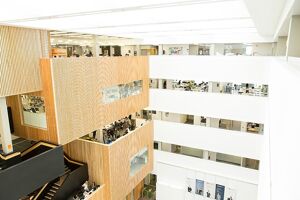
Architecture facilities
Take a look around some of the facilities, studios and workshops that you’ll have access to.
Our staff
Tom Tebby
Course Lead Foundation in Architecture and Design
Tom is the Course Lead for the Foundation in Architecture and Design. He has taught in the department for the last 10 years and brings a wide range of experience in different design disciplines including his own art and graphics practice.
More about TomMax Olof Karlsson Wisotsky
L4 Year Lead, Senior Lecturer in Architecture
Max Wisotsky is a Swedish-American designer, architectural historian and theorist from Los Angeles, California. He holds a BArch from California Polytechnic State University, San Luis Obispo, and an MA in Architectural History from the Bartlett School of Architecture, UCL.
More about Max OlofDr Yazid Khemri
Senior Lecturer in Architecture and Design - Academic Lead for Global Partnerships
Dr Yazid Khemri has been involved in the practice, research and teaching of Architecture for over a decade, and currently leads the third year (Level 6) of the BA (Hons) Architecture programme. Yazid was awarded a PhD in Architecture by the University of Portsmouth, where he also taught across Design Studio, Technology and History and Theory. He...
More about YazidDr. Jieling Xiao
Reader in Architecture and Sensory Environments | Research Degree Coordinator
Jieling teaches Environmental Design across different architecture courses. Trained as an architect and urban designer, Jieling believes that designers need to consider more than just how the hardware of architecture functions for its users. Interested in creative spatial practice related to people’s sensory experiences, she has developed her...
More about JielingDr Hocine Bougdah
Senior Lecturer in Architecture
Dr Hocine Bougdah is a senior lecturer in sustainability and Technical Studies. Before joining BCU in June 2022, he was a senior research and teaching fellow in the school of Architecture and Cities at the University of Westminster, London. His extensive career includes various academic positions involving teaching technical studies and...
More about Hocine