Research News Last updated 17 March
Used by billions of readers around the world, John Baskerville’s iconic typeface helped shape how we read today. Now, two years into a major research project, scholars are uncovering how the pioneering Birmingham printer created it.
Researchers recently gathered at the Library of Birmingham to mark a key milestone for the Small Performances project, a collaboration between Birmingham City University (BCU), the University of Cambridge, and Cambridge University Library.
Launched in March 2024 with funding from the Arts and Humanities Research Council (AHRC), the three-year project is investigating Baskerville’s innovations, the craft behind 18th-century printing, and the lasting influence of his work today.
The event on 4 March featured talks from the project’s interdisciplinary research team.
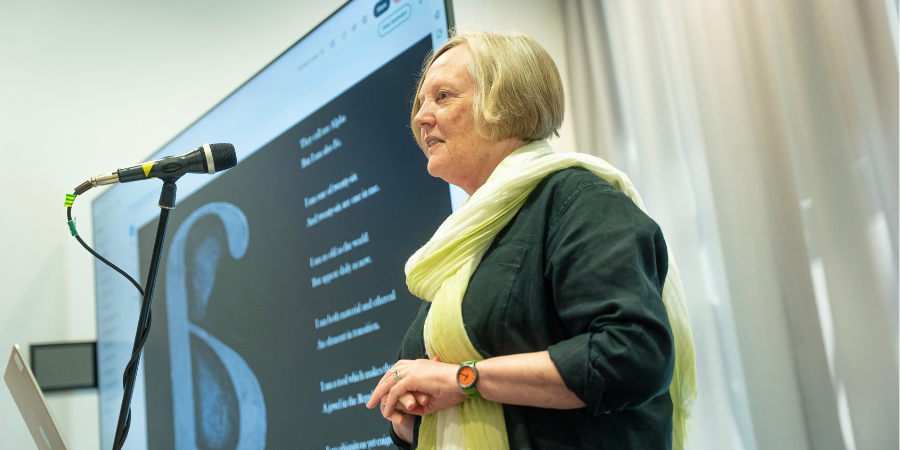
Dr Caroline Archer (pictured), co-lead of Small Performances, Professor of Typography at Birmingham City University and Chair of the Baskerville Society, charted the remarkable journey of a single metal “punch” used to create a letterform.
Her poem, ‘They call me Alpha’ traced the object’s story from its creation in Birmingham to its links with the French Revolution, its rediscovery in 1917, its return to Britain in the 1950s, and its continuing influence today.
“The project is providing an exciting opportunity to investigate and rethink the Baskerville punches,” said Professor Archer.
“By tracing how these objects travelled across 300 years, we’re uncovering not just how they were made, but the wider stories of people, cultures and societies connected to them.”
Over the past two years, the research team, which includes printing historians, archaeologists, heritage scientists, jewellers, engravers and type designers, has been examining the original punches used to create Baskerville’s type.
Using advanced imaging and scientific analysis, they have been able to study microscopic tool marks left by 18th-century craftspeople, offering a rare glimpse into printing techniques that have largely disappeared.
At the heart of the project is a collection of Baskerville punches now held at Cambridge University Library.
Researchers have already catalogued more than 3,000 of these tiny steel tools, with hundreds digitised and made freely available online.
Professor Marcos Martinón-Torres, Pitt-Rivers Professor of Archaeological Science at the University of Cambridge and co-lead of the project, said: “These small objects are helping us ask big questions about craft, technology and innovation.
“By studying them closely, we’re learning from the past in ways that can inspire the future.”
With one year of the project still to run, the team is planning a final phase of work that will bring their discoveries to wider audiences through workshops, public events and hands-on craft activities.