University News Last updated 30 January
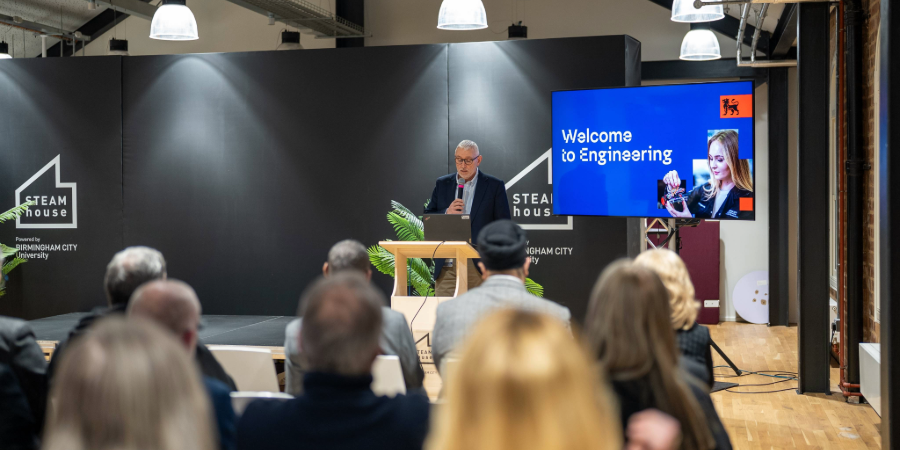
BCU is set to transform the way it teaches student engineers as part of efforts to tackle an industry-wide skills deficit.
Across the UK, 63% of engineering employers say graduates aren’t ready for industry (2023 ITE skills survey), pointing to a disconnect between academic learning and the practical skills required.
To combat this, from September 2026 students on BCU’s engineering courses will experience a radically new approach to how they gain the skills, expertise and knowledge needed for their future careers.
Launched at a ‘Reimagining Engineering’ event at BCU’s STEAMhouse building on Thursday 29 January, the university set-out plans to end the use of traditional lectures and exams and align closely with employers at every stage of their studies.
Students will be taught one module at a time, delivered across six weeks, with each set to be delivered in collaboration with industry, responding to real world challenges.
Organisations partnering with the University’s Engineering courses include Power Panels, Aurrigo, Centaur Robotics, Canals and Rivers Trust, Sertec and more.
The plans include no exams or traditional lectures for student engineers, and assessments becoming competency based and practical. Courses will also launch more flexible entry requirements to support STEM learners, with additional resources, including staff, being made available to facilitate this.
With £6.5 million worth of investment, BCU is also transforming spaces and investing in resources and facilities to support this new initiative. This includes introducing industry grade technology such as a material testing-split zone furnace and giving students access to the largest cyber physical manufacturing rigs in Europe through a partnership with GBSIoT.
The transformation of how students are taught within Engineering courses is closely aligned to the University’s new Education Strategy.
Launched earlier this month, the Strategy states BCU’s key priorities that will ensure that students are set up to succeed, including delivering practice-based courses that meet the skills required of the future workplace, and becoming a nationally recognised institution for STEAM attributes.
Building the next generation of engineers using the most innovative technologies, and listening and working alongside key industry figures, plays a vital role in establishing BCU as an anchor institution in Birmingham, supporting the University’s Strategy 2030 vision.
Birmingham City University’s Vice-Chancellor Professor David Mba commented: “I’m incredibly proud that we are developing the talent for tomorrow here at BCU. Thanks to initiatives like Reimagining Engineering, the possibilities are truly endless for our students, and this new approach to teaching could become the norm across the wider university.
“At the end of their time at BCU, our student engineers will be ready to tackle real world challenges, and they will be able to enter their careers with the confidence, skills and experience needed to succeed in the future.”
Rowan Crozier MBE, CEO of precision metal stamping specialists C Brandauer & Co Ltd, believed the initiative demonstrated BCU’s leadership in higher education innovation.
“As a long-standing industry partner to Birmingham City University, and Chair of the Industry Advisory Board for Engineering and the Built Environment, I am both proud of and inspired by the Reimagining Engineering initiative,” he said. “It reinforces BCU’s position as a visionary higher education provider, while delivering world-class technical graduates to industry.
“With employability at its core, these courses promise a flexible, industry-led approach to developing the next generation of engineers, offering a much-needed boost to social mobility and regional talent.”
Sukhi Clark, Head of Accessible Vehicles for Motability Operations Ltd, said BCU had developed “a modern engineering course built around the needs of students and industry”.
A visiting professor at the University, she added that it was crucial that “skills, employability and real-world learning” were to the fore in order to “create career-ready graduates”.
Steve Jones, Connected Curriculum Lead at Siemens, added that Reimagining Engineering will help BCU “better prepare their learners for the industry of tomorrow”.