University News Last updated 19 January
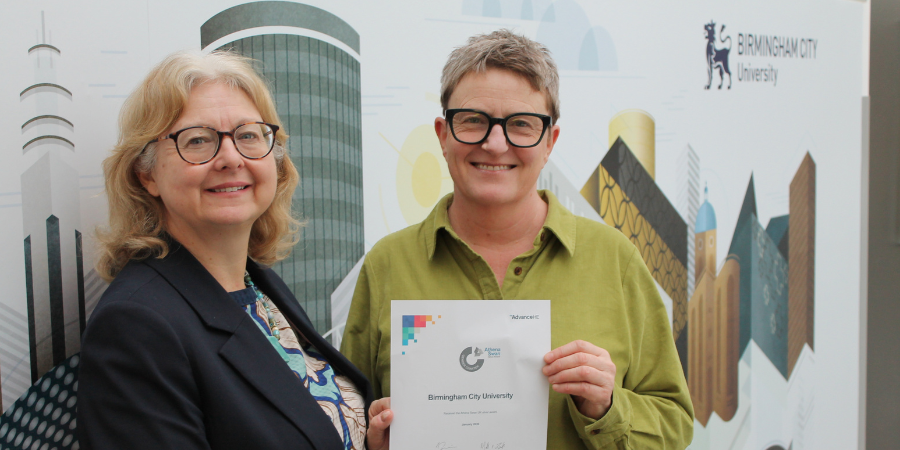
Birmingham City University (BCU) has been awarded the Athena Swan Institutional Silver Award by Advance HE, marking a significant milestone in the University’s ongoing commitment to advancing gender equality across higher education.
The Athena Swan Charter is the flagship framework for promoting gender equality in the UK and internationally, recognising excellence in higher education and research institutions.
Achieving a Silver Award demonstrates that BCU has not only identified key challenges relating to gender equality but has made measurable progress in addressing them and has a robust, evidence-based five-year action plan in place to drive further change.
This places BCU in an elite group of institutions. Fewer than 40% of UK higher education institutions currently hold an Athena Swan Silver Award. That figure falls to less than 23% for modern universities – underscoring the scale and significance of BCU’s achievement.
Project Manager Dr Kate Carruthers Thomas oversees Athena Swan activity at BCU.
Professor Maxine Lintern, Senior Lead for Athena Swan and Co-Chair of the Steering Committee, said the award reflects a truly collective effort across the institution.
“I am incredibly proud of the work undertaken by colleagues right across BCU,” she said.
“From the Women’s Professors Group delivering inspiring Women’s Words Lectures, to a strengthened female academic career pipeline through progression and conferment opportunities, and the development of reliable Equality, Diversity and Inclusion (EDI) data dashboards underpinning meaningful local action, this has been a genuine team effort.
“These initiatives have already contributed to a further five successful Bronze Departmental Awards, while the Institutional Silver Award reflects our shared ambition to enable equitable opportunities and achievements for women.”
The assessment panel highlighted substantial progress across three key priority areas. In particular, they praised the rise in the proportion of female professors at BCU to 40%, significantly exceeding the national benchmark of 31%.
The panel also commended improvements in the accuracy, availability and use of equality data at both institutional and departmental levels, enabling more targeted and effective action.
Innovative support for female academics was another standout feature of BCU’s submission. The University’s fully-funded residential writing retreats for women were singled out as an example of sector-leading practice, with BCU invited to contribute a case study to the Athena Swan Good Practice Database.
“This Athena Swan Institutional Silver Award is a powerful recognition of Birmingham City University’s values and our determination to turn commitment into measurable progress,” said Vice-Chancellor Professor David Mba.
“Advancing gender equality is fundamental to academic excellence, innovation, and social impact, so I am very proud of the leadership and collaboration that have brought us to this point.
“We will build on this momentum to ensure BCU continues to be a place where talent is recognised, supported, and able to thrive at every level.”
The Institutional Silver Award builds strong momentum across the University.
It follows the Royal Birmingham Conservatoire’s Athena Swan Bronze Award in July 2025 and comes ahead of BCU’s first Departmental Silver Award submissions in Nursing and Midwifery, and Psychology and Counselling, due in March 2026.
In addition, Library and Learning Resources has embarked on the University’s first Athena Swan Professional Services Award application. If successful, this would be the first Athena Swan award granted to a university library service in the UK.
BCU’s Silver Action Plan will focus on supporting early and mid-career academics, continuing to grow and diversify the female professoriate, using enhanced data to address intersectionality, expanding departmental awards within the new academic and professional services structure, and embedding sustainable infrastructure to support long-term cultural change.
Pictured: Professor Maxine Lintern and Dr Kate Carruthers Thomas (Credit: BCU)