
Filmmaking with a Foundation Year - BA (Hons)
Currently viewing course to start in 2026/27 Entry. Switch to 2027/28 Entry
September 2026 — UCAS code P31G
Are you passionate about creating high-production films? Our BA (Hons) Filmmaking with a Foundation Year will develop your technical skills and knowledge to pursue your dream career. On this course, you’ll start by exploring fundamental core skills such as media production, academic writing, researching and collaborative practice using state-of-the-art facilities and studios, which will prepare you to start the first year of the BA (Hons) degree.
Clearing
Hotline now open
Call 0121 331 6777
The Clearing Hotline is now open Mon-Fri 9am-5pm, Sat 9am-4pm & Sun 10am-2pm
- Level Foundation
- Study mode Full Time
- Award BA (Hons)
- Start date September 2026
- Fees View course fees
- Subject
- Location City Centre
This course is:
Open to International Students
Overview
Clearing 2026
Clearing
48 points required
(or equivalent) is the minimum you wil need to be considered for this course in Clearing.
Use the UCAS tariff calculator to work out your points.
Hotline now open
Call 0121 331 6777
The Clearing Hotline is now open from 7.30am, Thursday 13 August
The Foundation Year course option enables you to study for our BA (Hons) degree over an extended full-time duration of four years by including a Foundation Year (year one of four). The Foundation Year provides a broad study programme that underpins the follow-on degree. To progress to the next year of your degree, it is necessary to achieve a pass in all the Foundation Year modules.
Our practice-based, industry-focused BA (Hons) Filmmaking course enables you to develop creative and technical skills across a broad spectrum of filmmaking practices. You will be taught by experienced practitioners and scholars who support experimentation, craft development, and professional practice within the rapidly evolving world of the moving image.
What makes our course distinctive is the focus on the language of cinema. You will learn how professional filmmakers combine image, sound, editing, performance, storytelling, and collaboration to shape emotion, meaning and audience experience. Through hands-on practice, you will explore how every creative choice, from performance and camera to sound design and structure, helps to bring a story to life. Working in our purpose-built studios, sound stages, and on location, you will build practical skills, grow your confidence, and learn how to contribute effectively as part of a filmmaking team.
We encourage you to explore different forms of film production, including narrative film, documentary and more personal approaches to cinema. Through practical projects and critical reflection, you will develop as both an artist and a filmmaker, building your creative voice alongside the practical skills, confidence, and experience needed for a successful career in the screen industries.
What's covered in this course?
This course gives you the chance to explore a wide range of filmmaking styles, techniques, and creative approaches, from classic storytelling to the ever-evolving norms of today’s fast changing screen industries. You will learn how filmmakers bring stories to life through image, sound, editing, performance, and collaboration, building both your creative understanding and practical skillset.
Alongside making your own work, you will study key film traditions, from early Hollywood cinema to contemporary international filmmaking, and discover how different genres, cultures and voices have shaped the language of film. You will also build valuable industry knowledge through engagement with guest speakers, film festivals, entrepreneurship, and the active expansion of your own professional network.
Why Choose Us?
- The course combines practice, theory and industry approaches to filmmaking, alongside training in film festival programming techniques.
- You will be taught by noted film professors, cinema scholars and established screenwriters. Staff on the programme work together to ensure that you receive a balanced understanding of theory, practice and industry skilling relevant to the field.
- You will be taught at the city centre campus, home to an impressive range of media resources, studios and edit suites.
- You’ll have the opportunity to enhance your industry awareness by getting involved with our Curzon Street Studios team in a wide range of production and film projects, including working on gigs and commercials for professional football clubs and high-profile industry giants such as Sony, Disney and Microsoft.
- You will also have the opportunity to work on film projects completed for the Cine-Excess festival. One recent production completed by BCU students and staff was the award-winning documentary Tax Shelter Terrors (2017).
- You will have access to film collections that will enrich your course of studies. These include the Cult Film Archive, a collection of 4,000+ resources (including films, screenplays and promotional materials) that have been donated directly from leading filmmakers and distribution companies in the field.
Clearing Open Days
Join us for an Open Day where you'll be able to learn about this course in detail, chat to students, explore our campus and tour accommodation.
Next Open Days: 15, 17 and 18 August
Course in Depth
Foundation year
In order to complete this course you must successfully complete all the following CORE modules (totalling 120 credits):
This module will introduce you to the underlying principles required to understand media audiences. Audiences are diverse in their make-up and in their motivations for engaging with media. To explore this diversity you will learn a range of techniques for researching audience behaviour, such as survey work, focus groups and online ethnography. Alongside these methods you will explore key concepts to help you to interpret and understand this research data. You will engage with theories of identification and culture in order to understand audience motivations for engaging with media. You will explore the characteristics of audiences and learn how to identify their needs from a production perspective.
To complement this investigation, you will also examine other related concepts such as genres and understand how the wider media industry uses the category of audience to create, market and ultimately sell its products. You will learn how to use your research data to present an idea for a media product that will appeal to a particular media audience.
The purpose of this module is to assist you in developing the academic skills needed to succeed in higher education, and the professional skills required to support your ambitions to be a media worker. You will be introduced to the wide range of academic and practical support that the university offers.
Students will plan and produce a media artifact that will evidence their competence in media production to create a meaningful media artifact. The focus in this module is about understanding how image and sound is edited together to create meaningful narratives. In the module students will develop an idea and implement it as a short audio or video piece. Central to creating this piece is learning how to use relevant portable video and sound production equipment and software. The ability to effectively record and edit a variety of media formats using industry standard equipment software is a key skill to develop whilst at university. This module will introduce students to the practical basics of editing.
This module is focused on collaborative work in a media production context. Through a group production activity students will learn about media production hierarchies and how to behave within a team context in order to produce a successful outcome. The module will explore what makes for successful teamwork in the media. The module will further develop the understanding of media production practice.
Identifying and understanding the connections between media theory, culture, and production is an essential skill for students to develop. Understanding how these concepts and practises interlink is key to succeeding at university and working as effective media workers. This module will introduce basic research practise methods and media theory and will enable students to gain insights into the role these concepts play in underpinning media production and culture. The module offers an opportunity for you to explore theoretical concepts in your own practice.
The media project module will present students with the opportunity to consolidate their learning whilst on the Foundation Media course. Students will be invited to devise, plan, and deliver a practical piece of work focused on their area of media interest. Students will draw from their experience and knowledge gained from their engagement with the course and creativity that evidences their ability to produce effective media artifacts.
Year one
In order to complete this course you must successfully complete all the following CORE modules (totalling 120 credits):
This module introduces you to Hollywood film through its early, classical and post-classical traditions. The module is structured around the examination of these three stages of development, with a range of debates that also allow you to evaluate American cinema through its stylistic, generic, industrial and historical features.
Looking at forms in films, students will learn how visual languages are being used and how to compose shots that are translatable to other mediums such as animation. You will learn to storyboard and create effective animatics and to succinctly convey ideas and vision to produce short a film(s) as a group and individually. Expect to pitch your ideas individually and as a team.
This module introduces students to the core principles and workflows of post-production for screen media. It provides a structured and accessible foundation in file management, picture editing, basic sound work, and export procedures, supporting students as they transition into more independent filmmaking and media practice.
The module emphasises post-production as both a technical and creative process, focusing on organisation, clarity, rhythm, and finish. Students are encouraged to develop good working habits from the outset, including disciplined project setup, attentive listening, and intentional editing decisions.
A key aspect to understanding filmmaking, is the actual process. This module will provide you with an introduction to conventional filmmaking techniques, such as lighting, camerawork and sound recording. This also includes an introduction to pre-production operations. This will be in the form of visual and sound acquisition techniques, as well as strategies to plan for this. You will be expected to operate a range of equipment, reflecting typical processes to do with narrative and documentary filmmaking. This foundation can be built upon to support future production endeavours.
In this module you will explore the development of the film and television documentary by critically investigating the medium through a range of lectures, readings and screenings, and applying this to produce your own short documentary. We will consider different genres of documentary, such as direct cinema, mockumentary, investigative, ethnographic, docu-soap, experimental, docu-drama, reconstruction and the music documentary, as well as some of the contemporary issues facing documentary film makers. We will engage with a variety of academic debates that relate to the documentary, which include realism, representation, ethics and ideology, and the social, political, economic and technological contexts in which documentary can be critically located.
Year two
In order to complete this course you must successfully complete all the following CORE modules (totalling 80 credits):
This module will examine the role film festivals play in garnering critical acclaim, enabling audience access and acting as a trade hub for film, playing a part in the financing, distribution and marketing of independent titles. The aim is to unpack the culture of film festivals from the lavish, major international affairs through to grassroots events. You will examine the drivers, objectives and investment that underpins them and their strategic importance for relationship building, launching and generating PR for film.
This module follows on from the year one module and helps move you further towards your professionalism. Whereas introduced you to fundamental operations, this module introduces you to ways in which you can utilise filmmaking equipment to consider and enhance the aesthetics of production. Through the study of Light, Colour, Area, Depth, Time, Movement and Sound, you will be expected to consider these as a way to further enhance your production skills.
The module is an opportunity to learn and critically reflect on the skills of collaboration by enabling you to create an interdisciplinary project with students from complementary disciplines, or with academic staff. Collaboration is a vital employability skill within the Creative Industries and this module allows you to develop these skills, making use of University facilities and with the support of academic staff. Within this module framework, several kinds of collaborative opportunities are available. For example, with the approval of your supervisor, you can determine a project based on your own interests; your supervisor may set you a predetermined project to enable you to work with other students in a way that is appropriate to your subject area; or there may be opportunities for you to collaborate with staff on research projects. In all cases, you must apply your subject skills to an interdisciplinary project which will be agreed in advance with your supervisor.
In order to complete this course a student must successfully complete at least 40 credits from the following indicative list of OPTIONAL modules.
Options Block 1 Choice:
This module facilitates a transition from foundational filmmaking (Level 4) to a rigorous, in-depth engagement with the dual pillars of production sound and post-production design: a dynamic environment of integrated practice and research that encourages creative experimentation alongside the mastery of the 'aural half' of the cinematic experience.
This module follows on from Foundations of Filmmaking, but introduces you to the key elements of cinematography in greater detail. Whereas Foundations of Filmmaking introduced you to fundamental, wider aspect of production and associated operations, this builds upon these, yet purely focusses on the duties within the field of cinematography.
Options Block 2 Choice:
This module will provide students with an overview of the cultural relevancy of 1970s cinema. Initially exploring the context of the decade and the fragmented nature of film narratives at the time the module will discuss the emergence and demise of ‘American New Wave/New Hollywood’ but also explore further the style, substance and aesthetics of the varying sub-genres of the time as well as the cultural and creative impact they had on both cinematic presentation and other aspects of the media industry.
This module will teach you the essential skills of, and principles behind, the writing of short films. Although these principles apply primarily to screenwriting for film and television, this module will instead be concerned with the writing of short films. You will study a number of freely available short guides to screenplay layout and formatting and be trained in the practical application of screenplay formatting software. You will write three short scripts, given as fortnightly writing exercises, and receive detailed formative feedback on one of the scripts, which you can use to improve and develop your work for your final portfolio. You will focus on visual storytelling, layout conventions, and the issue of writing to scale (budget). You will also be encouraged to analyse, but also critique, dramatic construction in terms of character function, motivation and genre.
This module will teach the skills needed to take a screenplay through to principal photography via the process of pre-production. To be an effective filmmaker, knowing how to turn the words on a page into reality so that you can shoot requires an essential wide range of skills. Starting with a screenplay, the students will be taught to first build their vision through mood boards / look books, sizzle reels, reference clips, casting ideals, costume & art dept plans before evolving this newly formed vision into things such as scheduling, budgeting, legals & compliance, location scouting, casting and managing a team of creatives. In essence, from theory to practical reality.
Core modules are guaranteed to run. Optional modules will vary from year to year and the published list is indicative only.
Year three
In order to complete this course you must successfully complete all the following CORE modules (totalling 120 credits):
This Module focuses on the post production element of filmmaking. Specifically areas concerning editing techniques, colour correction and grading to aid narrative. Students will learn both the technical skills of audio and video editing as well as the grammar and structure that belong to the art in order to become better storytellers.
The module is an opportunity to learn and critically reflect on the skills of collaboration &/or your own professional practice. The module enables you to create either an interdisciplinary project with students from complementary disciplines or your own self-defined project.
The purpose of the module is to enable you to undertake a sustained, in-depth and theoretically informed research project exploring an area that is of personal interest to you. It is important that we can support you appropriately, so you will be guided towards choosing a research topic which is relevant to your discipline and in which your lecturers have expertise. The outcome may take the form of a written dissertation or a practice-based portfolio.
Core modules are guaranteed to run. Optional modules will vary from year to year and the published list is indicative only.
Download course specification
Download nowAs part of your Foundation Year you will be studying alongside Media, Journalism, Music Industries and PR students and you will be taught by staff from these disciplines.
Film as a subject requires skills from (and a critical awareness of) a wide range of media forms. By interacting with staff from different disciplines and working on projects across a wide variety of media, you will have the opportunity to develop a broader skillset going into your degree- ultimately making you a valuable team member for filmmaking and screenwriting projects, or a more informed film critic.
Classroom projects
During your studies there will be practice-based opportunities to engage with a regional film festival such as Cine-Excess, an annual international film festival and conference on global cult film cultures. You will also be able to access film collections such as the Cult Film Archive during the course of your studies.
Birmingham City University also has an established and inclusive research culture that promotes dialogue and collaboration between staff and students. The Birmingham Centre for Media and Cultural Research (BCMCR) here at BCU welcomes visiting researchers from across the world and holds regular research seminars which mix presentations from staff, PG students and speakers from a range of our collaborative partnerships. BCMCR welcomes all students to research seminars, which are free to attend.
Entry Requirements
Clearing
48 points required
(or equivalent) is the minimum you wil need to be considered for this course in Clearing.
Use the UCAS tariff calculator to work out your points.
Hotline now open
Call 0121 331 6777
The Clearing Hotline is now open from 7.30am, Thursday 13 August
Alternative options
If you do not have 48 points, you may like to look at our other available courses, or explore your options if you don't have enough points for any of our courses.
*Please note: the entry requirements listed below are relevant to main cycle applications and may not be applicable during Clearing.
Essential requirements
80 UCAS Tariff points. Learn more about UCAS Tariff points.
If you have a qualification that is not listed, please contact us.
Fees & How to Apply
UK students
Annual and modular tuition fees shown are applicable to the first year of study. The University reserves the right to increase fees for subsequent years of study in line with increases in inflation (capped at 5%) or to reflect changes in Government funding policies or changes agreed by Parliament. View fees for continuing students.
Award: BA (Hons)
Starting: Sep 2026
- Mode
- Duration
- Fees
- Full Time
- 4 years
- £9,790 in 2026/27
- Apply via Clearing
International students
Annual and modular tuition fees shown are applicable to the first year of study. The University reserves the right to increase fees for subsequent years of study in line with increases in inflation (capped at 5%) or to reflect changes in Government funding policies or changes agreed by Parliament. View fees for continuing students.
Award: BA (Hons)
Starting: Sep 2026
- Mode
- Duration
- Fees
- Full Time
- 4 years
- £18,570 in 2026/27


Clearing
Places available to start in September 2026
If you'd like to start this course full-time in September, you can apply through Clearing.
Hotline now open
Call 0121 331 6777
The Clearing Hotline is now open from 7.30am, Thursday 13 August
International and part-time students can apply online as normal using the links above.
Want to start in September 2027? You can apply via UCAS from September 2026.
You are not required to submit a portfolio for this course.
Employability
The BA (Hons) Filmmaking course has an excellent track record for graduate employment.
The course builds upon this employability-driven reputation, by opening avenues for students interested in potential careers in film research, film journalism, film archiving, marketing & PR, advertising and teaching film/media studies.
As well as gaining course-specific skills, you could also gain broader tools through our Graduate+ programme, which will help enhance your employment options by helping with careers development, employability activities, volunteering and part-time work experience.
Allied with this course-specific experience, you will also have access to a range of support staff and services from the University’s Careers Service, who can help with:
- Reviewing CVs, covering letters and application forms
- Career planning and decision making
- Preparing for interviews and assessment centres
- Developing portfolios
- Networking with employers
- Advice about self-employment and entrepreneurship
Placements
During your second year, you will have the opportunity to work as part of a mixed discipline team to respond to a brief, as part of an in-house placement element of the course.
In addition to this, there are regional opportunities for visiting and volunteering at film festivals, such as Cine-Excess, and for networking with producers and distributors who function as guest speakers at such events.
Facilities & Staff
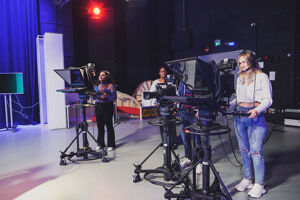
Film, Animation and Photography facilities
Take a look around the facilities available to you as a Film, Animation and Photography student at BCU.
Our staff
Ellie Tomsett
Senior Lecturer in Media and Communication
Dr Ellie Tomsett is a Senior Lecturer in Media and Communication. Ellie's research focuses on contemporary feminisms, stand-up comedy and television comedy drama. In 2017 she co-founded Mixed Bill a comedy and gender research network which seeks to engage comedy industry professionals, researchers and members of the public in discussions...
More about EllieRobin Kay
Senior Lecturer Music Business and Media and Communications (New Media)
Robin Kay is a Lecturer in Media and Communication with a New Media specialism. He has a background within the music industry having worked for several notable record labels and industry organisations including Ministry of Sound Recordings, Defected Records, Sanctuary Records and PRS.
More about RobinDave Harte
Deputy Head of Department of English and Media
Dave Harte is Deputy Head of Department of English and Media. Dave’s research is focused on local and community journalism, and he has published widely on these topics.
More about DaveDr Ross Hawkes
Course Director for MA Journalism
Ross is the founder and editor of an award-winning hyperlocal news website, Lichfield Live, and also leads the Community Interest Company producing The Lichfield and Burntwood Independent newspaper. His PhD explored the work of semi-professional journalists operating in the hyperlocal and independent space across the UK. He is a member of the...
More about Ross