Bringing the UPR to Parliament: Joint Committee on Human Rights Engagement
Dr Alice Storey and Professor Jon Yorke, alongside their colleague and BCU alumnus, Dr Michael Lane, provided expert evidence to the UK Parliament’s Joint Committee on Human Rights (JCHR) on the UK’s Universal Periodic Review in May 2023 and June 2025. Our collective aim was to inform parliamentarians about the UPR process and the UK’s related obligations, and engage the JCHR in supporting implementation of UPR recommendations the UK receives. Dr Storey’s evidence led the Committee to press the UK Government on its reservation to Article 59 of the Istanbul Convention, which affects the protection of migrant women from domestic abuse.
The UPR Project at BCU: Supporting Parliamentary Scrutiny of the UK’s Universal Periodic Review
Parliaments play a vital role in holding governments to account for their international human rights obligations. The UN General Assembly and Human Rights Council have repeatedly called for parliaments to be involved in all stages of the Universal Periodic Review (UPR). Yet for most of the UK’s first three review cycles, the UPR received little scrutiny from Westminster.
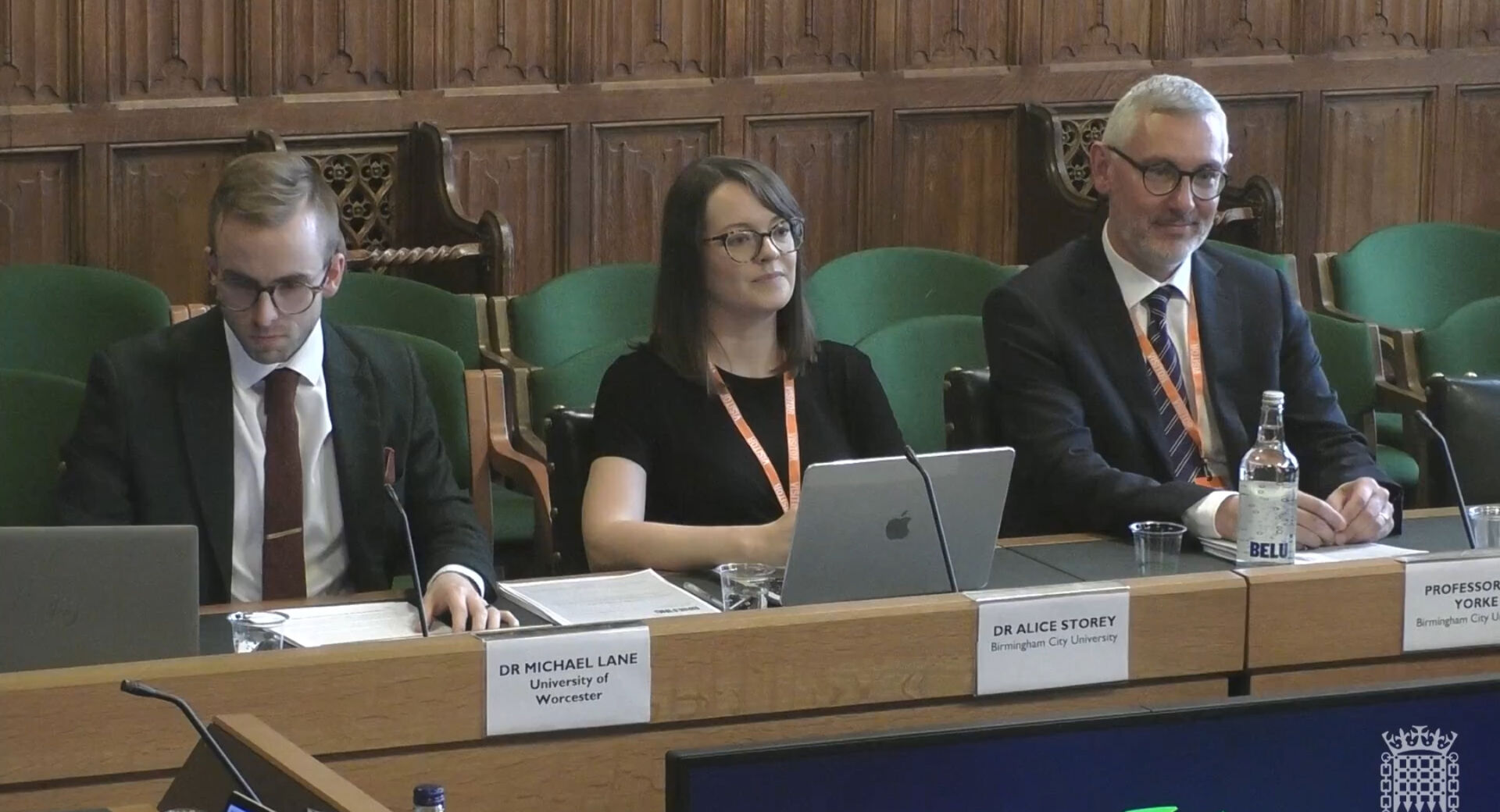
Since 2023, the Centre for Human Rights’ UPR Project at BCU has worked to change this. Building on the Universal Periodic Review 2022 – UK Civil Society Engagement project, funded by the Equality and Human Rights Commission (EHRC), Dr Storey, Professor Jon Yorke, and Dr Michael Lane gave evidence to the JCHR in a private session in May 2023 and a public evidence session in June 2025. This evidence has led to direct Committee action, correspondence with Government ministers, and continued parliamentary questioning on the protection of migrant women from domestic abuse.
Evidence to the JCHR (June 2025)
On 25 June 2025, Dr Storey, Professor Yorke and Dr Lane gave oral evidence to the JCHR in a public session on the UK’s engagement with the UPR (read the transcript). The witnesses used UK-focused examples to show how the UPR can be used outside Geneva:
- Dr Storey drew on UPR Info’s Beyond Reporting analysis, which shows how the UPR influenced Scotland’s decision to raise its age of criminal responsibility to 12.
- Professor Yorke emphasised the importance of distinguishing between who makes a recommendation and what is recommended. He also highlighted how the UPR Project at BCU’s own stakeholder report was referenced by Chris Henley KC in a Court of Appeal case.
- Dr Lane explained how the UPR has informed UK Supreme Court judgments, including the ruling on the UK–Rwanda asylum policy.
They also made the case for the UPR’s universal, cooperative and inclusive character. In closing, the Chair, Lord Alton of Liverpool, remarked that the Committee was now “a lot wiser” about what the UPR is capable of achieving.
Impact: protecting migrant women from domestic abuse
Dr Storey’s evidence has directly informed parliamentary scrutiny of the protection of migrant women from domestic abuse. Drawing on her research and on UPR recommendations made to the UK by Iceland, Mexico and Spain, she highlighted calls for the UK to withdraw its reservation to Article 59 of the Istanbul Convention. Article 59 ensures support for victims of domestic abuse regardless of their immigration status.
At the Committee’s request, Dr Storey followed up with a letter to the Chair in July 2025. In it she recommended that the JCHR resume scrutiny of the UK’s approach to migrant women under the Istanbul Convention. In October 2025, the Chair wrote to the Lord Chancellor, explicitly referencing Dr Storey’s evidence. He asked whether a review of the reservation was underway and invited the Government either to commit to lifting it or to provide the evidence for its position.
A formal government response in October 2025, reiterated in January 2026 in answer to a written question from Lord Alton, confirmed that the UK Government is actively considering its reservation to Article 59. This is a clear opening for legislative and policy reform.
Impact: bringing Parliament to Geneva
Following the UPR Project team’s advice to the Committee’s advisers, JCHR members visited Geneva in March 2026. They met UN agencies including the Office of the High Commissioner for Human Rights, and the visit allowed members to see the UPR in its international context and to consider how the UK’s international obligations relate to the Committee’s work.
Useful information
Parliamentary documents:
- Oral evidence transcript, 25 June 2025
- Letter from Dr Alice Storey to the JCHR, July 2025
- Letter from the JCHR Chair to the Lord Chancellor, October 2025
- Government response, October 2025
- Written question HL13449, January 2026
Related research:
- Alice Storey, ‘Improving Recommendations from the UN’s Universal Periodic Review: A Case Study on Domestic Abuse in the UK’ (2023) 35 Pace International Law Review 193 – available here: "Improving Recommendations from the UN's Universal Periodic Review" by Alice Storey.
- Michael Lane, The Universal Periodic Review and the UK: State Practice and Constitutional Actors (Bristol University Press 2026) – available here: Bristol University Press | The Universal Periodic Review and the UK - State Practice and Constitutional Actors, By Michael Lane.
- Alice Storey, Jon Yorke and Michael Lane, ‘Bringing the UPR to Parliament: Academic Engagement with the UK Parliament on the Universal Periodic Review’ in Gudmundur Alfredsson and Gianni Magazzeni (eds), The Universal Periodic Review (Brill, forthcoming 2027).