Beyond the 4th UPR Cycle: Strengthening the Process for Transformative Human Rights Impact
In June 2026, Dr Alice Storey was invited to take part in a high-level retreat in Rabat, Morocco, organised by the UN’s Office of the High Commissioner for Human Rights, UPR Info, and the Moroccan Interministerial Delegation for Human Rights. The event was attended by government ambassadors and representatives, UN experts, and civil society organisations. The Chairs’ Summary, launched at the UN in Geneva in September 2026, reflects 11 of her proposals.
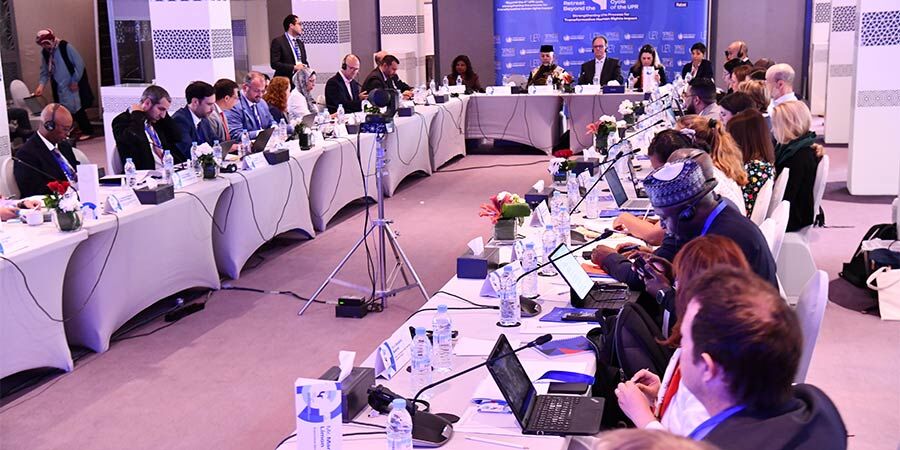
The aim of the ‘Beyond the 4th UPR Cycle’ retreat was to bring together key actors to provide a focused and strategic space for exchange as the UN’s Universal Periodic Review (UPR) transitions from Cycles Four to Five in 2027.
Such an initiative is vital to ensuring the UPR’s impact on the ground globally. This is of particular concern given the challenging context of non-cooperation with the UPR and the broader threats to international human rights.
As the only academic to be invited to the event, Dr Storey was able to draw upon over a decade of research and practical engagement with the UPR to make a number of interventions at the retreat, focused on:
- Systematic and consistent tracking of implementation of UPR recommendations
- The role of parliamentarians
- Empowering CSOs at the UPR
- Reflecting on state non-cooperation
You can read the full non-paper submitted by Dr Storey, including proposed actions and sharing of good practice.
Reflecting on her participation in this retreat, Dr Storey said, “it was a privilege to be invited to such a prestigious event and to help shape the future of the UPR mechanism and human rights globally.” Dr Storey, Associate Professor of Human Rights, created the UPR Project at BCU in 2018 which engages with the UPR through three streams of work: (1) research, (2) education, and (3) practice.
Chairs’ Summary launched at the UN
In September 2026, the co-organisers published the Chairs’ Summary of the retreat. It was launched at the UN on 24 September 2026 at a side event, ‘From Rabat to Geneva: Strengthening the UPR Process for Transformative Human Rights Impact’, held at the Palais des Nations in Geneva. Speakers included the President of the Human Rights Council, the Ambassadors of Morocco, Norway, the Maldives and Kenya, the Chief of OHCHR’s Universal Periodic Review Branch and the Executive Director of UPR Info.
Dr Storey’s proposals in the Chairs’ Summary
Eleven points from Dr Storey’s non-paper are reflected in the Chairs’ Summary, spanning every theme of her interventions:
- Implementation as the priority for the fifth cycle: closing the implementation gap should be a central priority (paragraphs 7 and 8).
- A methodology for measuring implementation: the need for indicators, criteria, or methodologies to measure progress and assess implementation over time (paragraph 10).
- Building on existing platforms: digital tools to track implementation, with UPR Info’s database and OHCHR platforms recognised as important resources (paragraph 21).
- Responsible use of technology: attention to bias, sustainability, and human oversight (paragraph 23).
- Efficiency with purpose: cost-effectiveness should strengthen the UPR’s value and impact, not merely reduce costs (paragraph 15).
- The role of parliaments: particularly where implementation requires legislative reform, budgetary oversight, or political accountability (paragraph 13).
- Protecting civil society: safeguarding those who engage with the UPR from reprisals (paragraph 13).
- Universality and stakeholder engagement: recognised as essential foundations to be preserved (paragraph 6).
- Funding: predictable resources and stronger fundraising for implementation and participation (paragraph 25).
- Sharing good practice: peer-to-peer learning and capacity building to strengthen implementation (paragraphs 25 and 27).
- State non-cooperation: the need for continued reflection on how such situations are addressed (paragraph 19).
Dr Storey said: “It’s incredibly rewarding to see my research, as well as the work of the UPR Project at BCU more broadly, reflected so clearly in the Chairs’ Summary. The UPR has generated thousands of recommendations, yet their implementation is still not tracked in a structured way. The fifth cycle is the moment to change that, and I look forward to working with OHCHR, UPR Info, and Member States to make it happen.”
Next steps
The outcome of the retreat, as set out in the Chairs’ Summary, will inform structured discussions on preparing the fifth cycle of the UPR, in close dialogue with the President of the Human Rights Council and relevant stakeholders.
Dr Storey has also been invited to deliver training to the OHCHR on her methodology for measuring the implementation of UPR recommendations, which will be published in 2027. Through the UPR Project at BCU and the UPR Academic Network, which she co-leads, she will continue to contribute to these discussions as the UPR moves into its fifth cycle.
Annex 1: Intervention Map
Side-by-side mapping of the points in Dr Storey’s non-paper (June 2026) that are referenced in the Chairs’ Summary of the Rabat Retreat (published September 2026).
|
No. |
Non-paper proposal |
Chairs’ Summary para. no. |
What the Chairs’ Summary says |
|
Non-paper theme 1: Systematic and consistent tracking of implementation (5 points) |
|||
|
1 |
Implementation must be the central focus of the fifth cycle (the opening line of the non-paper). |
Paras 7 and 8 |
Credibility in the fifth cycle depends on strengthening implementation; closing the implementation gap should be a central priority for the fifth cycle. |
|
2 |
A replicable framework, built on clear indicators, for measuring implementation; adopt it as a shared methodology. |
Para 10 |
The need for indicators, criteria or methodologies to measure progress and assess implementation over time. |
|
3 |
Cost-effective automated monitoring, given persistent funding uncertainties. |
Para 15 |
Efficiency discussions are needed given UN financial constraints, but cost-effectiveness must not undermine the UPR; efficiency should strengthen value and impact. |
|
4 |
Build on existing platforms (UPR Info’s Database; OHCHR’s pilot UPR Implementation Tracker), giving them a methodological foundation. |
Para 21 |
Digital tools have significant potential, including for tracking implementation; OHCHR platforms, the National Recommendations Tracking Database and UPR Info’s database recognised as important resources. |
|
5 |
Caution when using AI, particularly on bias and sustainability. |
Para 23 |
Technology must be ethical, transparent, sustainable and human rights compliant, with attention to bias, data governance and human oversight. |
|
Non-paper theme 2: Empowering CSOs at the UPR (4 points) |
|||
|
6 |
CSOs are vital to the UPR, and their engagement is more important than ever to the mechanism’s legitimacy. |
Para 6 |
Openness to stakeholder engagement recognised as an essential foundation to be preserved. |
|
7 |
CSOs continue to report reprisals; review the UN’s approach to reprisals across all mechanisms. |
Para 13 |
Civil society participation must be safeguarded, including by protecting those engaging with the mechanism from reprisals. |
|
8 |
Funding underpins everything; set out a plan for sustaining CSO and small-State engagement, prioritising implementation. |
Para 25 |
Importance of financial and technical assistance for implementation and participation; need for predictable resources and stronger fundraising. |
|
9 |
Technical support and capacity building for CSOs, drawing on partnerships between larger organisations and local CSOs. |
Para 27 (and para 25) |
Peer-to-peer learning, regional platforms and the exchange of good practice identified as important avenues for strengthening implementation (para 27); capacity-building (para 25). |
|
Non-paper theme 3: The role of parliaments (1 point) |
|||
|
10 |
Parliaments are instrumental to implementation; parliamentary human rights committees as a channel for scrutiny (JCHR example). |
Para 13 |
The role of parliaments highlighted as particularly important where implementation requires legislative reform, budgetary oversight or political accountability. |
|
Non-paper theme 4: Reflecting on State non-cooperation (1 point) |
|||
|
11 |
Non-cooperation directly threatens the UPR’s legitimacy; how to maintain continuity and pressure when a State steps back. |
Para 19 |
Non-cooperation discussed; need to continue reflecting on how such situations should be addressed. |