Research Informed Teaching
Research-informed teaching is central to the ethos of the Urban Cultures research cluster, where research activity enhances learning across undergraduate, postgraduate, and doctoral levels. The cluster actively connects research with teaching through CoLab live projects, studio-based learning, and participation in design competitions, allowing students to engage with real-world urban challenges informed by current research. Through these platforms, students apply theoretical knowledge to practical contexts, working on issues such as urban regeneration, sustainability, cultural identity, health and wellbeing, and inclusive design.
CoLab projects in particular create opportunities for collaboration with external partners, enabling students to gain experience of live briefs and community engagement, while design competitions further encourage innovation, experimentation, and professional skills development. This integrated approach creates a vibrant learning environment where research, teaching, and practice inform one another. By embedding research within live projects and studio culture, the Urban Cultures research cluster supports the development of critical thinking, creativity, and professional readiness, preparing students at all levels to respond to complex urban challenges.
Example 1: Urban Oasis: the arena of urban life
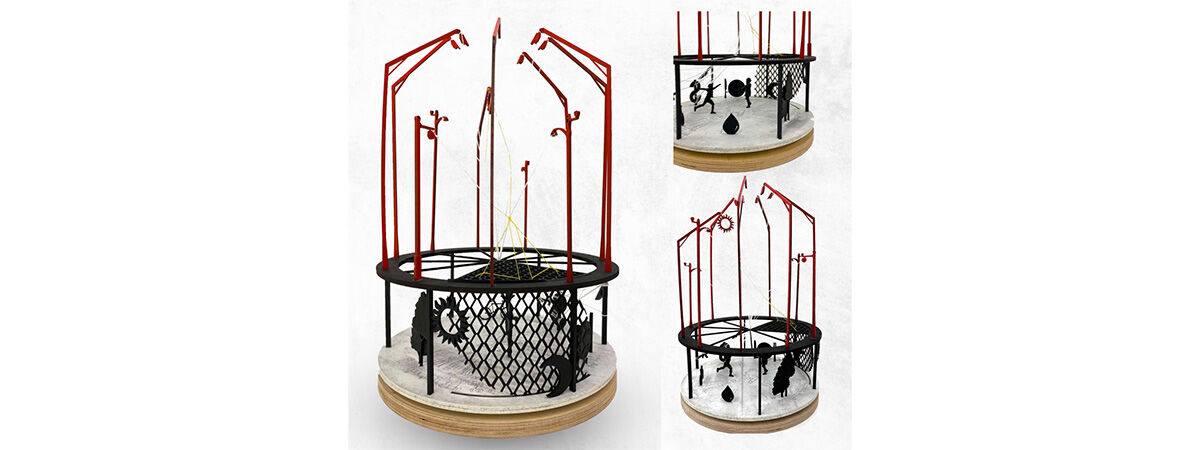
Research installation exhibited at the Venice Architecture Biennale 2023 within the international event “Students as Researchers”, organised by New York Institute of Technology.
Urban Oasis is a research-led installation exhibited at the Venice Architecture Biennale 2023, one of the world’s most prestigious international cultural exhibitions, attracting more than 500,000 visitors annually. The project was presented within the collateral event “Students as Researchers: Creative Practice and University Education”, organised by New York Institute of Technology and featuring contributions from more than twenty universities worldwide.
Led by Dr Yazid Khemri, the project brought together research, design, and pedagogy through the participation of undergraduate architecture students from Birmingham City University. Under the leadership of Dr Yazid Khemri, students Harvey Farren and Eduard-Dumitru Popescu worked on the concept of Urban Oasis, an artefact exploring how public space can stimulate vibrant, inclusive, and sustainable urban life. The installation draws on research into everyday spatial practices and the concept of El Houma in Algiers, proposing a framework for reactivating public spaces as arenas of social interaction, wellbeing, and ecological resilience.
The artefact symbolically represents the interconnected “stimulators” of urban life—play, safety, social interaction, environmental comfort, and biodiversity, illustrated through a circular spatial composition emphasising unity and symbiosis. As Artistic Director of the project, Dr Yazid Khemri supervised the research and fabrication process and presented the work at an international symposium at the Biennale, positioning the research within global debates on the future of public space and participatory urban design.
Dissemination and media coverage:
La Biennale di Venezia (2023) Students as Researchers: Creative Practice and University Education – Collateral Events, Biennale Architettura 2023. Available at: https://www.labiennale.org/it/architettura/2023/eventi-collaterali (Accessed: 16 March 2026).
Venezia News (2023) Students as Researchers: Creative Practice and University Education. Available at: https://venezianews.it/thebag2023/students-as-researchers-biennale-architettura-2023/ (Accessed: 16 March 2026).
My Art Guides (2023) Students as Researchers: Creative Practice and University Education. Available at: https://myartguides.com/collateral-events/venice/students-as-researchers-creative-practice-and-university-education/ (Accessed: 16 March 2026).
Melis, A. (2023) Students as Researchers: Creative Practice and University Education [LinkedIn post]. Available at: https://www.linkedin.com/posts/alessandro-melis-b71211129/students-as-researchers-creative-practice-activity-7064710329439547392-9Q30/ (Accessed: 16 March 2026).
Students as Researchers Exhibition (2023) Students as Researchers: Creative Practice and University Education [Instagram post]. Available at: https://www.instagram.com/p/CsWlI8MMiYF/ (Accessed: 16 March 2026).
Example 2: Sensory Architecture and Design
Drawn from her research in soundscapes and smellscapes, Dr Jieling Xiao integrates multi-sensory design approaches into studio teaching and live workshops, encouraging students to explore architecture through sensory experience as well as visual form. Her teaching adopts a human-centred and research-informed approach, where students engage with sound, smell, and atmosphere as critical design parameters.
This approach facilitates a two-way exchange between research and teaching, where academic inquiry informs pedagogical practice while student experimentation, prototyping, and reflection contribute to the evolution of her research. Through this reciprocal model, students are positioned not only as learners but as active contributors to knowledge production within a design school environment. Examples of project include the Soundscape Investigation in the Library of Birmingham, the Sensory Devices project with the Roundhouse Birmingham, the Expanded Dinning Project with Kaye Winwood, etc. This has also resulted a number of creative dissertation projects at postgraduate levels, including the 2025 MArch Best Dissertation Award project by Eleanor Owen, titled How can the sensory experience enhance public architecture for people with visual impairments?
Dissemination and media coverage:
Xiao, J., Aletta, F. and Ali-Maclachlan, I., 2022. On the opportunities of the soundscape approach to revitalise acoustics training in undergraduate architectural courses. Sustainability, 14(4), p.1957. https://doi.org/10.3390/su14041957
Dezeen (2021) Birmingham City University Creative Partnership presents student projects. Dezeen School Shows, 21 July. Available at: https://www.dezeen.com/2021/07/21/birmingham-city-university-creative-partnership-school-show/ (Accessed: 16 March 2026).
Xiao, J. and Aletta, F., 2016. A soundscape approach to exploring design strategies for acoustic comfort in modern public libraries: A case study of the Library of Birmingham. Noise Mapping, 3(1), pp.264-273. https://doi.org/10.1515/noise-2016-0018
Example 3: Save Smallbrook, C20 Society and MArch Studio The Modern Gazetteer

On 1st February 2024, Birmingham City Council’s planning committee voted 7-4 in favour of demolishing Smallbrook Ringway Centre (James Roberts, 1962). It was the second time in six months they had made this decision, having been forced to reconsider by a legal challenge from the Save Smallbrook campaign group.
Conceived as gated city wall that combined disparate sites, Smallbrook Ringway Centre was one of the first buildings to line Birmingham’s Inner Ring Road, forming the spine to an urban ensemble that addressed the changing patterns of life and mobility, and representative of the power of city governance.
Save Smallbrook, a coalition of heritage and climate campaigners, have led the call for the adaptive reuse of the building, at the centre of which has been a counter proposal by Dr Michael Dring of the Department Architecture & the Built Environment.
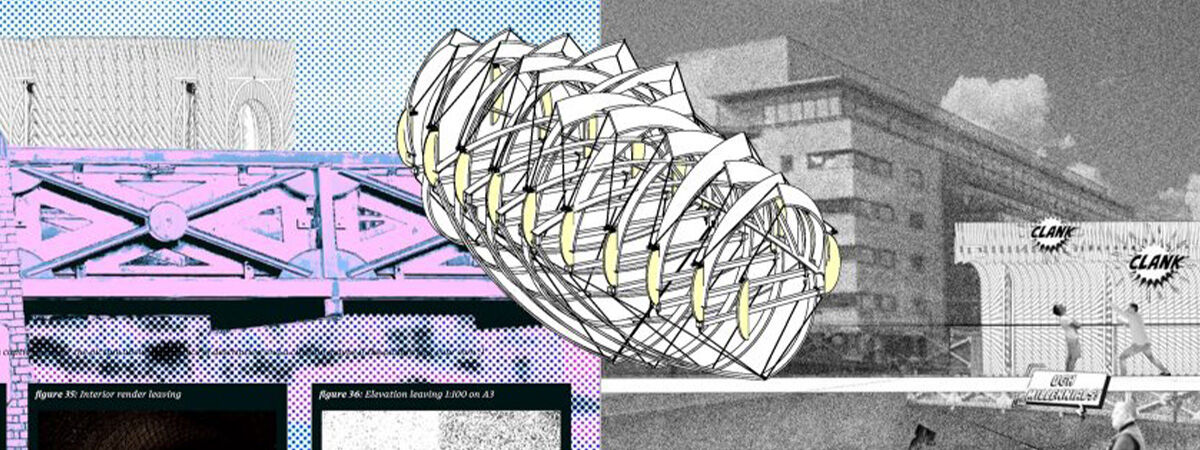
In April 2024, students and staff of MArch unit the Modern Gazetteer, together with Intervention Architecture, artist Sean Burns, engineers Webb Yates, and members of the Save Smallbrook campaign group, were longlisted for the national Davidson Prize, on the theme of ‘Rethinking Home - Adapt & Reuse’. Smallbrook Ringway Centre formed the basis of the submission. Students also took Smallbrook Ringway Centre as their project site for the year, presented to the public and Kevin McCloud.
A documentary on the campaign by Doberman Documentaries was premiered at Flatpack Film Festival 2024 at the Bethel Welsh Presbyterian Chapel (James Roberts, 1968) followed by a rallying talk by McCloud on the value and need of the campaign around twentieth century architecture. The campaign group also launched a crowd funding site in support of the ongoing judicial review. BBC published an article on the eventand campaign, following an earlier BBC article related to the Learning from the Centre exhibition curated by Dr Dring.
He presented a paper entitled ‘Mending Wall – Continuity in the Modernist City: Interpreting Smallbrook Ringway Centre, Birmingham‘ at docomomo conference 2024 in Chile as part of the session ‘Monumental modernism: Legacy or waste?’, extending the reach of this important campaign.
Dissemination and media coverage:
-
Khan, S. (2024) Future of threatened brutalist building reimagined. BBC. Available at: https://www.bbc.co.uk/news/articles/c4nnjkpdnxjo [Accessed 18.03.2026].
-
Spocchia, G. and Dring, M. (2022) Anti-demolition coalition proposes alternative to Corstorphine & Wright’s Birmingham plans (including illustrations of counter-proposal for Smallbrook Ringway Centre, Birmingham). Architects' Journal. Available: www.architectsjournal.co.uk%2Fnews%2Fanti-demolition-coalition-proposes-alternative-to-corstorphine-wrights-birmingham-plans
-
Spocchia, G. and Dring, M. (2023) Campaigners make final plea as Brutalist Birmingham landmark is tipped for demolition (including illustrations of counterproposal and photographs of campaign events for adaptive reuse of Smallbrook Ringway Centre). Architects' Journal. Available: www.architectsjournal.co.uk%2Fnews%2Fcampaigners-make-final-plea-as-brutalist-birmingham-landmark-is-tipped-for-demolition
-
Spocchia, G. and Dring, M. (2023) Fate of Birmingham landmark as crucial as M&S Oxford St, say campaigners (including illustrations of counterproposal and photographs of campaign events for adaptive reuse of Smallbrook Ringway Centre). Architects' Journal. Available: www.architectsjournal.co.uk%2Fnews%2Ffate-of-birmingham-landmark-as-crucial-as-ms-oxford-st-say-campaigners
-
Waite, R. and Dring, M. (2023) Demolition of Brutalist Birmingham landmark narrowly approved (including photographs of campaign events for adaptive reuse of Smallbrook Ringway Centre). Architects' Journal. Available: www.architectsjournal.co.uk%2Fnews%2Fdemolition-of-brutalist-birmingham-landmark-narrowly-approved