University News Last updated 24 November
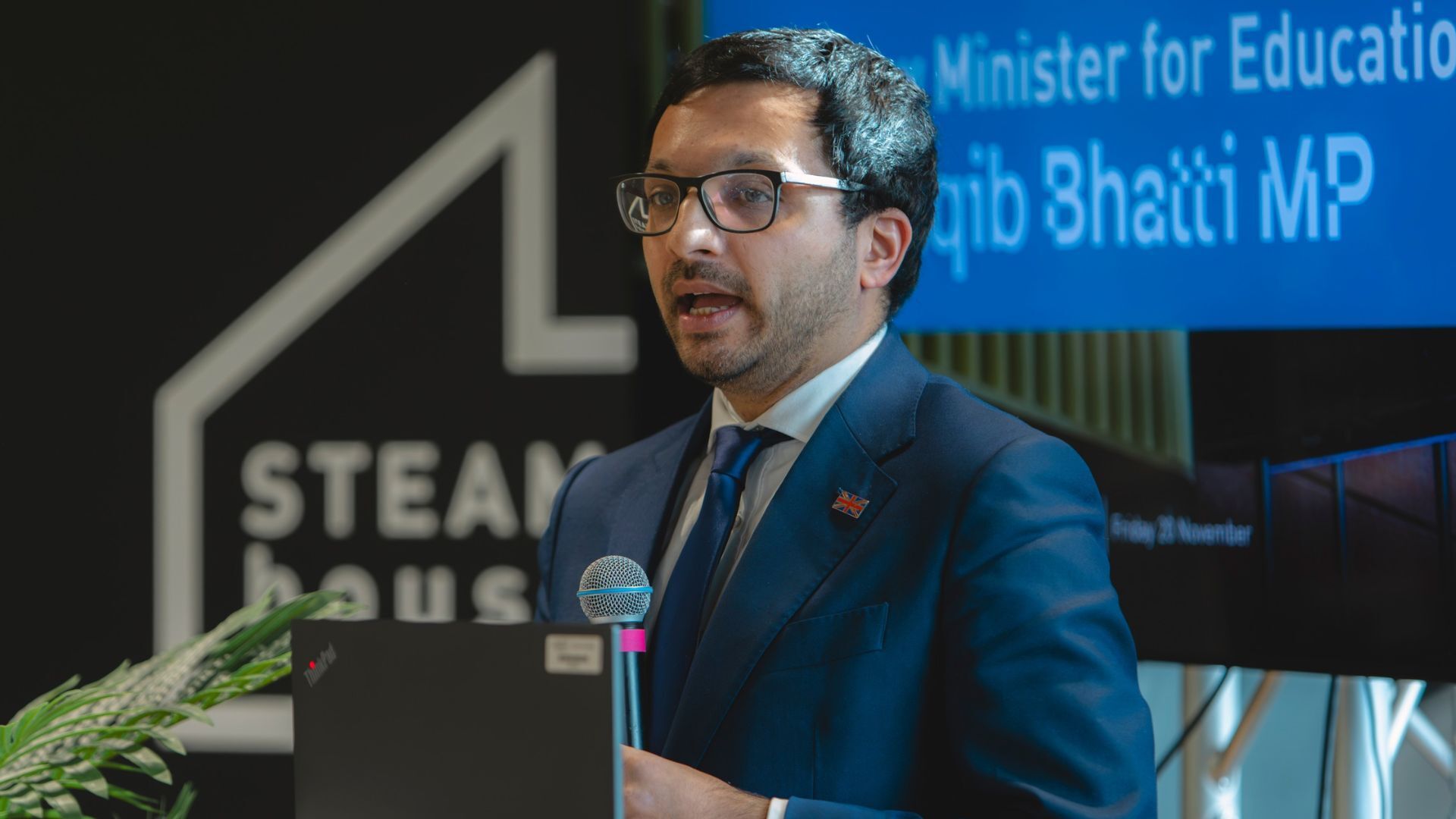
Saqib Bhatti MP has welcomed Birmingham City University’s approach to developing the skills students need for employment, including its work to incorporate artificial intelligence into learning.
Speaking at a summit celebrating the University’s STEAM agenda, the Shadow Minister for Education discussed the challenges graduates face in securing employment, and the role universities can play in preparing students for the workplace.
Mr Bhatti, MP for Meriden and Solihull East and Shadow Education Minister, said students want to see clear value in their university education and confidence that it will support their future career prospects.
Mr Bhatti (pictured) said “Universities have an important role to play in ensuring graduates are equipped with the skills employers are looking for.
“It’s vital that universities deepen their relationships with business and industry so that students gain opportunities to develop the knowledge and practical experience they need to secure good jobs after graduating.
“I was very grateful to learn more about BCU’s initiative and thank them for a constructive conversation on this very important and timely issue. I remember when STEAMhouse was first discussed when I was a LEP Director and how BCU working with Andy Street delivered it.”
He recognised that graduates are entering a challenging and competitive jobs market, while businesses are operating in a difficult economic climate and placing increasing importance on the skills, knowledge and experience of potential employees.
He highlighted the importance of universities and businesses working together to create opportunities for students and ensure graduates are equipped for the demands of the modern workplace.
The STEAM Summit, held in the Belmont Suite at STEAMhouse, showcased BCU’s ambition to embed its distinctive STEAM approach across the University, bringing together science, technology, engineering, arts, humanities and mathematics to create new opportunities for students, industry and the wider community.
Opening proceedings, Professor Islam Issa, Professor of Humanities at BCU, introduced the event before guests heard a video message from University Chancellor Ade Adepitan.
Vice-Chancellor Professor David Mba then welcomed attendees, outlining how the STEAM agenda is central to BCU’s ambition to become an exemplar anchor institution, recognised for its technical, creative and professional excellence.
He explained that STEAM is about more than bringing together different academic disciplines. It is also about equipping and empowering students through a personalised, collaborative education focused on innovation, inclusion and industry excellence.
Professor Mba highlighted how BCU’s STEAM approach will help the University respond to the growing demands on higher education and wider society through inspiring, accessible and inclusive practice-based teaching.
He described BCU’s approach as a fundamentally different proposition in its scale, breadth and ambition, emphasising that it is not simply a slogan but an operating model which embeds interdisciplinary, challenge-led and industry-co-created learning into the curriculum.
Professor Hanifa Shah OBE, Pro Vice-Chancellor of Research, Enterprise, Engagement and STEAM at BCU, also addressed attendees, highlighting the importance of the agenda to the University's future.
“STEAM is much more than an educational approach - it is a statement of intent about the kind of university BCU wants to be and the impact we want to have,” said Professor Shah.
“We are challenging traditional boundaries, connecting ideas and creating an environment where creativity, technology and human ingenuity come together to tackle real-world challenges.
“BCU has a significant role to play in shaping the future of higher education and the skills our economy needs.
“Our ambition is to demonstrate what is possible when interdisciplinary thinking, industry collaboration and an inclusive, practice-based education are placed at the heart of the university experience.
“We don't want to simply follow the conversation about the future of skills; we want to lead it.”
The event featured a programme of talks, workshops and tours of STEAMhouse, alongside opportunities to explore some of the University's key STEAM projects and see how its interdisciplinary approach is being put into practice.