Research News Last updated 25 June
Artists, academics, healthcare professionals and researchers have been brought together by Birmingham City University (BCU) to explore a vital question: can art make us healthier?
Where Art Meets Health, an interactive symposium held at BCU’s School of Art on Wednesday 24 June, is part of this week’s Healing Arts Birmingham 2026 programme.
Five panellists each posed a central question for discussion, covering themes from arts education and trauma recovery to art therapy, gallery curation and the role of wonder in healthcare settings.
Speakers included Stephen Stapleton, co-founder of the Jameel Arts and Health Lab; Regan McDonald from Ikon Gallery's Creative Health programme; visual artist Jaskirt Dhaliwal-Boora; Dr Pamela Whitaker from the Belfast School of Art; as well as BCU Visiting Professor and multidisciplinary artist, Jason Bruges.
The event was chaired by Dr Justin Varney-Bennett, Regional Director of Public Health (South West Region) and Creative Health Lead at the Department of Health and Social Care.
“Creative Health offers huge potential to improve individual and population health,” said Dr Varney-Bennett. “Across the nine creative industries from publishing to architecture, museums to crafts, there are examples of impact in prevention through to the end of life.
“At every age and stage of life being exposed to the arts, engaging through creativity and participating in something creative can improve your health, being creative every week whether it’s listening to music or taking in a show can be as important as being active when it comes to improving health.”
Discussion across the day reflected a growing consensus that public health is undergoing a significant shift: moving away from treatment and hospitals towards prevention and communities.
This shift also represents a real opportunity for artists and practitioners who were described as “changemakers” and able to reach communities and individuals that other disciplines may struggle with.
The conversation also included how the sector itself needs to evolve. Art schools and studios were urged to look beyond site-specific workshops and take their practice to where people naturally are, through pop-ups, community spaces and everyday settings. Building a pipeline of talent and skills, fostering creative citizenship and nurturing pride in place were all identified as priorities for arts education and research in the years ahead.
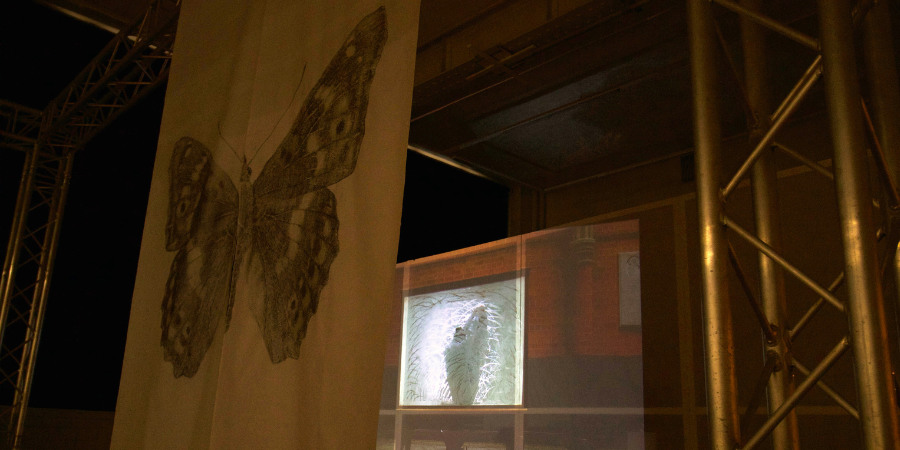
The symposium also featured artwork by Franziska Schenk, Senior Lecturer in Fine Art at BCU, forming part of her wider practice-based research project Emerging from the Chrysalis.
“By assuming the butterfly’s various stages of transformation through performance, I aim to evoke the gradual process of self-healing I underwent after suffering a stroke,” she said.
“In using metamorphosis as a metaphor for healing, I am consciously calling back to visceral, bodily, performative forms of art made for their healing properties.”
The symposium reflects BCU's commitment to research and practice that sits at the intersection of creativity and social impact, bringing together diverse voices to ask how the arts can reach further and mean more in people's lives.
Photo: Franziska Schenk, Incubation Chamber, live performance, Birmingham School of Arts.