Introduction
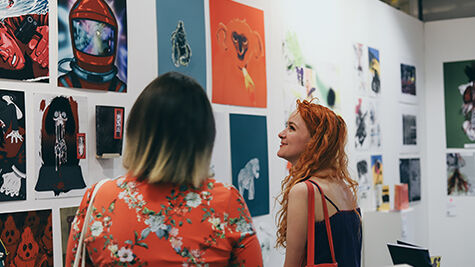
Located in a Grade I listed building in the heart of the city (which is unquestionably one of the finest art school environments in the country), this course is characteristically open and broad based, as can be seen in both this year's degree show and the degree show last year. There are many strong examples of painting, sculpture, installation, film, print and drawing, with students either working throughout the course on one discipline or across a range, using the most appropriate media to express their ideas. It is your journey and your choice.
Summary
- Duration
- Full Time: 3 years
- Fees
- 2012/13: £8,200 per year
2012/13 (International): £9,900 per year
Further Studies
For further information on courses Tel: +44(0)121 331 5595 or go direct to the courses section of the website.
Employment Opportunities
There is such a diverse range of post-degree opportunities, which reflects the sought after skills you will develop and be able to employ: imaginative and creative skills; analytical and critical skills; negotiation and communication skills; presentation and exhibition skills; a range of practical and technical skills; and good self-management and organisation skills.
As you can imagine from a course centred on individual development, our students are resourceful and confident. As the passion seldom dies, they often continue to develop a professional practice in one form or another. Many progress to postgraduate level study – the highest percentage of students for a course in the faculty – or to setting up or joining existing local, regional or national studio groups.
In addition, our graduates forge careers across all art and design related subjects: arts administration, teaching in schools and colleges, art therapy, digital media, mural painting, theatre, television, film, music and the design disciplines. They are also extremely good in any project-based activity, including in areas such as event design, fashion, advertising, retail management and travel.
For 2008/09
- 79% of leavers who responded went into either employment and / or further study
- 69% of leavers achieved a graduate level destination
- The average salary for a leaver who went into full time paid employment was £24,000. The highest salary was £40,000
- The top industrial sectors employing leavers from the School of Art were Education, and Arts, Entertainment and Recreation
- The top occupation types entered by leavers from the School of Art were Associate Professional and Technical Occupations, and Professional Occupations
- Employers who hired leavers from the School of Art include Eileen Mason Photography and Milton Keynes Gallery
Structure
Course Structure
The course is designed to help you establish your individual creative identity. For this reason there is an opportunity to work in painting, sculpture, printmaking, drawing, photography, film and video, digital media, sound, installation and performance – there are no set pathways. With the highest quality learning resources at your fingertips, you’ll be able to make the most of your learning. You will be supported by highly experienced staff, who are all nationally and internationally active as artists, and you will have access to excellent studio, workshop, installation and research facilities.
Academic guidance is delivered through individual and group tutorials, workshops, seminars and lectures. You’ll also have the opportunity to participate in exhibitions, work placements, exchanges and international study visits. Studio practice is supported and underpinned by an exciting range of core and optional contextual and professional practice modules.
You’ll benefit from the course’s significant links to the Ikon, Eastside Projects, New Art Gallery Walsall , International Project Space and Birmingham Museum and Art Gallery, as well as a range of other independent studios galleries set up by ex-students, such as The Lombard Method, Grand Union and Trove.
Modules
Level 4
- Practice and Context (15 credits)
- Methods and Materials (30 credits)
- Establishing Practice (45 credits)
- Themes and Concepts in Art (15 credits)
- Methods of Presentation (15 credits)
Level 5
- Developing Practice (45 credits)
- Extending Practice (45 credits)
- Art in Theory and Writing (15 credits)
- Art, Space and Audience (15 credits)
- International Exchange (option - 60 credits)
Level 6
- Practice and Professional Presentation (75 credits)
- Practice-Led Dissertation (15 credits)
- Professional Portfolio (30 credits)
Assessment
We use a broad range of assessment methods across the course to test you and allow you to evidence and further develop your skills. You will be required submit bodies of practical work for the studio practice modules; reflective journals, blogs and a website (don't worry, you will be able to do it!); to make individual and group presentations; write essays and artist statements. In addition, you will be able to plan and manage your time and activity effectively.
Staff
The academic and technical support staff for the course are all practising artists. Between them they have specialist knowledge and skills to cover the diverse range of approach in contemporary art practice - painting, sculpture, print, photography, installation, film/video, drawing, performance and site specific public art. The staff are highly qualified, regularly exhibit their work nationally and internationally, and have good contacts with major centres of art practice. In addition to their excellence as artists and researchers, their significant experience as lecturers and tutors will provide you with the confidence and skills to fully develop your creative potential.
Academic staff research interests
The School of Art is in a unique position of being able to offer an established artist the opportunity of working on site for a year in the form of a residency - they have their own studio and access the the resources of the school and university. Over the past 12-years the £9,000 Wheatley Fellowship has enabled students to develop a relationship with the artists, who have been able to give clear guidance and advice related to their experienceas as a professional practitioner. In terms of diversity and quality we have been delighted to have the following work with us:
Miranda Whall
Nayan Kulkarni
John Russell
Italo Zuffi
Kathrin Bohm
Mark S Gubb
Aaron Williamson
John Wood/ Paul Harrison
Kit Poulson
Juneau Projects
Jesse Ash
Mhairi Vari
Beth Derbyshire
In addition, every year we invite visiting artists to give talks about their work. Some of these have been in association with the Ikon exhibitions and have involved round table discussions, others inspiring presentations in themselves. Over the years we have had Tracey Emin, Cornelia Parker, Mark Wallinger, Richard Billingham and Martin Creed. We have also has some excellent talks and discussions with film makers, such as Ken Loach, architects, Rem Koolhaas, and Art Critics, Judith Halberstam and Jonathan David Katz.
The School of Art is also a participant in the national AA2A scheme which supports local artists.
Graduates
Students graduating from the fine art course are imaginative, determined and resourceful. They often take on more than one job or role at at a time and can find themselves using the skills from the course in all sorts of ways.
Students often tell us that the three years on the course was the most defining moment of their lives. It gave them the confidence to express their ideas and a sense of freedom to make choices.

Victoria Mitchell graduated from the course making video work, having for two years worked solely with drawing - the nature of the course allows this to happen. This in itself has led to her developing a career in television and film production, winning an BAFTA for her work on The Choir (BBC2). She says of the course and her experience, "TV is a highly competitive business but I definitely think that my background in Fine Art has equipped me well. Studying Fine Art is all about finding ways to communicate ideas visually and being original and inventive in your approach, skills that I have found absolutely invaluable."
Matthew Evans graduated last year and is currently studyiing on an MA Fine Art course. His work was selected at the Fine Art degree show for a £10,000 commission at the Royal Orthopaedic Hospital in Birmingham. Working in collaboration with another student, this work has carefully evolved through consulation with staff and patients and is now complete. As Matt says, "without the support of the course this would not have been possible. This has been a fantastic opportunity and I am really excited that the work is seen by the public on a more or less permanent basis. It has given me confidence as an artist to work on more commissions. "
Philippa O'Driscoll graduated last year and progressed to study a MA Curating Contemporary Art in London. In addition she is on an internship as an International Events Assistant at Matt Roberts Arts and has been promoted in ther role as manager at Monsoon Accessorize. This ability to effectively manage a number of roles at the same time is typical of a fine art graduate. She says, " the course has given me the practical and communication skills to succeed across a range of situations - I believe that fine art students are able to adapt well to change. Having met other fine art students in London from equivalent courses, I feel that I was by far the most equipped to deal with the variety of challenges. This is entirely due to the quality of the fine art course at Margaret Street."
Hannah Gaunt graduated last year and is currently engaged on four things: working in a commercial gallery, as a volunteer at MK Art and Health attached to a hospital, an intern at MK Gallery in Milton Keynes, and further developing her art practice. She says, "the course has given me the self-belief to do all of these things and I feel that they make up a whole. On an intellectual level a contemporary art gallery of any kind can be quite a daunting place, but the course gave me the confidence in my own ideas and opinins and I now feel a very valued member of the team."
Luke Perry graduated in 2008 with a very strong degree show of steel text-based sculpture. He became the founder and director of Industrial Heritage Stronghold, a not-for-profit organisation which aims to 'build public artworks which celebrate the country's industrial heritage in a very real way'. Luke led the re-building of the Titanic's bow in Belfast, restoring the Titanic Engineers' Memorial in Southampton and bringing the Titanic's anchore home to the Black Country. He has just been been awarded a University prize of Alumni of the Year 2011.
How to apply
Entry Requirements
A good portfolio plus one of the following:
- 280 tariff points
- BTEC National Diploma overall grade DMM
- Level 3 Diploma in Foundation Studies (Art and Design) with merit or distinction in the final stage
- International Baccalaureate with 28 points
- Equivalent qualifications or experience
As a guide, a good portfolio should have evidence of imaginative approaches to fine art practice, as well as some research and contextual knowledge, often located in notebooks, sketchbooks or reflective journals. We are interested in how you develop your ideas and how you employ appropriate techniques. All of this we will explore in a 15-minute personal interview you will be invited to attend. If you are on an art and design foundation course or BTEC equivalent you will be offered an interview date on receipt of application. If a direct entry from 'A' Level you may be required to supply 10 digital images of your work to determine interview. EU and International Students will be required to provide a digital portfolio and will not be interviewed.
Portfolio and interview guidance
Application Details
UCAS Code: W101
Search for this course on UCAS.
Fees Notes
If you already have an equivalent level qualification, you may be charged a higher fee for your course. For further information visit the fees area of the Student Info section.
Enquiries
Prospective students from the UK or EU may enquire online by using the Course Enquiry Form or call +44 (0)121 331 5595.
Prospective students from non-EU countries may enquire via the International Enquiry Form or call +44 (0)121 331 6714.