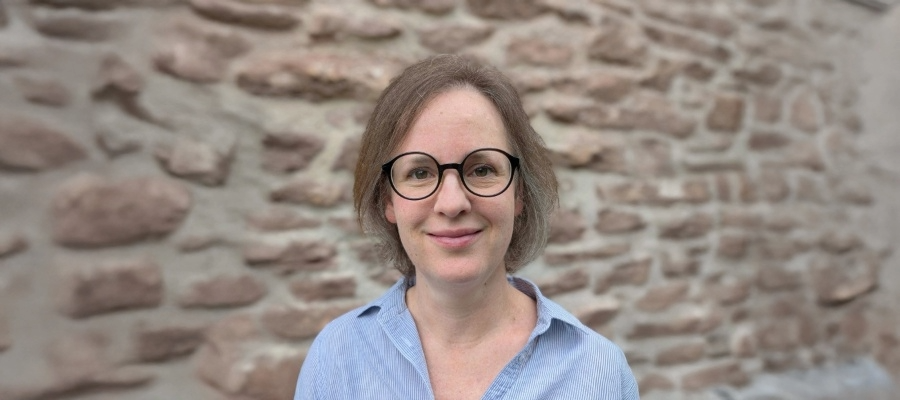
Jenny Powell
Planning Built Environments MA
Before studying MA Planning Built Environments at BCU, Jenny was returning to work after a career break and exploring a new interest in planning. After retraining through an RTPI-accredited master’s in planning, enabled her to change career. She now works as a Senior Planning Officer at Shropshire Council, supporting planning decisions across diverse urban and rural environments.
“My academic journey leading up to my master’s began with a strong foundation in History; I started my MA at BCU as a mature student, having completed a BA (Hons) in History followed by an MPhil in Medieval History.
My decision to study a master’s at BCU was quite by accident. After taking a career break to raise my children, I wanted to do something for myself and decided not to return to my previous work in local government corporate policy and partnership working.
I took a part-time planning assistant role at a local consultancy because it fitted around school hours and sounded interesting. I have always been interested in landscapes and buildings, and planning was a field I knew very little about at the time.
It was my manager, Ruth, who suggested that I might be underselling my skills and that I would benefit from learning the theory of planning alongside the practical experience I was gaining at work. She encouraged me to apply to BCU, having previously supported other early-career planners through the same route, and offered to fund my place on the part-time course while I continued working.
The course was accredited by the Royal Town Planning Institute (RTPI), which was why I chose BCU. BCU was also a practical choice, with a manageable one-hour commute from home, making it possible to balance work, study, and family life.
My experience of studying at BCU was demanding but highly rewarding, particularly as a part-time student balancing work and family life. There were a wide range of ages and professional backgrounds on my course Some students were recent graduates, while others had been working in plan-related roles for many years, including in local authorities and private consultancies. Several, like me, were changing career direction.
The course covered a broad range of subjects, including the history of planning, placemaking, professional practice, governance, a group development project, and a final dissertation. Teaching was delivered through a mix of lectures and seminars, making each study day varied and engaging.
Many of the required resources were available online, which allowed me to study at home. This became particularly important when teaching temporarily moved online during my second semester. Despite the disruption, we adapted well and returned to in-person teaching by the final semester.
Although the course was more challenging than my undergraduate degree or MPhil, it felt far more relevant, with clear real-world application. Balancing study with work and home life was intense, but it was incredibly satisfying to apply what I was learning directly to my role. It helped rebuild my confidence and gave me a renewed sense of purpose.
My advice to anyone considering studying this course at BCU would be to give it a go. Planning can seem mysterious, but it is not scary, and for me, it has turned into a fulfilling and fascinating career. The course provides the core understanding employers look for and supports learners, whether they are new to planning or already working in the field.
Now, I am working as a Senior Planning Officer at Shropshire Council, where I had previously worked, but this time within the development management team. My work includes liaising with consultees, planning agents, and parish and town councils, drafting reports, attending site visits and committee meetings, reviewing submissions and plans, and continuing to build my technical knowledge.
Since graduating from BCU, my career has progressed across both private and public sector planning roles. In 2021, I moved to an architectural and planning practice, shifting my focus from rural land-use planning in constrained areas, such as the Green Belt and protected landscapes, to urban commercial and residential development projects.
My course at BCU directly underpins my current role and future career aspirations; I would not have my current position without an RTPI-accredited planning master’s degree. The course provided the theoretical foundation for my practice, and while I am not yet a fully chartered member of the RTPI, this remains my goal, as I would need to be MRTPI (Member of the Royal Town Planning Institute) to progress as a Principal Planning Officer.
A typical workday for me involves managing a varied caseload of planning applications while working largely remotely. I usually handle around 30 applications, progressing and determining them in line with statutory timescales, national and local planning policy, and relevant case law.
The most challenging aspect of my career path has been accepting that planning is a profession where learning never stops. Every case brings something new, and applying theory to practice can be complex. While challenging, I am supported by experienced colleagues and approach each case knowing that every day adds to my knowledge and confidence.
My proudest moment since graduating was winning the RTPI student prize at BCU. Graduating with a distinction further reinforced my belief that I had chosen the right career one that is stimulating, meaningful, and constantly evolving.
In the long term, I am looking to continue developing within local government planning. I enjoy the autonomy and variety of my current role and feel fortunate to have experienced both private and public sector planning. Despite the challenges facing local authorities nationally, I am enjoying being back in the sector and hope it will be a long and interesting career.
For fellow BCU graduates starting their careers, my advice is to trust the knowledge you already have, and what you do not know, you can learn. Keep up to date with legislative changes and case law. Try to understand the bigger picture and remember why the work you do matters.”