Fahima Khatun
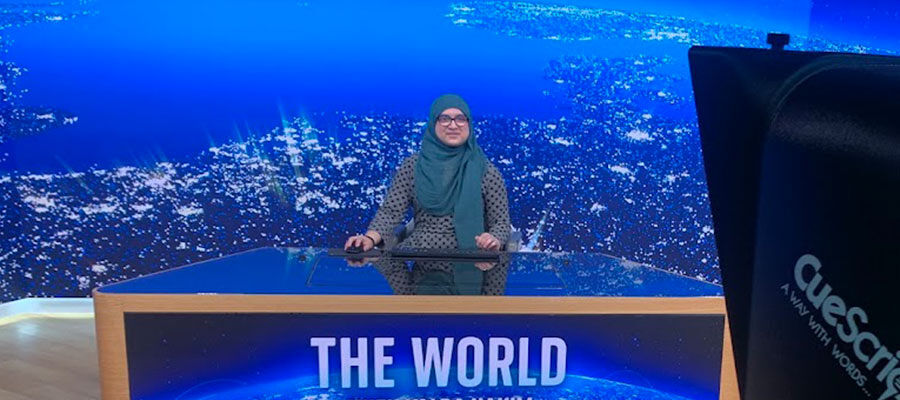
Fahima Khatun
Media and Communication (BA) Hons), Multiplatform and Mobile Journalism MA
With the support, facilities, and opportunities at BCU, Fahima gained the confidence, skills, and industry connections to break into broadcasting. Now, she has built a successful career at Sky News, developing a strong reputation through dedication and resilience.
“From a young age, my parents taught me the importance of education, so to me university was a natural progression from college.
I knew I wanted to work in the media industry after first being exposed to it through BBC School Report in secondary school and then being a part of the British Film Institute (BFI) Academy in college. However, I had no idea how I would get into the industry, as I did not know anyone in that world, so I felt university would be the best place to learn.
I also knew I wanted to stay close to home to save money, so I looked at nearby universities. BCU was my first choice because the facilities were by far the best of all the universities I visited. I also really liked the atmosphere; the people I met were very welcoming.
It was only when I was at university, when I spoke to a specialist as part of a project, that it was suggested I showed signs of dyslexia. Looking back, all the signs were there, but like many people with learning difficulties, I found ways to work around it.
At school, dyslexia wasn’t always properly recognised, and I was often told I just needed to work harder. I struggled with spelling and would sometimes write the same word in different ways without realising. As I got older, typing my work helped, and tools like spellcheck made a big difference. I also relied on support from my sister and teachers to review my work.
Deep down, I knew something wasn’t quite right, but I felt embarrassed and worried it meant I wasn’t capable. Now I understand that wasn’t the case, I simply needed the right support.
I did struggle at school to get the grades I needed. I had to retake some of my GCSEs; despite passing everything, I did not achieve the grades required to study what I wanted at college. At the time, I felt very embarrassed being a year behind my friends and the oldest in my year, but looking back, I realise it wasn’t my fault; I wasn’t receiving the support I needed.
College made a huge difference. I had teachers who genuinely cared and supported me. I worked hard and eventually achieved the grades needed to go to university. While I was once embarrassed about retaking, I’m now proud - I didn’t give up, and that experience shaped who I am today.
BCU’s facilities were excellent, and access to industry-standard equipment allowed me to develop my skills beyond the classroom. In many projects, I took on technical roles like setting up cameras and editing, opportunities I wouldn’t have had without those resources.
During my MA, I took part in the Sky Scholarship scheme, which was one of the main reasons I was able to gain the opportunity to work there. While on the scheme, a manager approached me, said he had heard good things, and encouraged me to apply.
It really was a combination of bringing the right attitude and being in the right place at the right time, and that was largely due to BCU’s Sky scheme. There are quite a few BCU graduates at Sky.
I am now a Co-Lead Overnight Director at Sky News, where I direct overnight programming and help shape the structure of the show. I’ve been in this role since February 2025.
I was quite fortunate that I secured a job right before I graduated, largely due to the exposure I gained from the Sky Scholarship scheme, but also because during my time at university I took every opportunity that was available to me. Whether that was reaching out to companies to gain experience or taking advantage of the excellent facilities at BCU, I used my time at university to try different things, and that really helped shape me.
Since graduating, I’ve spent the past six years building my career at Sky and continuing to grow. Learning doesn’t stop after university; in every role I have taken on, I have continued to grow and develop my skill set.
I still love what I do, and I think that’s important. Whatever you do, you have to enjoy it. While there have been challenging moments, especially covering difficult news, being proud of my work and surrounded by a supportive team has helped me through.
BCU gave me access not only to equipment but also to industry opportunities. Through lecturers, online resources, and job portals, I gained valuable experience and explored different roles.
Completing my BJTC-accredited MA in Journalism was another key step. Combined with my BA in Media and Communication, it has opened doors and given me a strong foundation in the industry.
My advice to prospective BCU students is to go beyond your studies. While grades matter, experience is what sets you apart. Take every opportunity available to you. At the start, much of the work may be unpaid or labelled as experience, which isn’t ideal, but it helps build your portfolio. It’s normal not to have everything figured out, what matters is putting yourself out there and continuing to learn. Even now, I’m still learning. There is always room to grow.
On a typical day, I get into work, check the gallery, run system checks, and make sure everything is functioning properly. I meet with producers to discuss the night ahead, then brief my team before preparing the show.
For around six hours, I direct the overnight news before co directing the breakfast show. My role is to lead the team through the rundown and work closely with the producer to ensure everything going to air is clean and runs smoothly. A director is essentially the person who brings everything together. We are responsible for calling the shots, cueing presenters, camera operators, and sound, and making sure every element is delivered at the right time.
I’m also responsible for ensuring all content meets Sky’s standards before going to air. As the final checkpoint, accuracy and professionalism are essential. Overnight, I also oversee gallery maintenance and monitor breaking news.
Throughout my career, I’ve struggled with imposter syndrome. I was encouraged multiple times to apply for director roles but initially held back due to self-doubt. With support from colleagues, I eventually took that step.
I’ve realised this is a pattern for me, in that I often need that push and for someone else to believe in me before I believe in myself. After speaking with colleagues, I have learned it is a very common feeling. It pushes me to work harder, and one consistent strength others have recognised in me is my strong work ethic.
As the child of immigrant parents, my journey has come with both challenges and strengths. My parents didn’t have the opportunity to attend university, so while they supported me, I had to navigate this path largely on my own. I am the first in my family to work in media and the first woman to pursue a career like this.
At times, this path wasn’t widely understood in my community, but over time, support has grown. My parents, sisters, cousin, and colleagues have all played a vital role in my journey. Having that support system has been invaluable in such a demanding industry.
I am currently the only Muslim, hijab-wearing South Asian female director on my team. Representation in the newsroom is still limited, but I’ve started to see more diversity over time, which makes me proud. I hope my presence encourages others from similar backgrounds to enter the industry.
I’ve been part of several major news events, including Covid, the war in Ukraine, the Middle East conflict, and the recent moon mission. One moment that stands out most is reporting on the death of the Queen. I was involved from the initial broadcast through the days that followed, being part of such a historic moment was incredibly meaningful.
Being part of those moments is something I am really proud of. They are the kinds of events where people later ask where they were when it happened, and knowing I was part of the broadcast team that helped deliver that news is very special.
Another defining moment was when experienced directors encouraged me to step into the role myself. Their belief in me, before I fully believed in myself, was incredibly impactful.
Looking ahead, I want to continue telling stories and growing within the industry. It’s something I’ve been passionate about since I was young, and I’m grateful to now be doing it professionally.
To fellow BCU graduates: whatever your role, aim to excel in it. Build a strong reputation. My progression came from consistently working hard in every position. Take every role seriously, and opportunities will follow.
To me, ‘I AM BCU’ represents a stepping stone into the industry.”