On 17 June, the BBC’s new Director-General Matt Brittin emailed staff to set out a plan to cut between 1,800 and 2,000 posts over three years, in pursuit of £500 million in savings. [1] Jonathan Munro, interim chief executive of BBC News, filled in the programmes: Radio 4’s The World Tonight would end after 56 years, Breakfast would go from Sunday mornings, Today would drop from five presenters to four. [2] To begin: 550 posts across News, Nations and Content, around 700 corporate roles, and a 10 per cent cut to senior leadership. [3]
What neither email addressed is the question that ought to sit at the centre of any public discussion of these cuts. Who bears them? The BBC has a Charter duty to reflect the communities it serves. The honest answer, on the evidence the BBC itself publishes, is that we do not know.
But this is not its first savings programme, and the last five have left a data trail. Since 2020 the BBC has announced 450 post closures in News, [4] 450 more across England’s regional television, local radio and online, [5] more than 150 in the nations, a digital-first plan targeting up to 1,000 fewer publicly funded roles, [6] a local radio restructure, [7] the shrinking of Newsnight from 57 roles to 23, an accelerated voluntary redundancy scheme, [8] and 185 further News closures including HARDtalk and Click.
From 2021/22 the BBC began publishing its leavers by exit route, broken down by ethnicity, disability and age. [9] Five years of that data now exist. Read together, these Equality Information Reports show that the BBC’s cuts do not fall evenly. The Sir Lenny Henry Centre has extracted and analysed all five editions, alongside a decade of BBC Annual Reports. This dataset is available on request.
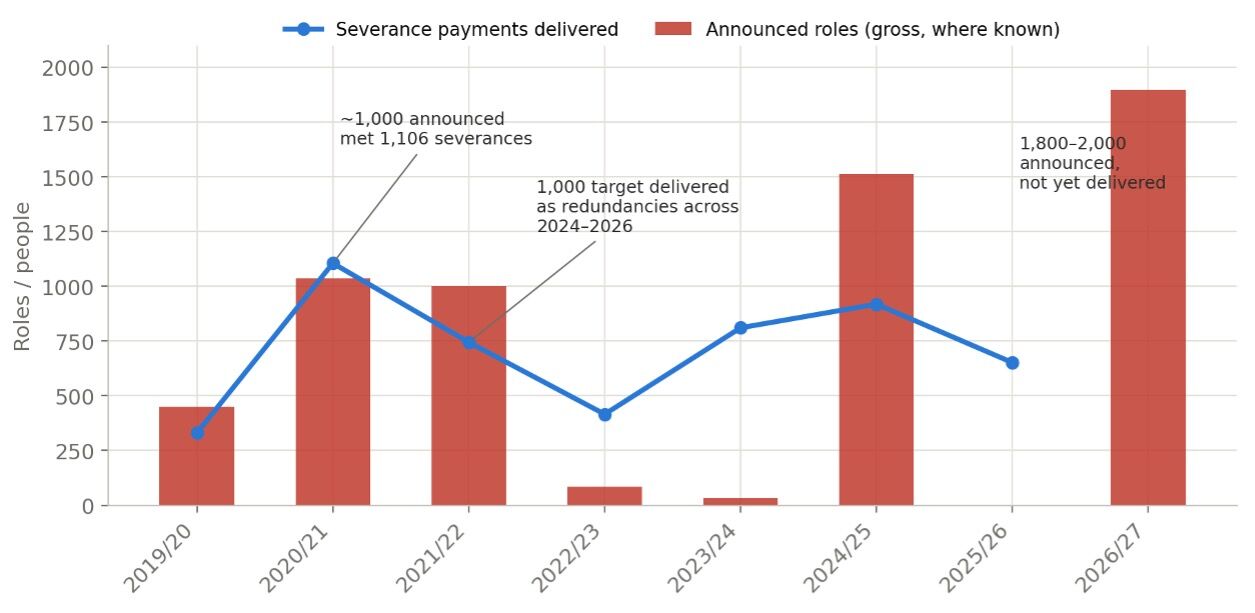
Announced roles versus severance payments delivered, by BBC financial year. The 2021/22 digital-first target of 1,000 roles does not appear as a single spike — it dissolved into the elevated severances of 2023 to 2026. Sources: BBC News, Press Gazette, Deadline, Variety; BBC Annual Report and Accounts [10].
Three findings hold across every year the data covers.
Age
In each of the five years, staff aged 50 and over bore most formal redundancies: 58 per cent, then 53, 61, 60 and 55, against a workforce share that never once reached a third. [9] Across roughly 3,500 redundancies the pattern did not break. This is not, as it might first appear, the BBC renewing itself. The over-50 share of the workforce rose across the period, because the organisation is shrinking and its hiring has fallen, from 2,605 joiners a year to 1,948. Older staff are being paid to leave in large numbers, and the workforce is ageing anyway.
Fixed-term contracts
Formal redundancy shows no consistent bias against ethnic minority staff: in three of the five years their share of redundancies sat below their share of the workforce, and in a fourth it was level. But redundancy is not the only way out. Among staff leaving at the end of a fixed-term contract, ethnic minority employees made up between 23.5 and 29 per cent, seven to eleven points above their workforce share, in every year without exception. [9] Black staff are 3.6 per cent of the workforce. In 2021/22 they were 6.3 per cent of those leaving at the end of a fixed-term contract; in every year since, between 10 and 12 per cent, close to three times their share. Disabled staff fare worse still, over-represented at both exits above their workforce share in fixed-term departures in all five years, and above it in redundancies in four.
This matters because redundancy is paid, announced, recorded in the annual accounts. The end of a fixed-term contract is none of those things. It carries no severance, appears in no financial table, requires no press release. And in 2025/26, for the third time in five years, more people left the BBC this way than through redundancy: 672 against 653. [11] So the exit route that falls hardest on the staff the BBC’s diversity goals exist to protect is precisely the one invisible in every financial disclosure the corporation makes. A savings programme could hollow out the fixed-term workforce entirely and leave no trace in the severance figures.
Freelancers
The BBC’s freelance base has fallen every year since 2023, from16,288 to 13,736, shedding people at three to four times the rate of the permanent workforce. [9] But the contraction was not spread evenly, and where it fell tells its own story. Between 2024 and 2026, News and Current Affairs lost a third of its freelancers. Content, having already shed nearly two in five since 2022, kept falling. Nations lost about one per cent.
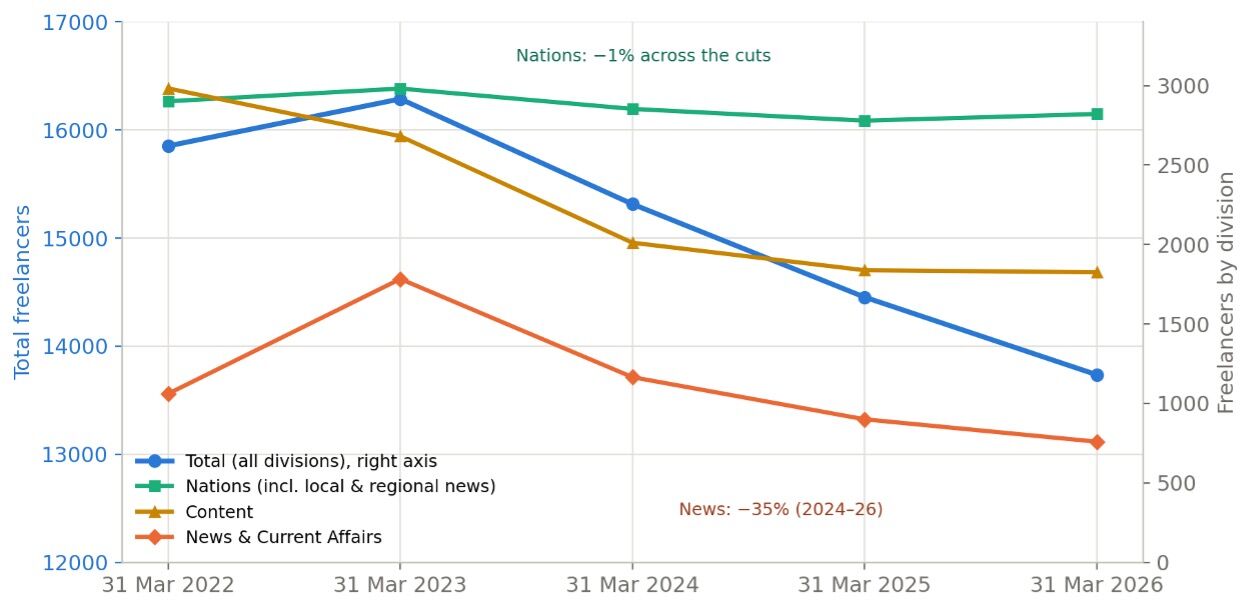
Freelance headcount on 31 March, total and by division. Nations — which houses England’s local and regional news — barely moved, while News fell by a third. Source: BBC Equality Information Reports 2021/22 to 2025/26 [9]. The 2022/23 News figure reflects a one-year reporting merger and is not directly comparable.
Where the freelance cuts fell before
England’s local and regional news does not sit within News. For equality-reporting purposes it sits inside Nations, alongside Scotland, Wales and Northern Ireland. And Nations is the least ethnically diverse division in the corporation: 7.2 per cent ethnic minority among staff, 7.9 per cent among freelancers, the lowest of any division on both counts. [11] The freelance pool the cuts almost entirely spared is also the one with the fewest ethnic minority workers to begin with, and the one that carries the BBC’s local journalism.
The News and Content freelance pools, by contrast, are the most ethnically diverse of the BBC’s UK output divisions, and in both cases more diverse than the staff working beside them; the same is true, more narrowly, even in Nations. [11] Even the World Service’s freelance base, the most diverse in the corporation, fell by a quarter in the final year. So, the aggregate claim that BBC freelancers are less diverse than staff turns out to be a trick of composition. It holds in total only because the two largest freelance pools, Nations and Studios network production, are among the least diverse and together account for two-thirds of the count.
There is a limit to how far the published data can be pushed. The Equality Information Report does not separate England’s regional and local news from the three national regions within the Nations figure. The 450 English regional cuts of 2020 and the local staffing reductions of 2022 landed inside that division but cannot be isolated within it. To go further would need a Freedom of Information request. That the public data stops exactly where the question sharpens is itself part of the problem.
Who’s leaving the building?
None of this tells us how the next 2,000 job losses will land, or how the £500 million of savings will. But there is no reason to expect the BBC to tell us, because it has never done so for a round that has already happened. Its 2025/26 Equality Information Report covers a year in which more than 1,300 people left through redundancy or the end of a fixed-term contract. It breaks those departures down by ethnicity, disability and age — and then says nothing about them. Across 73 pages, almost all of them tables, there is not one sentence of commentary on the leaver figures.
Nor is that an oversight. The BBC has four workforce goals: 50 per cent women, 20 per cent ethnic minority, 14 per cent deaf, disabled and neurodivergent, 25 per cent working class. Every one sets a threshold for who is in the building. None sets one for who leaves it. So a leaver figure cannot be met or missed. It arrives as a number with no verdict attached, and the pattern it describes can repeat for five years without ever being recorded as a failure.
Article 14 of the BBC Charter requires it to reflect the diverse communities of the whole United Kingdom in its organisation and management, and the Framework Agreement adds a duty to promote equality of opportunity. [12] A monitoring regime that counts arrivals and ignores departures is not measuring compliance with either.
Three things would change that, and none is onerous for an organisation that already holds the data.
-
Publish an equality impact assessment of the savings plan before the roles close, not after.
-
Report redundancy and fixed-term non-renewal outcomes by protected characteristic, for each round, so that the paid and unpaid exits can be compared.
-
Extend that reporting to freelancers, division by division, because the aggregate conceals exactly where the damage is done.
The BBC has been able to tell us, down to the last million, what these cuts will save. It has told us nothing about who they will cost, though its own figures show the last five rounds fell in a consistent and knowable pattern.
The 1,800 to 2,000 posts earmarked for closure are staff posts: the mechanism is voluntary and compulsory redundancy, and every divisional breakdown is counted in roles. [3] Freelancers appear nowhere in the number. Responding on the day of the announcement, NUJ general secretary Laura Davison said previous rounds of cuts had already produced “unmanageable workloads, low morale, loss of staff, and fewer opportunities for freelances”. [13] Yet the same announcement cuts 100 to 150 hours of originated television, 350 to 400 hours of radio, and £80 million of commissioning spend. Commissioned hours are freelance hours. The freelance losses will be real, and they will be uncounted.
Newsrooms include staff and freelancers, and we need to know what these cuts will mean for how diverse our newsrooms are, across the BBC and especially throughout the United Kingdom. In his second annual lecture, Sir Lenny Henry warned that “we are trying to fight inequality with less evidence”. To its credit, the BBC has collected and published that evidence for five consecutive years. It should now answer the question: cuts for whom?
Jaldeep Katwala is Director of the Sir Lenny Henry Centre for Media Diversity, Birmingham City University
References
- [1] NewscastStudio, “BBC to cut 550 jobs in first round of cost cuts”, 17 June 2026. https://www.newscaststudio.com/2026/06/17/bbc-layoffs-cost-reductions/
- [2] IBC, “BBC to cut £160m and 550 jobs”, 17 June 2026. https://www.ibc.org/people-purpose/news/bbc-to-cut-160m-and-550-jobs/22794
- [3] Advanced Television, “BBC confirms first round of cuts”, 17 June 2026 (divisional breakdowns; senior leadership reduction; voluntary and compulsory redundancy mechanism). https://www.advanced-television.com/2026/06/17/bbc-confirms-first-round-of-cuts/
- [4] BBC News, “BBC News to close 450 posts as part of £80m savings drive”, 29 January 2020. https://www.bbc.co.uk/news/entertainment-arts-51271168
- [5] BBC News, “BBC announces cuts to English regional TV, radio and online output”, 2 July 2020. https://www.bbc.co.uk/news/entertainment-arts-53263793
- [6] Variety, “BBC Director-General Tim Davie plans for ‘digital first’ BBC”, 26 May 2022. https://variety.com/2022/tv/news/digital-first-bbc-1235278518/
- [7] BBC News, “BBC NI job cuts: BBC Northern Ireland to lose 36 posts”, November 2022. https://www.bbc.co.uk/news/uk-northern-ireland-63793557
- [8] The Hollywood Reporter, “BBC to lay off 500 staff by 2026, annual report reveals”, 24 July 2024. https://www.hollywoodreporter.com/news/general-news/bbc-lay-off-staff-annual-report-finance-uk-1235955351/
- [9] BBC Equality Information Reports, 2021/22 to 2025/26 (leaver-by-exit-route tables; freelance divisional tables). https://www.bbc.co.uk/aboutthebbc/documents/equality-information-report-2022.pdf
- [10] BBC Group Annual Report and Accounts, 2016/17 to 2025/26, gov.uk (severance payment volumes, people data tables). https://www.gov.uk/government/publications/bbc-group-annual-report-and-accounts-for-2025-to-2026
- [11] BBC Equality Information Report 2025/26: headline goals p.3; leaver-by-reason tables pp.7, 11, 25; staff ethnicity by division p.22; freelance ethnicity by division p.63. https://www.bbc.co.uk/aboutthebbc/documents/equality-information-report-2025-26.pdf
- [12] BBC Royal Charter (Cm 9365, December 2016), Article 14(1), p.10; Framework Agreement, Schedule 3, paragraph 12. https://assets.publishing.service.gov.uk/government/uploads/system/uploads/attachment_data/file/577829/57964_CM_9365_Charter_Accessible.pdf
- [13] NEN, “550 jobs to go as BBC announces £160m cuts programme”, 18 June 2026 (Laura Davison quote; commissioning-hour reductions; £80m commissioning cut). https://nen.press/550-jobs-to-go-as-bbc-announces-160m-cuts-programme/
Additional EIR editions: 2022/23, 2023/24 and 2024/25, all at bbc.co.uk/aboutthebbc/documents/. The divisional freelance analysis and exit-route calculations are the author’s own, from the EIR tables; a data workbook with page-level references accompanies this article.