
Economics - BSc (Hons)
Currently viewing course to start in 2024/25 Entry.
The applied nature of our BSc (Hons) Economics degree prepares you to work as an economist, or in a related role which is concerned with the study of the economy and its impact on society and the natural environment. Economics is a major social science which informs major challenges faced by our societies today, including inequality, environmental sustainability and economic policy....
- Level Undergraduate
- Study mode Full Time
- Location City Centre
- Award BSc (Hons)
- Start date September 2024
- Fees View course fees
- School Birmingham City Business School
- Faculty Faculty of Business, Law and Social Sciences
This course is:
Available with Professional Placement year
Open to International Students
Overview
The applied nature of our BSc (Hons) Economics degree prepares you to work as an economist, or in a related role which is concerned with the study of the economy and its impact on society and the natural environment.
Economics is a major social science which informs major challenges faced by our societies today, including inequality, environmental sustainability and economic policy. Economics draws on and influences other social sciences and humanities and it is also a core business discipline which is integral to understanding organisational behaviour, strategy and corporate performance.
The unique offering of this course lies in its use of a pluralist approach to teaching, which will empower you to understand the relevance of competing economic theories and their application in your daily life and in your future workplace.
The course will provide you with a firm foundation of economics to interpret, analyse and question diverse economic theories and policies in a real-life context. To do so effectively, this course equips you with a vast analytical toolkit, which includes mathematical and statistical analysis, critical thinking, qualitative techniques and proficiency in a range of industry-specific software packages that are relevant to the Economics profession. You will also learn how to communicate results and ideas concisely to a variety of specialist and non-specialist audiences.
Economics is a global subject. You will be encouraged to look at situations from an international perspective. You will apply the knowledge learnt in the course to examine global events and look at how different economic ideas help us understand and address global challenges such as poverty, inequality, climate change and the impact of new technologies on the economy and society. Moreover, your course will be delivered by a multinational team of experts. Your classmates will also come from a variety of countries and cultural backgrounds. Finally, we offer you a study abroad opportunity: you can study for one term overseas in one of our partner universities.
The course will foster your intellectual and professional development to support you in pursuing a wide range of career goals. After successful completion of the course, you will be able to work as a professional economist in the public sector, the private sector and the third sector; as an analyst in the financial services industry, or as a business professional. The technical and critical thinking skills taught in this course, alongside your voluntary engagement with our Graduate+ employability programme, will further enhance your development as a work-ready graduate.
Professional Placement Year
This course offers an optional professional placement year. This allows you to spend a whole year with an employer, following successful completion of your second year, and is a great way to find out more about your chosen career. Some students even return to the same employers after completing their studies.
If you choose to pursue a placement year, you will need to find a suitable placement to complement your chosen area of study. You will be able to draw on the University’s extensive network of local, regional, and national employers, and the support of our Careers teams. If you are able to secure a placement, you can request to be transferred to the placement version of the course.
Please note that fees are payable during your placement year, equivalent to 20% of the total full-time course fee for that year.
"I have achieved so much, and received so much guidance and so many opportunities over the past few years. Birmingham City University has broadened my horizons and opened many doors for the future. I am proud to be part of the BCU community."
Emily Chesson, Economics student
Why Choose Us?
- We have a strong focus on employability and through placement opportunities and our links with local businesses, we aim to ensure you graduate not only with your degree but also with the skills and knowledge needed to embark on your chosen career.
- The STEAMhouse offers amazing opportunities for entrepreneurial students to kick start and build a business. Services available include the Incubator which helps focus and solidify business ideas and the Hatchery which offers support in getting your business off the ground.
- We pride ourselves on being the University for Birmingham and supporting and giving something back to the local business community. We have strong links with local businesses in the city across several industries. These links help us enhance students’ experiences by giving them access to industry experts for guest lectures, exciting placement opportunities and other chances to engage with the business community as a whole.
- We aim to infuse learning with exposure to real-world experiences. Through the Tax clinic and City Trading Room we give students the chance to work on real-life projects using industry-standard software and with real-world clients. These offer a unique opportunity for students to gain this invaluable experience while they study.
Open Days
Join us for an on-campus Open Day where you'll be able to meet us in person. Booking for the next event isn’t open yet. Register your interest below and we’ll email you as soon as booking goes live.
Next Open Day: 29 June 2024
Entry Requirements
These entry requirements apply for entry in 2024/25.
All required qualifications/grades must have been achieved and evidenced at the earliest opportunity after accepting an offer to help confirm admission and allow for on-time enrolment. This can also include other requirements, like a fee status form and relevant documents. Applicants can track their application and outstanding information requests through their BCU mySRS account.
112 UCAS tariff points
Please note: If you qualify for our BCU Accelerate scheme, you could receive an offer that is two grades below our normal entry requirements. Find out more about BCU Accelerate.
If you have a qualification that is not listed, please contact us.
Fees & How to Apply
UK students
Annual and modular tuition fees shown are applicable to the first year of study. The University reserves the right to increase fees for subsequent years of study in line with increases in inflation (capped at 5%) or to reflect changes in Government funding policies or changes agreed by Parliament. View fees for continuing students.
Award: BSc (Hons)
Starting: Sep 2024
- Mode
- Duration
- Fees
- Full Time
- 3 Years
- £9,250 in 2024/25
- Apply via UCAS
International students
Annual and modular tuition fees shown are applicable to the first year of study. The University reserves the right to increase fees for subsequent years of study in line with increases in inflation (capped at 5%) or to reflect changes in Government funding policies or changes agreed by Parliament. View fees for continuing students.
Award: BSc (Hons)
Starting: Sep 2024
- Mode
- Duration
- Fees
- Full Time
- 3 Years
- £16,085 in 2024/25


Guidance for UK students
UK students applying for most undergraduate degree courses in the UK will need to apply through UCAS.
The Universities and Colleges Admissions Service (UCAS) is a UK organisation responsible for managing applications to university and college.
Applying through UCAS
- Register with UCAS
- Login to UCAS and complete your details
- Select your course and write a personal statement
- Get a reference
- Pay your application fee and submit your application
Guidance for International students
There are three ways to apply:
1) Direct to the University
You will need to complete our International Application Form and Equal Opportunities Form, and submit them together with scan copies of your original academic transcripts and certificates.
2) Through a country representative
Our in-country representatives can help you make your application and apply for a visa. They can also offer advice on travel, living in the UK and studying abroad.
3) Through UCAS
If you are applying for an undergraduate degree or a Higher National Diploma (HND), you can apply through the UK’s Universities and Colleges Admissions Service (UCAS).
You can request a printed form from your school or nearest British Council office. You will be charged for applying through UCAS. Birmingham City University’s UCAS code is B25 BCITY.
Personal statement
UK / EU students are required to submit a personal statement as part of their application for this course.*
The personal statement gives you a crucial opportunity to say why you’re applying and why the institution should accept you.
Here are the key areas you’ll need to address:
- Course choice - Why does this course appeal? What areas are of particular interest?
- Career plans - If you have a specific career in mind, say how your chosen course will help you pursue this goal.
- Work experience - Mention any work that is relevant to your subject, highlighting the skills and experience gained.
- School or college experience - Highlight skills gained at school/college, eg summer schools or mentoring activities.
- Non-accredited skills or achievement - eg Duke of Edinburgh Award, Young Enterprise scheme.
You should also mention your future plans – if you’re planning to take a year out, don't forget to give your reasons. Talk about any subjects you’re studying that don’t have a formal assessment and any sponsorships or placements you’ve applied for. And don't be scared to add in details about your social, sports or leisure interests.
Worried about Personal Statements?
If you've got no idea where to start or just want to check you're on the right track, we’ve got expert advice and real examples from our students to help you nail your personal statement. You can even download our ultimate personal statement guide for free.
*Non-EU students are not required to submit a personal statement when applying for this course.
Course in Depth
First Year
In order to complete this course you must successfully complete at least 120 credits from the following list of CORE modules.
This module offers a firm theoretical foundation in economic theory at introductory level. It aims to provide you with sound knowledge of basic economic concepts and models that can be used to explain and predict the behaviour of various businesses, consumers, markets and national economies.
This module will introduce you to the history of humanity and civilisation, which starts with the evolution of the economy. There can hardly be any social formation without the existence of economy, even in its most primitive forms.
The dual aim of this first year transition module is to provide you with the numeric skills you will require as you embark on your economic undergraduate studies, as well as preparing you for a graduate placement and/or a career within this discipline.
The Economic Analysis module provides an understanding of statistical methodologies essential for economic data analysis. The module plays a pivotal role in the curriculum for students interested in economics, concentrating on interpreting complex data sets and fostering the ability to make informed decisions.
This module introduces the students to basic finance as well as the financial world within which businesses operate. The module provides the basic foundation upon which other Level 5, 6 and 7 finance modules are designed.
This module is designed to develop your knowledge and understanding of data intelligence tools and techniques, introducing you to the different approaches that are used to manage, mine and visualise complex data sets to facilitate effective decision-making within National and International organisations.
Second Year
In order to complete this course you must successfully complete all the following CORE modules (totalling 80 credits).
This module equips you with key tools for conducting microeconomic analysis and introduces a number of policy applications. The specific topics include consumption and production theories, perfectly competitive markets, market power, game theory and risk and uncertainty.
Our understanding of the economy is contested. Reflecting this there are discernible schools of economic thought which vary in the extent to which they recommend government intervention, and in their understanding of market processes. This module offers you a relativist introduction to the major works of four great, and very different, thinkers: Adam Smith, Karl Marx, John Maynard Keynes and Friedrich Hayek.
Macroeconomics is a study of different views on how the economy operates at the national and international level. It analyses how actions of different groups of economic agents (including consumers, firms, workers, governments, and the financial system) interact with each other to shape economic processes and outcomes at the aggregate level. This module offers sound knowledge and understanding of macroeconomic theories, debates, and practices at the intermediate level.
This module is consistent with the applied philosophy of the course, where it presents a comprehensive coverage of the main techniques and practical applications of analysis for economics, business and financial-type data, starting with the application of regression analysis.
In order to complete this course you must successfully complete at least 40 credits from the following list of OPTIONAL modules.
The aim of this module is to provide an understanding of how to apply economic evidence to analyse the opportunities and challenges of sustainable development. You will explore key features of the three pillars of sustainable development – the economy, the society, and the natural environment – and how they are related to each other, using a case study of the 17 UN Sustainable Development Goals.
This module focuses on the tools and techniques used by Operation Managers within service, manufacturing, private and public sector institutions to ensure activities are aligned with corporate and market objectives. The module requires you to apply a range of operations management tools and techniques to given scenarios in order to produce a range of verbal, written and numerical solutions focussed on the efficiency, effectiveness and economy of an operation’s processes.
You will investigate the impacts of global issues such as pandemics, public health, global warming, financial interconnectedness, migration, geopolitical events, the power of media, and demographic shifts on large businesses in the Dynamic Business Issues and Solutions module.
Corporate Finance is a rigorous and comprehensive module that is designed to broaden your understanding of the main issues in modern corporate finance. Corporate Finance is concerned with how businesses raise funds and invest those funds to provide a return to investors. This module aims to equip you with the skills and knowledge required by a financial manager to make appropriate investment and financing decisions for a business in a global environment.
This module will introduce you to the language spoken by accounting professionals. You will gain an understanding of how financial statements are prepared. This is key to being able to interpret the financial position and performance of companies using ratio analysis. This module will also give an insight into how standard costs are developed for products and services and how they are key to the budgeting process.
This module, where a programme of study enables it, is open to Business School students, who choose to undertake an international Study Abroad mobility experience within their second year of study. The aim of this module is to enable you to explore your mobility experience through a cross-cultural lens that focusses on the key themes of your discipline in an international context, together with your personal development.
This module introduces you to personal investments and wealth management of individuals. You will learn about the wealth management process and be able to develop investment policy statements for individuals given their unique goals, constraints and circumstances. In addition, you will develop a thorough understanding of the different global tax regimes. You will also develop analytical skills in estate planning and risk management of personal investments.
This module is designed for the student who wishes to learn how to utilize financial theory in real world applications. The course is practical in nature and will implement computational approach to many financial problems. This module will build upon modules that are covered in year 1 and will link to the year 3 modules.
In this module, you will study the financial management of entrepreneurial firms (small and medium-sized) and venture firms. You will first consider different sources of financing for entrepreneurial firms including bank loans, government funding, angels, venture capital, peer-to-peer financing, online banking, and various types of private equity as well as the process of obtaining these sources.
All core modules are guaranteed to run. Optional modules will vary from year to year and the published list is indicative only.
Professional Placement (Optional)
In order to qualify for the award of BSc (Hons) Economics with Professional Placement Year you must successfully complete the following module.
This module is designed to provide you with the opportunity to undertake a credit bearing, 40- week Professional Placement as an integral part of your Undergraduate Degree. The purpose of the Professional Placement is to improve your employability skills which will, through the placement experience, allow you to evidence your professional skills, attitudes and behaviours at the point of entry to the postgraduate job market. Furthermore, by completing the Professional Placement, you will be able to develop and enhance your understanding of the professional work environment, relevant to your chosen field of study, and reflect critically on your own professional skills development within the workplace.
Final Year
In order to complete this course you must successfully complete all the following CORE modules (totalling 80 credits).
The module will develop your knowledge of economic theory to enhance your skills in analysing economic problems and situations. Topics covered will be competitive equilibrium, welfare theorems, general equilibrium with incomplete financial markets, public choice, choice under uncertainty, asymmetric information (signalling and principal agent models) and game theory (Nash equilibria, subgame perfection, super-games).
The module aims to develop your skills in understanding, analysing and evaluating issues and policies in the world economy. You will build upon your knowledge of macroeconomics and expand your analysis to the open economy framework. You will learn how exchange rates are determined and how they affect the balance of payments, price level, national level of output and other macroeconomic indicators. You will analyse a variety of alternative exchange rate regimes and study their relative advantages, downsides and effects on the rest of the economy.
Select 40 credits from the following:
The aim of this module is to provide a framework for you to undertake a substantial economics research project. The module provides a framework for integrating the principles, tools and methods of economics, developing your practitioner skills via research methods, analytical tools and techniques. The project requires a high degree of professionalism in time management and managing the supervisory relationship.
OR both modules below
Although there are a variety of business disciplines – including strategy, marketing, accounting, finance, or human resource management – researchers often employ a common body of techniques as they investigate these areas. The aim of this module is to provide you with the knowledge of research project management, research philosophy and the analytical “toolkit” to conduct a piece of research, in line with established research ethics.
The aim of this module is to provide a framework for you to undertake a significant piece of disciplinary-relevant research and consultancy. It is founded upon Birmingham City Business School’s teaching and learning philosophy which integrates theory and practice, in this case community or third-sector practice, based on business principles.
In order to complete this course you must successfully complete at least 40 credits from the following indicative list of OPTIONAL modules.
The UK is witnessing an increase in the number of public companies collapsing and it may be arguable that a lot of such failures can be attributed to poor corporate finance strategies. As a result of this, the module explores the advanced mechanics of corporate finance and the different strategies that can help a company detect or prevent financial difficulties.
This module will help you in developing knowledge and understanding of the underlying principles and concepts relating to corporate finance and give the theoretical underpinnings of financial management in corporates.
This module offers a comprehensive treatment of the theory and practice of industrial economics (aka Industrial Organisation). It provides an understanding of how a range of theoretical models can be used to explain and predict the behaviour of firms in different types of markets, and how the actions of firms affect household welfare.
You will be given the opportunity to apply relevant economic models to the investigation of a labour market issues within a country of your choice. The module aims to encourage the development of transferable skills, which enhance career prospects, by accessing and interpreting information from a variety of sources, in order to evaluate theoretical models. The module also locates the UK labour market in the context of productivity, working hours, migration, international competitiveness and employee wellbeing.
As events of the last decade will indicate, money and banking are of paramount importance in their influence on the economics. Indeed, the collapse of various financial institutions triggered significant drops in living standards for a period of time, with lasting effects on government budgets. The module provides you with an understanding of the issues in the role of money in the economy and the operation of the monetary and financial system and policy by the application of appropriate economic principles, frameworks and analytical techniques.
The 2008 Global Financial Crisis and the consequent global recession were directly triggered by the events in the American real estate market. These dramatic events have highlighted the lack of understanding by many professionals of the linkages between the property market and the rest of the economy, which played an important role in the development of this crisis.
The Real Estate Economics module attempts to close this knowledge gap. It will provide you with practical understanding of how property market operates, what drives property prices and yields, and how to spot signs of approaching booms and busts.
All core modules are guaranteed to run. Optional modules will vary from year to year and the published list is indicative only.
Download course specification
Download nowA variety of delivery approaches will be utilised throughout the course, including lectures, seminars, tutorials, workshops and experiments.
As a practice-based course, sessions will usually involve the application of academic concepts and themes, as well as case studies. The latter will be used to explore concepts applied to real-world scenarios, helping you sharpen your skills and employability prospects.
The first year of the course will provide a solid grounding in the principles of economics and its importance to business, as well as ensuring you are fully prepared to make informed decisions as to your route of study in future years of the course.
During the second and later years of the course there will be flexible learning opportunities to specialise in subject areas which are most appealing, tailoring the course to a particular career aim. There’ll also be opportunities to try out different graduate roles with a wide variety of placements and internships on offer to complement your studies.
Trips and Visits
You will have the opportunity to visit a number of leading businesses during your studies, both locally and across the country. Recently, students visited leading brewery company Sadler’s Ales, gaining an innovative insight into how a successful business runs.
Employability
Throughout the programme, you will receive assistance for your own development through co-curriculum activities including dedicated Employability Challenge Weeks and extended induction and transition programmes.
The University has introduced the BCU Graduate+ programme, which is an extra-curricular awards framework that is designed to augment the subject based skills that you develop through your programme with broader employability skills and techniques that will enhance your employment options when you leave University.
Placements
There’ll be opportunities to try out different graduate roles with a wide variety of placements and internships on offer to compliment your studies.
International
Welcome to the Birmingham City Business School, home to students from over 70 countries all around the world!
Birmingham City Business School is one of the UK’s largest, most established and most respected business schools. Our programmes are practice based and many have an international focus, which means your course will be entirely relevant to today’s business world. Almost all of our courses, both at undergraduate and postgraduate level, are open to international students.
We also have links with universities across the world, including Europe, the USA, China, India and Malaysia.
International ServicesOur international pages contain a wealth of information for international students who are considering applying to study here, including:
- Explore some of the good reasons why you should study here
- Find out how to improve your language skills before starting your studies
- Find all the information relevant to applicants from your country
- Learn where to find financial support for your studies
The University is conveniently placed, with Birmingham International Airport nearby and first-rate transport connections to London and the rest of the UK.
Facilities & Staff
Our Facilities
We are constantly investing in our estate and have spent £400 million on new learning facilities.
The Curzon Building
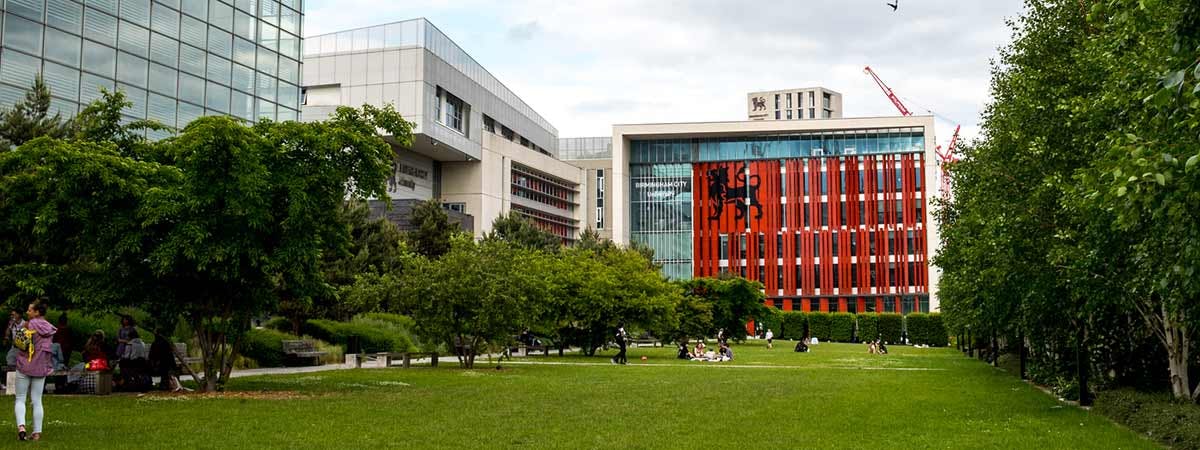
This course is based at our City Centre Campus – and specifically The Curzon Building, alongside other Social Sciences, Law and Business students.
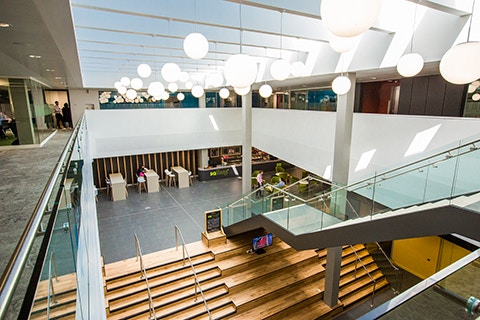
The £63m building offers students a unique social learning space, including a dedicated student hub incorporating student support services, in the heart of Birmingham’s Eastside development.
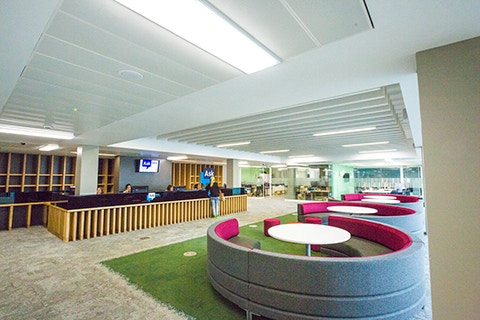
The Business floors house an extensive number of IT facilities, breakout areas, and specialised rooms. The Marketing Link Agency is designed to replicate a modern marketing firm, allowing students to get real-life experience of working in the marketing sector. There is also the City Trading Room, which features state of the art stock market tracking equipment, keeping you up to date with all the financial comings and goings of the London Stock Exchange and Wall Street.
The Curzon building is also conveniently close to Birmingham’s business and financial centre, allowing for strong links between your studies and the real world.
The Curzon Building also features:
- An impressive library with access to over 65 million full text items and stunning views of Eastside City Park
- Your Students’ Union which is located in a beautifully restored 19th century pub, The Eagle and Ball
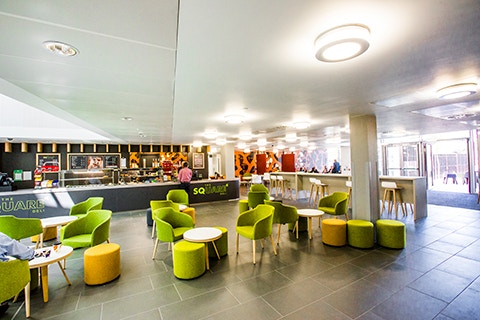
- A modern 300-seat food court with space to study and socialise
- Accessible IT facilities with full Office365 for all students for free
- Shared facilities with the wider campus including the Parkside Building and Millennium Point
Our staff
Dr Bruce Philp
Head of Graduate School of Management
Prior to studying at university, Bruce Philp worked in the pharmaceutical industry. After roles at several universities, he is now the Head of Graduate School of Management at Birmingham City University.
More about BruceDr Eleni Papagiannaki
Equality, Diversity and Inclusion Lead for Business School, Course Leader - BA (Hons) Economics
Dr Elena Papagiannaki has completed her Phd in Economics and Operational Research at Aston University.She researches, teaches and writes about the economics of labour, working time, income inequality and the future of work.
More about EleniFrancis McGonigal
Senior Lecturer, Mathematics and Statistics
Francis McGonigal held several positions in industry as a programmer and systems analyst specialising in applying mathematical, statistical and operational research techniques. He has worked at Birmingham City University and its predecessor organisations since 1987, joining the Business School in 2010.
More about FrancisAnna Yartseva
Senior Lecturer in Economics, Programme Leader for BA Economics
Anna Yartseva main area of academic expertise is macroeconomics and economic policy. Most of the research she has done so far is related to various macroeconomic phenomena.
More about AnnaDr Paul Heap
Senior Lecturer in Economics
After completing his DPhil ‘General Equilibrium Models of Monetary Economies’, Paul Heap held temporary lectureships at the Universities of Manchester, Bristol and Bath. He was then a tutor at the University of Nottingham, before coming to work at BCU.
More about Paul