
Business Finance - BSc (Hons)
Currently viewing course to start in 2024/25 Entry.
The world of finance is rapidly changing, with new innovative financial products being developed on a constant basis. Recent times have seen an unprecedented number of companies failing because of poor financial management. All these challenges call for dynamic and brilliant people who can design financial solutions and make the world a better place....
- Level Undergraduate
- Study mode Full Time/Part Time
- Location City Centre
- Award BSc (Hons)
- Start date September 2024
- Fees View course fees
- School Birmingham City Business School
- Faculty Faculty of Business, Law and Social Sciences
This course is:
Available with Professional Placement year
Open to International Students
Overview
00:00:01:05 - 00:00:10:21
Speaker 1
I wouldn't have seen myself studying business finance. But when I started to look through university courses and look through career paths, it really sparked my interest.

00:00:11:14 - 00:00:29:22
Speaker 2
The world of finance is experiencing ongoing changes and challenges with the continuous development of innovative products and ever unpredictable global financial markets. Our business finance degree is designed to equip you with the wider knowledge of the global financial environment.

00:00:30:00 - 00:00:37:17
Speaker 3
The academic staff have been very helpful any time, any type of question. They've been hands on, happy to help me that being in person or on teams.

00:00:38:18 - 00:00:48:12
Speaker 1
It's allowed me to develop my mind on the outside world and understand finances a lot better and understand how the world operates financially.

00:00:48:24 - 00:00:58:03
Speaker 4
So I work for a financial planning firm that's in the top hundred for the Financial Times. It's a really competitive world. So I think anything you do and utilise your timing well is valuable.

00:00:59:07 - 00:02:00:16
Speaker 2
We aim to equip you with the necessary skills to thrive in a rapidly evolving global financial landscape, enabling you to pursue employment opportunities worldwide.

00:02:05:16 - 00:02:08:04
Speaker 5
So what is your most memorable time at university?

00:02:08:12 - 00:05:50:01
Speaker 1
My most memorable time at university would probably be learning about financial statements and the big impact they have on businesses and how they show how well and how well a book that my most memorable time at university would probably be learning about financial statements is how they are able to show how good and how bad business is doing each year.

00:05:50:22 - 00:06:13:04
Speaker 1
I think the most important thing I'm taking away from my course is time management and how on top of everything I have to be and how important it is, I really do. Business and finance has been such a great course for me because.

00:06:29:09 - 00:06:32:02
Speaker 6
Think that right now.

00:06:32:20 - 00:10:37:23
Speaker 1
It's about going on what I wanted to do. And I also studied it in sixth form, which really helped me gain an even better interest. And this is what I want to do for university.

00:10:42:05 - 00:10:57:00
Speaker 1
My best advice to people trying to pivot business and finance would be, if you're interested in financial markets and you really want to understand how finance works, this is definitely a course for you.

00:10:59:19 - 00:11:12:11
Speaker 3
I'm happy with my course decision, as I believe that business finance has set me a good pathway to what I'm going to do in the future. And now from doing the three years of study, I know exactly what I want to do in the future.

00:11:17:02 - 00:11:25:13
Speaker 5
Awesome. And how has the course help you'd like to set up for the future? Was it taught you? Maybe like as in business skills or personal skills or anything else?

00:11:26:01 - 00:12:03:11
Speaker 3
I think the course itself content was taught me the core fundamentals of finance, of businesses and how is actually used in the real world. And then I think just like actual value itself, I've learned how to tie, manage and actually put my work first and not procrastinate is a last minute. I had a decent background knowledge of finance because in my spare time before I used to study the markets and looking to financial study of the economy and from studying finance going now, I actually more focused on what exactly all that data means.

00:12:03:11 - 00:12:10:08
Speaker 3
And now I can merge my previous knowledge with my new knowledge and now have a clearer understanding of the market as a whole.

00:12:14:10 - 00:12:46:08
Speaker 3
So I did a one year placement and I think from it I've gained so many valuable soft skills, which I was I had in a sense, but weren't to the extent that I know that future employers want. And now from it, I know I can progress my career path in quite a comfortable and hopefully fast manner. I think from my placement, my confidence shot up as I used to be involved with a lot of internal meetings and speaking to a bunch of different people.

00:12:46:14 - 00:13:19:09
Speaker 3
It was different teams in the organization itself and from the skills I've learned from my managers, my different types of time management techniques that I'm now using my personal life as well as well as my academic life. So I'm very grateful for that. For those who are thinking of studying business finance, my biggest advice would be make sure you ask questions, because if you have one week of content that you don't understand, you won't get the next coming weeks.

00:13:19:09 - 00:14:23:04
Speaker 3
Because in finance it normally adds on top of knowledge. So always ask questions. So don't be afraid to. I think the academic staff are busy or very helpful. I know that in my time here and some of the question I've been directly, I love the academic stuff. Yeah, I know. Have had a lot of previous knowledge in the industry that they teach in being other companies or even other universities.

00:14:23:10 - 00:14:28:24
Speaker 3
So that's quite reassuring. As students. So I know that they actually have applied that knowledge and know exactly what they're talking about.

00:14:30:06 - 00:14:30:19
Speaker 5
Fantastic.

00:14:31:01 - 00:14:31:09
Speaker 1
When you think.

00:14:34:15 - 00:15:16:02
Speaker 3
Back, you facilities I think are quite good in terms of in-person. We have a lot of study rooms, spaces, cafes and a lot of spaces just be around. And in terms of online facilities, I believe there's a bunch as the teachers support and upload loads of content up to before and after your lectures from completing my course at BCU, I look to go into the over the financial sector or the automotive industry, hopefully actually merge the two together and I know that after I leave uni the career stable or supportive after I leave, which is also a very helpful thing for myself to stay.
The world of finance is rapidly changing, with new innovative financial products being developed on a constant basis. Recent times have seen an unprecedented number of companies failing because of poor financial management. All these challenges call for dynamic and brilliant people who can design financial solutions and make the world a better place.
The degree is designed to equip you with wider business and Finance environment knowledge. Offering you the opportunity to acquire key business and financial skills, explore innovative practices and entrepreneurial skills. The course is accredited by Chartered Institute for Securities and Investments (CISI). The course also aligns with various other professional bodies courses such as Association of Corporate Treasures (ACT), Association of Chartered Certified Accountants (ACCA) Chartered Institute of Management Accountants (CIMA), and many others.
Delivery of the course is flexible and includes a blend of lectures, workshops, field trips and online learning. The modules, which feed into the course, are widespread, broad, covers key current topics such as Sustainable Development Goals (SDGs) and help you to appreciate finance from a range of perspectives. Ultimately, decision making in finance, calls for one to exercise their judgement and intuition and this course helps you to strengthen that judgement.
The course team has, between it, years of industrial experience in the finance field as well in academia. Therefore, students with little or no background in finance are assured of getting all the help they need in order to excel in the course. You will learn a lot from course team’s knowledge and experience, as you will be regularly engaging in inquiry based and experiential learning, which has been designed to assimilate work-based scenarios.
In order to enhance your employability, extra-curricular activities such as trading trainings, conferences and field trips will be arranged throughout the academic years. Outside speakers from industry will also be invited to give presentations on how best to improve your employability. Moreover, you’ll also have the opportunity to gain industry experience by going on a professional placement, or to travel overseas to study abroad at one of our partner universities. In a nutshell, the knowledge attained from the course will help you to seek a variety of employment in the sector nationally and internationally.
Professional Placement Year
This course offers an optional professional placement year. This allows you to spend a whole year with an employer, following successful completion of your second year, and is a great way to find out more about your chosen career. Some students even return to the same employers after completing their studies.
If you choose to pursue a placement year, you will need to find a suitable placement to complement your chosen area of study. You will be able to draw on the University’s extensive network of local, regional, and national employers, and the support of our Careers teams. If you are able to secure a placement, you can request to be transferred to the placement version of the course.
Please note that fees are payable during your placement year, equivalent to 20% of the total full-time course fee for that year.
Accredited By
This course is accredited by:

The University has provided me with more than an education, with all the extra activities, events, competitions and societies available. Birmingham City University has helped me gain more employability skills and made me more confident as an individual.
Navdeep Dhillon
Why Choose Us?
- We have a strong focus on employability and through placement opportunities and our links with local businesses, we aim to ensure you graduate not only with your degree but also with the skills and knowledge needed to embark on your chosen career.
- The STEAMhouse offers amazing opportunities for entrepreneurial students to kick start and build a business. Services available include the Incubator which helps focus and solidify business ideas and the Hatchery which offers support in getting your business off the ground.
- We pride ourselves on being the University for Birmingham and supporting and giving something back to the local business community. We have strong links with local businesses in the city across several industries. These links help us enhance students’ experiences by giving them access to industry experts for guest lectures, exciting placement opportunities and other chances to engage with the business community as a whole.
- We aim to infuse learning with exposure to real-world experiences. Through the Tax clinic and City Trading Room we give students the chance to work on real-life projects using industry-standard software and with real-world clients. These offer a unique opportunity for students to gain this invaluable experience while they study.
- This course is accredited and meets the high standards of the Chartered Institute for Securities and Investment.
Open Days
Join us for an on-campus Open Day where you'll be able to meet us in person. Booking for the next event isn’t open yet. Register your interest below and we’ll email you as soon as booking goes live.
Next Open Day: 29 June 2024
Entry Requirements
These entry requirements apply for entry in 2024/25.
All required qualifications/grades must have been achieved and evidenced at the earliest opportunity after accepting an offer to help confirm admission and allow for on-time enrolment. This can also include other requirements, like a fee status form and relevant documents. Applicants can track their application and outstanding information requests through their BCU mySRS account.
112 UCAS tariff points
Please note: If you qualify for our BCU Accelerate scheme, you could receive an offer that is two grades below our normal entry requirements. Find out more about BCU Accelerate.
If you have a qualification that is not listed, please contact us.
Fees & How to Apply
UK students
Annual and modular tuition fees shown are applicable to the first year of study. The University reserves the right to increase fees for subsequent years of study in line with increases in inflation (capped at 5%) or to reflect changes in Government funding policies or changes agreed by Parliament. View fees for continuing students.
Award: BSc (Hons)
Starting: Sep 2024
- Mode
- Duration
- Fees
- Full Time
- 3 Years
- £9,250 in 2024/25
- Apply via UCAS
- Part Time
- 5 Years
- Show fees
- £1542 per 20 credits
- Year 1 - 80 credits
- Year 2 - 80 credits
- Year 3 - 80 credits
- Year 4 - 80 credits
- Year 5 - 40 credits
Fees for Part-time students
This course can be studied on a Part-time study basis. The cost per year of study is based on credit requirements for that year.
International students
Annual and modular tuition fees shown are applicable to the first year of study. The University reserves the right to increase fees for subsequent years of study in line with increases in inflation (capped at 5%) or to reflect changes in Government funding policies or changes agreed by Parliament. View fees for continuing students.
Award: BSc (Hons)
Starting: Sep 2024
- Mode
- Duration
- Fees
- Full Time
- 3 Years
- £16,085 in 2024/25


Guidance for UK students
UK students applying for most undergraduate degree courses in the UK will need to apply through UCAS.
The Universities and Colleges Admissions Service (UCAS) is a UK organisation responsible for managing applications to university and college.
Applying through UCAS
- Register with UCAS
- Login to UCAS and complete your details
- Select your course and write a personal statement
- Get a reference
- Pay your application fee and submit your application
Guidance for International students
There are three ways to apply:
1) Direct to the University
You will need to complete our International Application Form and Equal Opportunities Form, and submit them together with scan copies of your original academic transcripts and certificates.
2) Through a country representative
Our in-country representatives can help you make your application and apply for a visa. They can also offer advice on travel, living in the UK and studying abroad.
3) Through UCAS
If you are applying for an undergraduate degree or a Higher National Diploma (HND), you can apply through the UK’s Universities and Colleges Admissions Service (UCAS).
You can request a printed form from your school or nearest British Council office. You will be charged for applying through UCAS. Birmingham City University’s UCAS code is B25 BCITY.
Personal statement
UK / EU students are required to submit a personal statement as part of their application for this course.*
The personal statement gives you a crucial opportunity to say why you’re applying and why the institution should accept you.
Here are the key areas you’ll need to address:
- Course choice - Why does this course appeal? What areas are of particular interest?
- Career plans - If you have a specific career in mind, say how your chosen course will help you pursue this goal.
- Work experience - Mention any work that is relevant to your subject, highlighting the skills and experience gained.
- School or college experience - Highlight skills gained at school/college, eg summer schools or mentoring activities.
- Non-accredited skills or achievement - eg Duke of Edinburgh Award, Young Enterprise scheme.
You should also mention your future plans – if you’re planning to take a year out, don't forget to give your reasons. Talk about any subjects you’re studying that don’t have a formal assessment and any sponsorships or placements you’ve applied for. And don't be scared to add in details about your social, sports or leisure interests.
Worried about Personal Statements?
If you've got no idea where to start or just want to check you're on the right track, we’ve got expert advice and real examples from our students to help you nail your personal statement. You can even download our ultimate personal statement guide for free.
*Non-EU students are not required to submit a personal statement when applying for this course.
Course in Depth
First Year
In order to complete this course you must successfully complete all the following CORE modules (totalling 120 credits).
This module offers a firm theoretical foundation in economic theory at introductory level. It aims to provide you with sound knowledge of basic economic concepts and models that can be used to explain and predict the behaviour of various businesses, consumers, markets and national economies. You will gain an understanding of the following: the basics of demand and supply, how markets operate, and how the interaction of demand and supply determines the equilibrium outcome; how firms compete in various types of markets (from perfect competition to monopoly), and how a type of the market affects firms’ profitability and social welfare; theory of production and costs, how individual firms decide how much to produce and what price to charge in order to minimise costs and maximise profits; how economies perform at the national level, macroeconomic environment (national income, long-run economic growth, short-run business cycle, inflation and unemployment); and how they are affected by government policies and international forces.
Whilst your degree is a highly valued indicator of achievement and ability for employers, a successful career is also dependent on the development of the right attitudes and behaviours. This is reflected in the findings from a survey undertaken by the Confederation of British Industry (CBI), which identifies that, in addition to qualifications, employers also look for broader skills when recruiting individuals straight from education.
This module is designed to help students understand the quantitative methods necessary to allow progression in Finance, Investment, Business and Accounting professions. It also serves as an introduction to the various analytical approaches required in the manipulation and presentation of business type data and demonstrates how its analysis can be used to make commercially sensitive decisions.
This module introduces the students to basic finance as well as the financial world within which businesses operate. The module provides the basic foundation upon which other Level 5, 6 and 7 finance modules are designed.
This module introduces the preparation of financial statements for a sole trader and develops the financial statements for a simple limited company. This module covers in depth the recording, processing and reporting of business transactions and events and will help you develop knowledge and understanding of the underlying principles and concepts relating to financial accounting and give you the opportunity to learn and use the system of double entry.
This module is designed to develop your knowledge and understanding of data intelligence tools and techniques, introducing you to the different approaches that are used to manage, mine and visualise complex data sets to facilitate effective decision-making within National and International organisations.
Second Year
In order to complete this course you must successfully complete all the following CORE modules (totalling 80 credits).
Corporate Finance is a rigorous and comprehensive module that is designed to broaden your understanding of the main issues in modern corporate finance. Corporate Finance is concerned with how businesses raise funds and invest those funds to provide a return to investors. This module aims to equip you with the skills and knowledge required by a financial manager to make appropriate investment and financing decisions for a business in a global environment. Financial managers face many varied problems and tasks, and a common theme that underpins this module is the need for financial managers to be able value alternative courses of action and to make a decision on which is the best choice in financial terms.
This module will develop your skills in both the preparation of financial statements for single and group companies (in accordance with the IASBs Conceptual Framework for Financial Reporting and relevant International Financial Reporting Standards) and the analysis and understanding of such financial statements. This module will also help develop your skills in ratio analysis and interpretation.
This module will introduce aspects of UK taxation to develop knowledge relating to the tax system applicable to individuals and companies. The module will enable you to develop skills relating to the general principles of taxation, the UK tax framework and regulatory environment. The module will introduce the computational aspects of income tax, national insurance contributions, capital gains tax, inheritance tax in respect of individuals and introduce corporation tax and value added tax for businesses.
The module will help you in developing knowledge and understanding of the risk management strategies of corporate organisations, including multinational corporations. They will develop skills on how to identify, classify and evaluate different types of organisational risks. Risk management using both internal and external strategies will be explored. The knowledge of assessing and managing risk associated with cash flows and capital investment decisions will also be acquired. Credit risk will also be introduced. You will be able to understand the ethical issues involved in risk management.
In order to complete this course you must successfully complete at least 40 credits from the following list of OPTIONAL modules.
In this module, you will study the financial management of entrepreneurial firms (small and medium sized) and venture firms. You will first consider different sources of financing for entrepreneurial firms including bank loans, government funding, angels, venture capital, peer-to-peer financing, on-line banking, and various types of private equity as well as the process of obtaining these sources. It will also include innovative ways of raising funds such as crowdfunding. You will then consider short-term financial planning and cash management, which are crucial to the early stages of an entrepreneurial firm’s development. You will then analyse the financial performance of entrepreneurial firms, financial forecasting, and the preparation of pro-forma statements. Following that, you will look at the valuation of entrepreneurial and venture firms, the ways to structure agreements and choose the firm’s capital structure to properly align the incentives between the entrepreneur and investors. You will also analyse the decision-making process of choosing a right mix of financing sources for entrepreneurs. You will then discuss various exit and succession strategies, liquidation events and strategies that enable the entrepreneur to survive during financial distress.
The main aim of this module is to enable you to apply available tools for critical financial statement analysis and other relevant information for investment. The core purpose of this module is to help you develop a thorough understanding of the different uses of financial statements in valuing securities in national and international markets as well as provide the strengths and limitations of each valuation method. Therefore, this module equips you with the basic knowledge and skills necessary for financial statements analysis and security valuation.
The financial crisis of 2008 exposed the failings of the conventional financial system and an alternate was sort. Islamic Finance is a type of financing activities that must comply with Islamic law (Sharia). The concept can also refer to the investments that are permissible under Islamic Law. The establishment of formal Islamic finance occurred only in the 20th century and the Islamic Finance sector grows at 15% - 25% per year, while Islamic financial institutions oversee over $2trillion.
The module offers you with an opportunity to explore and understand how entrepreneurship and innovation contribute to economic and social development. You will become aware with the theory and practice of entrepreneurship in different international contexts through illustrative case studies. Further, you will develop an understanding of the different issues underlying enterprise creation, motivations and strategies of entrepreneurs in diverse settings including corporate, social, women’s and ethnic minority entrepreneurship.
This module focuses on the tools and techniques used by Operation Managers within service, manufacturing, private and public sector institutions to ensure activities are aligned with corporate and market objectives. The module requires you to apply a range of operations management tools and techniques to given scenarios in order to produce a range of verbal, written and numerical solutions focussed on the efficiency, effectiveness and economy of an operation’s processes.
This module is designed for the student who wishes to learn how to utilize financial theory in real world applications. The course is practical in nature and will implement computational approach to many financial problems. This module will build upon modules that are covered in year 1 and will link to the year 3 modules. Upon completion of the course, you will be fluent in both Excel as well as financial modelling. Such fluency will position you very well for essentially many financial job. You will also have a nice tool kit of many real world financial models across a very broad range of topics. This combination of fluency of financial modelling and portfolio of models will prove invaluable during both interviews with potential employers as well as execution of finance-related employment tasks. A successful completion of the module would provide you with valuable skills for a wide range of careers in areas such as investment and banking.
Macroeconomics is a study of different views on how the economy operates at the national and international level. It analyses how actions of different groups of economic agents (including consumers, firms, workers, governments, and the financial system) interact with each other to shape economic processes and outcomes at the aggregate level. This module offers sound knowledge and understanding of macroeconomic theories, debates, and practices at the intermediate level. It develops your skills to apply different macroeconomic concepts and theories to explain the functioning of the national economy, to analyse the potential effects of various economic events and policies on macroeconomic outcomes for the country as a whole and the different groups of agents in particular, and to analyse and understand trends in macroeconomic data.
All core modules are guaranteed to run. Optional modules will vary from year to year and the published list is indicative only.
Professional Placement (Optional)
In order to qualify for the award of BSc (Hons) Business Finance with Professional Placement Year you must successfully complete the following module.
This module is designed to provide you with the opportunity to undertake a credit bearing, 40- week Professional Placement as an integral part of your Undergraduate Degree. The purpose of the Professional Placement is to improve your employability skills which will, through the placement experience, allow you to evidence your professional skills, attitudes and behaviours at the point of entry to the postgraduate job market. Furthermore, by completing the Professional Placement, you will be able to develop and enhance your understanding of the professional work environment, relevant to your chosen field of study, and reflect critically on your own professional skills development within the workplace.
Final Year
In order to complete this course you must successfully complete all the following CORE modules (totalling 80 credits).
This module will introduce you to the financial system including the banking system, financial markets and institutions. In addition to exploring the characteristics and functions of financial system, you will be provided with analytic framework that uses economic principles to develop systematic understanding about the determinants of interest rate, the role of monetary policy and bank risk management.
Financial technology (Fintech) integrate technologies like artificial intelligence (AI), blockchain and data science into traditional financial services to make them safer, faster and more efficient. It is one of the fastest-growing industries, with companies innovating in almost every area of finance from mobile banking and insurance to cryptocurrency and investment apps, Fintech has broad applications.
This module will help students in developing knowledge and understanding of the underlying principles and concepts relating to corporate finance and give the theoretical underpinnings of financial management in corporates. The course gives a broader understanding of the philosophies behind the financial management decisions, capital structure, dividend policies and current developments in and modern theories of finance. The module will enable students to evaluate research and synthesise information about corporate financial issues and problems, ability to solve quantitative problems, presentation of ideas, and participation in debates.
This module is designed to encourage you to contextualise current issues and debates in finance by placing them within the historical evolution of finance, and getting you to develop and express your ideas through in-class discussions/debates and coursework essays.
In order to complete this course, you must successfully complete at least 40 credits from the following indicative list of OPTIONAL modules.
A rise in importance and complexity of international financial management poses a challenge for multinational organizations and those wish to pursue a career in the sector. This module will provide you an intuitive and real world grasp of the concepts and issues in international finance which includes foreign exchange rate movements, managing exchange rate risks and foreign investment issues faced by of modern companies. A wealth of examples and cases are provided to enable you to see the implications of the subject to business, mostly from a multinational corporation’s perspective. You will be encouraged and supported to undertake case studies and investigate contemporary issues relating to international finance.
This module covers the attributes of investment in equity and bond instruments. It will enable you to understand, interpret and analyse the risk and return associated with bonds and equities. The main purpose of the module is to help you develop strategies for managing investments in capital market instruments, considering many investment alternatives that are available in the market today. This will result to the development of transferable skills in managing your money, clients’ investment or employers’ holdings in other companies' securities. In line with this, the module mixes description, theories and computations in relation investment decision making, especially the critical appraisal of many investment choices available in the capital markets around the globe.
This module will introduce you to investment and portfolio management. The contents of the module cover exciting topics such as fundamental and technical analyses, modern portfolio theory and performance evaluation. You will learn about different asset classes for investment and how to create and manage and investment portfolio. It will enable you to learn how to forecast investment returns and the estimate stand-alone as well as portfolio risk. The module will provide you an opportunity to put finance and investment theory into practice through application of the underlying concepts to investments in financial markets. You will require extensive use of the Trading Room and Datastream Eikon for investment analysis and portfolio management throughout the term particularly for the completion of the coursework.
This module introduces you to the financial systems, products and services offered by Islamic financial institutions in the Islamic Banking and insurance (takaful) industries. The module will discuss the product features and mechanisms that are specialised due to the Sharia compliance aspect. It highlights the pertinent risk management issues relevant to the financial institutions involved in Islamic financial activities. You will understand how schools of Islamic jurisprudence permit some forms of transactions, but exclude others, through principles such as the requirement of risk sharing within contracts, the avoidance of excessive risk and the use of real contracts.
The aim of this module is to provide insight into the methodological foundations of business research, which will enable you to conduct a substantial piece of disciplinary research.
The aim of this module is to provide a framework for you to undertake a significant piece of disciplinary-relevant accounting, business or management research. It is founded upon Birmingham City Business School’s teaching and learning philosophy which integrates theory and practice, in this case research practice. A Business Research Project presents a short academic piece of work based, delivered in a “letters” journal article format, which is relevant to your degree programme.
All core modules are guaranteed to run. Optional modules will vary from year to year and the published list is indicative only.
Download course specification
Download now
Chartered Institute for Securities and Investment
CISI actively promote the advancement of knowledge in the field of securities and investment in schools and colleges by introducing students to the world of financial services and its many career opportunities. CISI help integrate their professionally recognised financial services qualifications into our curriculum and provides support for both teachers and students.
Employability
The business finance specialism and professional alignment of the programme enables progression into a career in business finance, treasury finance, corporate banking or business management.
Placements
In order to apply and enhance the skills you learn from the course, you will have the option to undertake a year-long work placement in the UK or overseas. Shorter-term work placements, voluntary work and internships will also be available.
We boast partnerships with businesses across the globe, including AXA Insurance, HSBC, Lloyds Bank and PwC.
International
Welcome to the Birmingham City Business School, home to students from over 70 countries all around the world!
Birmingham City Business School is one of the UK’s largest, most established and most respected business schools. Our programmes are practice based and many have an international focus, which means your course will be entirely relevant to today’s business world. Almost all of our courses, both at undergraduate and postgraduate level, are open to international students.
We also have links with universities across the world, including Europe, the USA, China, India and Malaysia.
International ServicesOur international pages contain a wealth of information for international students who are considering applying to study here, including:
- Explore some of the good reasons why you should study here
- Find out how to improve your language skills before starting your studies
- Find all the information relevant to applicants from your country
- Learn where to find financial support for your studies
The University is conveniently placed, with Birmingham International Airport nearby and first-rate transport connections to London and the rest of the UK.
Facilities & Staff

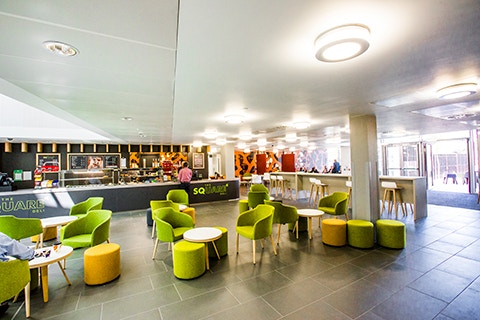

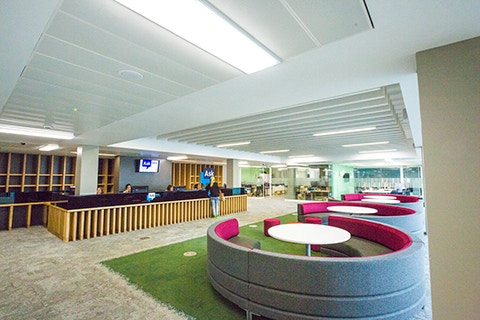
Our Facilities
We are constantly investing in our estate and have spent £400 million on new learning facilities.
The Curzon Building
This course is based at our City Centre Campus – and specifically The Curzon Building, alongside other Social Sciences, Law and Business students.
The £63m building offers students a unique social learning space, including a dedicated student hub incorporating student support services, in the heart of Birmingham’s Eastside development.
The Business floors house an extensive number of IT facilities, breakout areas, and specialised rooms. The Marketing Link Agency is designed to replicate a modern marketing firm, allowing students to get real-life experience of working in the marketing sector. There is also the City Trading Room, which features state of the art stock market tracking equipment, keeping you up to date with all the financial comings and goings of the London Stock Exchange and Wall Street.
The Curzon building is also conveniently close to Birmingham’s business and financial centre, allowing for strong links between your studies and the real world.
The Curzon Building also features:
- An impressive library with access to over 65 million full text items and stunning views of Eastside City Park
- Your Students’ Union which is located in a beautifully restored 19th century pub, The Eagle and Ball
- A modern 300-seat food court with space to study and socialise
- Accessible IT facilities with full Office365 for all students for free
- Shared facilities with the wider campus including the Parkside Building and Millennium Point
Our staff
Dr Hafiz Muhammad Usman Rana
Programme Director for BSc Business Finance
Dr. Hafiz Muhammad Usman Rana is a Senior Lecturer in Finance and heads the Business Finance Business Finance - BSc (Hons) programme at Birmingham City Business School. He has been a founder member of the Centre for Accountancy, Finance and Economics (CAFE) and has been working as a seminar convenor since the centre's...
More about Hafiz Muhammad Usman